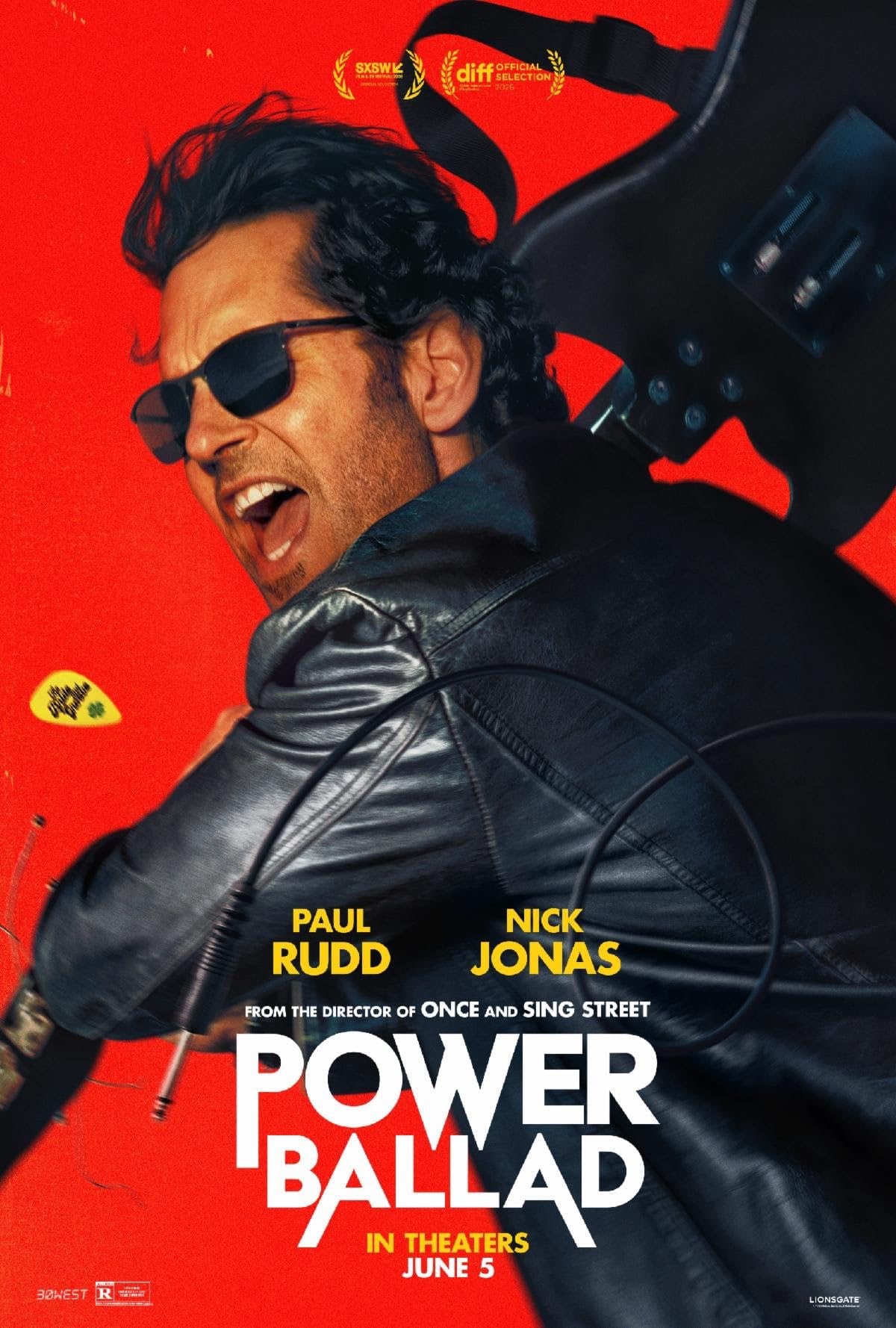


The best parts of Power Ballad drift through the film in brief, unsettled currents, and Paul Rudd carries them with a worn, inward ache that never fully resolves. John Carney keeps the surface bright, but something bruised keeps pressing upward, a reminder that the story wants more than it’s willing to claim. The melancholy that flickers through Rudd’s performance gives the film its pulse, even when the script refuses to deepen the wound.

Rudd’s Rick moves through Dublin in a fog of half‑buried longing, his wedding‑band routines and family rituals arranged around a life he once imagined would be louder. Carney hints at the cost of that quiet surrender, then backs away, content to let the mood hover. The restraint leaves the film wistful in a way that feels both intentional and evasive, a portrait of middle‑aged drift that never quite confronts its own sadness.

The late‑night jam session between Rick and Danny should be the film’s emotional ignition point, and in flashes it is. Their music carries a fragile charge, a sense of two men briefly remembering who they wanted to be. Yet Carney keeps the moment airy, unwilling to let the collaboration bruise or bind. The scene aches for sharper edges, for the risk of genuine connection, but the film softens every contour.

When Danny steals Rick’s song, the betrayal lands with a muted thud. The film gestures toward artistic theft, the machinery of fame, the hunger for validation, but it never digs into the rot. The industry satire remains feather‑light, a shrug where a reckoning might have stood. Still, the melancholy of the theft lingers, a reminder of how easily a life can be rewritten by someone with more reach.

Rick’s unraveling carries the film’s most affecting notes. Rudd lets the character’s disappointment seep through the cracks, never overstated, never fully spoken. His grief over the song is inseparable from the grief over the life he didn’t chase, and the film’s refusal to articulate that tension becomes its own kind of statement. The melancholy hangs in the air, unresolved and strangely tender.

Carney’s direction keeps drifting toward uplift, even when the story strains against it. The family scenes feel thin, more symbolic than lived‑in, yet their fragility adds to the film’s wistful tone. They become reminders of what Rick stands to lose, even if the script doesn’t give them the emotional density they deserve. The film’s lightness becomes both its charm and its limitation.

The confrontation in Los Angeles should be volcanic, but Carney keeps the flame low. The moment turns inward rather than explosive, a quiet collapse instead of a catharsis. The choice is frustrating and oddly moving, a refusal to grant Rick the victory he believes he needs. The melancholy deepens, and the film briefly brushes against something true.

The final stretch returns to gentler rhythms, and the reconciliation feels earned even if the path there is smoothed over. The discovery of the home video gives Rick the proof he lacked, but the film treats it as grace rather than triumph. The wistfulness remains, a soft ache that refuses to resolve into triumphalism. Carney lets the story settle into acceptance rather than vindication.

Rudd anchors the film with a performance built on small tremors. His restraint becomes the film’s emotional architecture, a quiet insistence that the story matters even when the script hesitates. He gives Power Ballad its weight, its sadness, its fleeting warmth. Without him, the film would drift away entirely.

Power Ballad never becomes the deeper, sharper film it keeps hinting at, but its melancholy lingers. The wistfulness of its missed opportunities mirrors the story it tells, and in that echo the film finds a strange, modest beauty. It’s a mixed but gently affecting work, carried by Rudd’s steady ache and Carney’s instinct for emotional residue.

Letter Grade: B+.


Leave a Reply