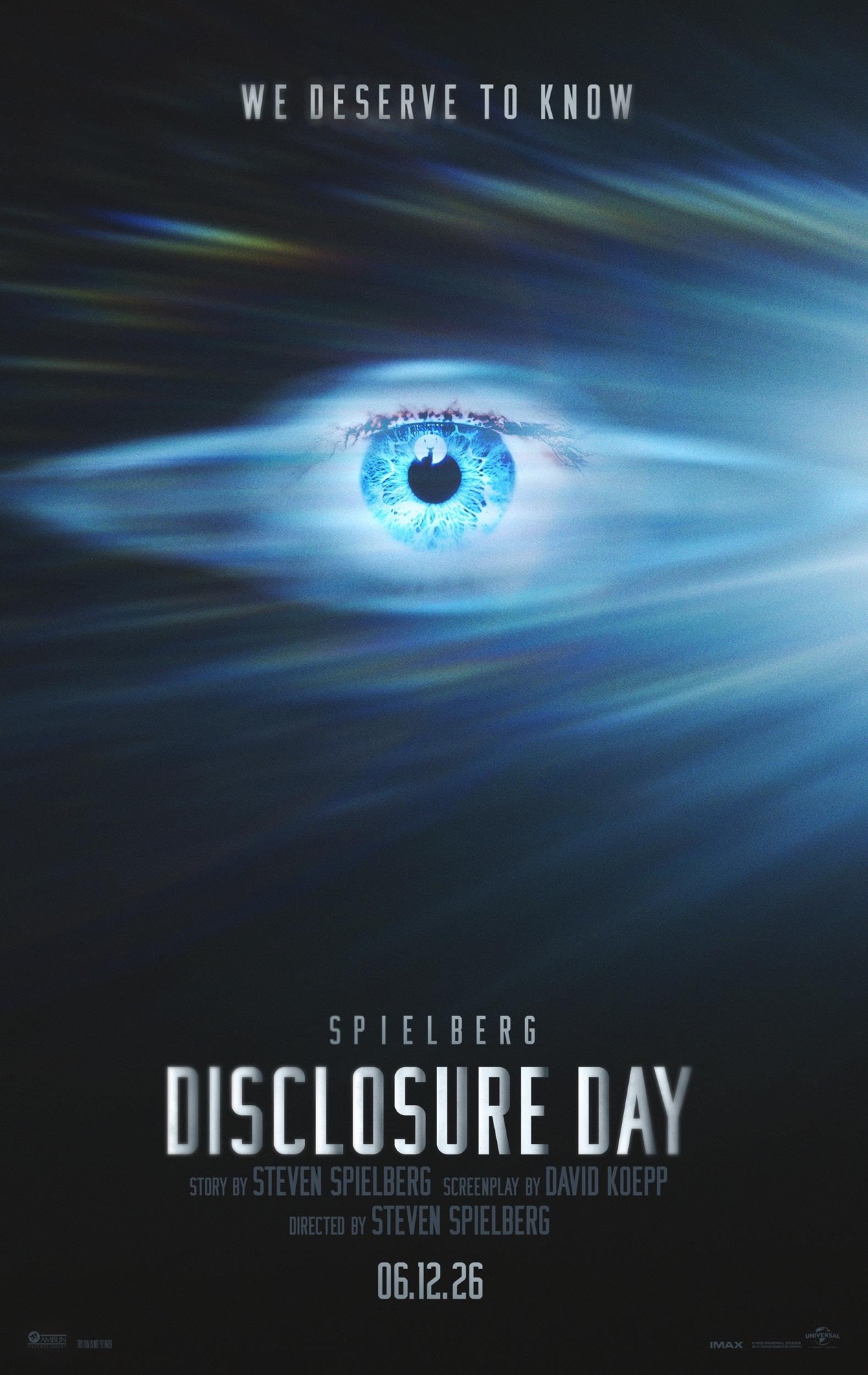


Steven Spielberg’s Disclosure Day moves with a charged steadiness that never loosens its grip. The film announces its intentions early: spectacle in service of conviction, velocity in service of moral weight. Emily Blunt anchors the whole thing with a performance that cuts clean through the noise, and Spielberg meets her intensity with direction that refuses to coast on legacy. The result is a work that feels sharpened rather than softened by its scale.

The film’s propulsion becomes a statement of purpose. Spielberg uses the chase structure not as a crutch but as a pressure chamber, tightening the frame until every gesture carries consequence. The movement on screen becomes a form of inquiry, a way of testing how far people will go to protect truth when institutions collapse around them. Blunt’s Margaret Fairchild embodies this tension; her scenes hum with a restless intelligence that deepens the film’s stakes.

Spielberg threads the extraterrestrial material through the narrative with a deliberate restraint that heightens its impact. The aliens remain a presence rather than a spectacle, a force that shapes human behavior rather than overshadowing it. This choice gives the film its hard edge. The unknown becomes a mirror, and the reflection is not always flattering. The film’s critique of secrecy and power lands with force because it grows organically from the characters’ desperation.

Blunt’s work deserves special attention. Her Margaret is a figure in transition, pulled between fear and responsibility, and Spielberg gives her space to let that conflict register in the smallest shifts of breath and posture. Her scenes with Josh O’Connor gain strength from their friction; his softness meets her precision, and the contrast sharpens both performances. Their dynamic becomes the film’s emotional engine, never sentimental, always under pressure.

Spielberg’s craft remains astonishing in its clarity. The action sequences carry a looseness that feels earned, a confidence that comes from decades of refining instinct into technique. The chaos never muddies the frame. The humor never undercuts the danger. The film’s tonal balance becomes a kind of argument: that awe and fear can coexist without diluting each other, that cinema can hold multitudes without losing coherence.

The film’s self-referential gestures work because they are not nostalgic indulgences. They function as commentary, a way for Spielberg to interrogate his own history without retreating into it. The echoes of Duel, Minority Report, and Close Encounters operate as connective tissue, reminders of the questions he has returned to for half a century. Here, those questions feel newly urgent.

The moral dimension of Disclosure Day emerges gradually, carried by Colman Domingo’s grounded presence and the film’s insistence on responsibility as a collective act. Spielberg refuses to let the story drift into cynicism. The film’s belief in disclosure, in shared knowledge, in the possibility of a public capable of listening, gives it a rare emotional charge. It is a film that trusts its audience to rise to the moment.

The climactic broadcast sequence gains its power from the film’s cumulative pressure. Spielberg builds toward it with a steady escalation that never feels manipulative. When Margaret steps forward to speak, the moment lands because the film has earned it through rigor rather than sentiment. The final note—Margaret’s single word—carries the weight of everything that came before it.

Disclosure Day stands as one of Spielberg’s most vital late works. It is playful without softness, expansive without drift, humane without ornament. Blunt delivers one of her strongest performances, and Spielberg directs with the urgency of someone who still believes cinema can shift the ground beneath us. The film leaves you charged, alert, and strangely hopeful.

Grade A.


Leave a Reply