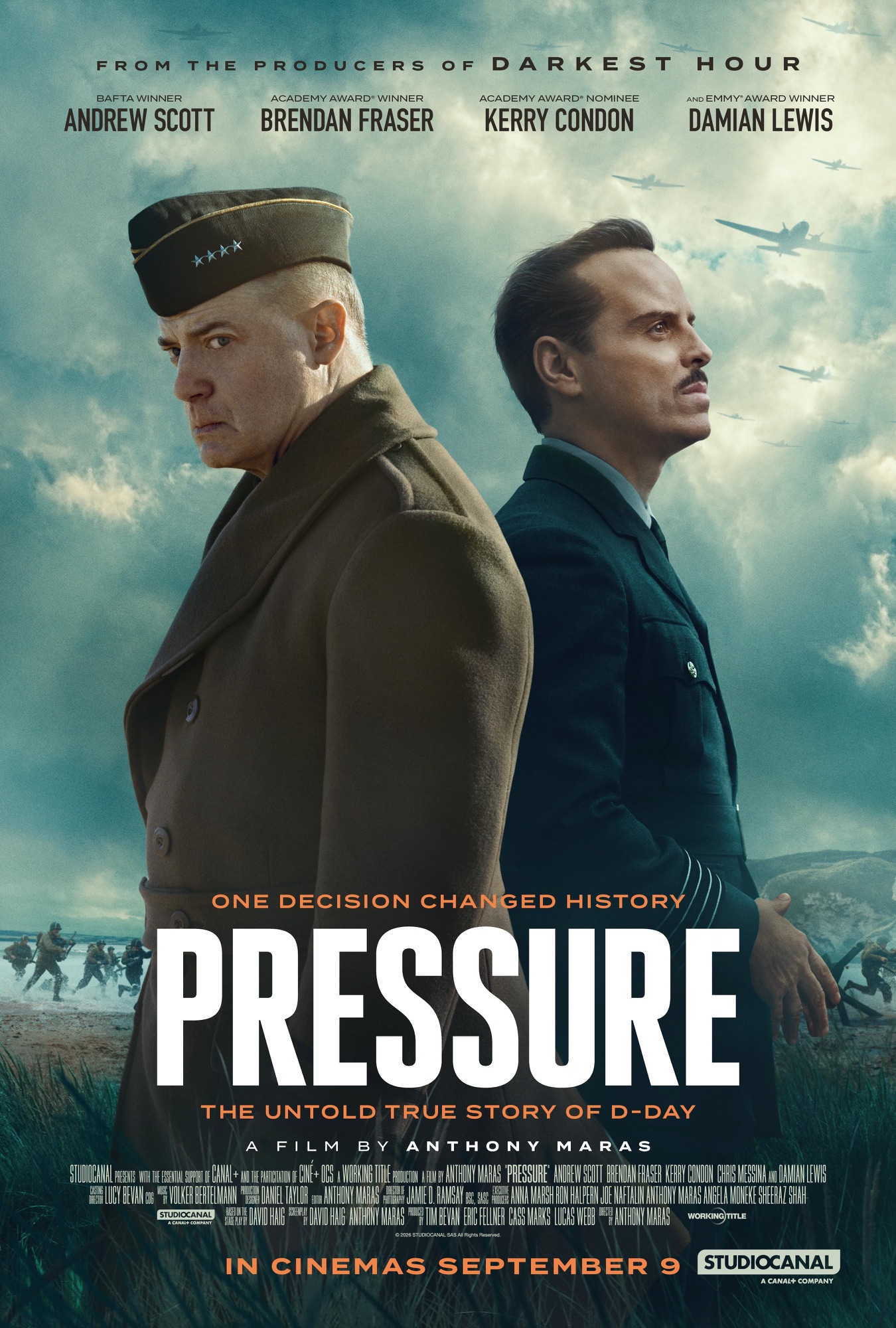


Pressure opens on a world bracing for rupture, and Anthony Marad keeps that tension pressed against every frame. Brendan Fraser’s Eisenhower carries the burden of command with a steadiness that never softens into sentiment. The film’s force comes from its refusal to let the weather remain background noise. It becomes the hinge on which the entire war tilts, and Marad treats that hinge as a living threat.

The early scenes at Southwick House establish a rhythm of clipped exchanges and hard decisions. Marad refuses to let the film drift into procedural comfort. Each forecast meeting becomes a confrontation with uncertainty, and the camera holds on the strain in the room. The plot machinery is familiar, but the film’s edge comes from the way it treats meteorology as a battlefield with its own casualties.

Andrew Scott’s Stagg is the film’s coldest instrument. His readings, charts, and warnings carry more dread than any explosion. Marad pairs Stagg’s precision with Fraser’s controlled restraint, and the result is a dynamic built on pressure rather than conflict. The film’s strongest passages emerge from this interplay, where data becomes fate and hesitation becomes danger.

Fraser gives Eisenhower a grounded authority. His performance avoids grandstanding and instead leans into the weight of responsibility. The film’s best scenes place him alone with the decision he cannot escape. Marad keeps the frame tight, the air heavy, the stakes unspoken but unmistakable. Fraser thrives in that confinement.

The film’s treatment of Krick, played by Chris Messina, adds a necessary countercurrent. His confidence in historical patterns becomes a kind of seduction, a promise of clarity in a world drowning in variables. Marad uses him to expose the peril of certainty. The film never mocks him; it simply lets the consequences of his method speak.

Kerry Condon’s Kay Summersby becomes the film’s quiet stabilizer. Her presence sharpens Eisenhower’s isolation rather than softening it. Marad gives her scenes that cut through the military machinery and expose the human cost of waiting. Her performance adds depth without drifting into melodrama.

The film’s middle stretch tightens its grip. The storm system grows, the forecasts diverge, and the command room becomes a crucible. Marad keeps the pacing taut, and the editing refuses to let the audience settle. Even the personal subplot involving Stagg’s wife is handled with restraint. It deepens his urgency without turning him into a martyr.

When the June 5 storm hits, the film earns its release. The violence of the weather is rendered with a brutal clarity that vindicates Stagg’s warnings and exposes the fragility of the entire operation. Marad avoids triumphalism. The storm is not a victory; it is a reminder of how close the world came to disaster.

The final decision to launch on June 6 lands with a hard, clean weight. Fraser’s Eisenhower does not celebrate. He accepts. The film ends on a note of earned gravity, acknowledging the enormity of the moment without drowning it in spectacle. Marad trusts the audience to feel the shift.

Pressure is not flawless. Some scenes linger longer than they need to, and a few supporting characters flatten into function. But the film’s core—its study of decision-making under threat—holds firm. Marad delivers a war film built on tension rather than combat, and Fraser anchors it with one of his most disciplined performances.

Letter Grade: B+


Leave a Reply