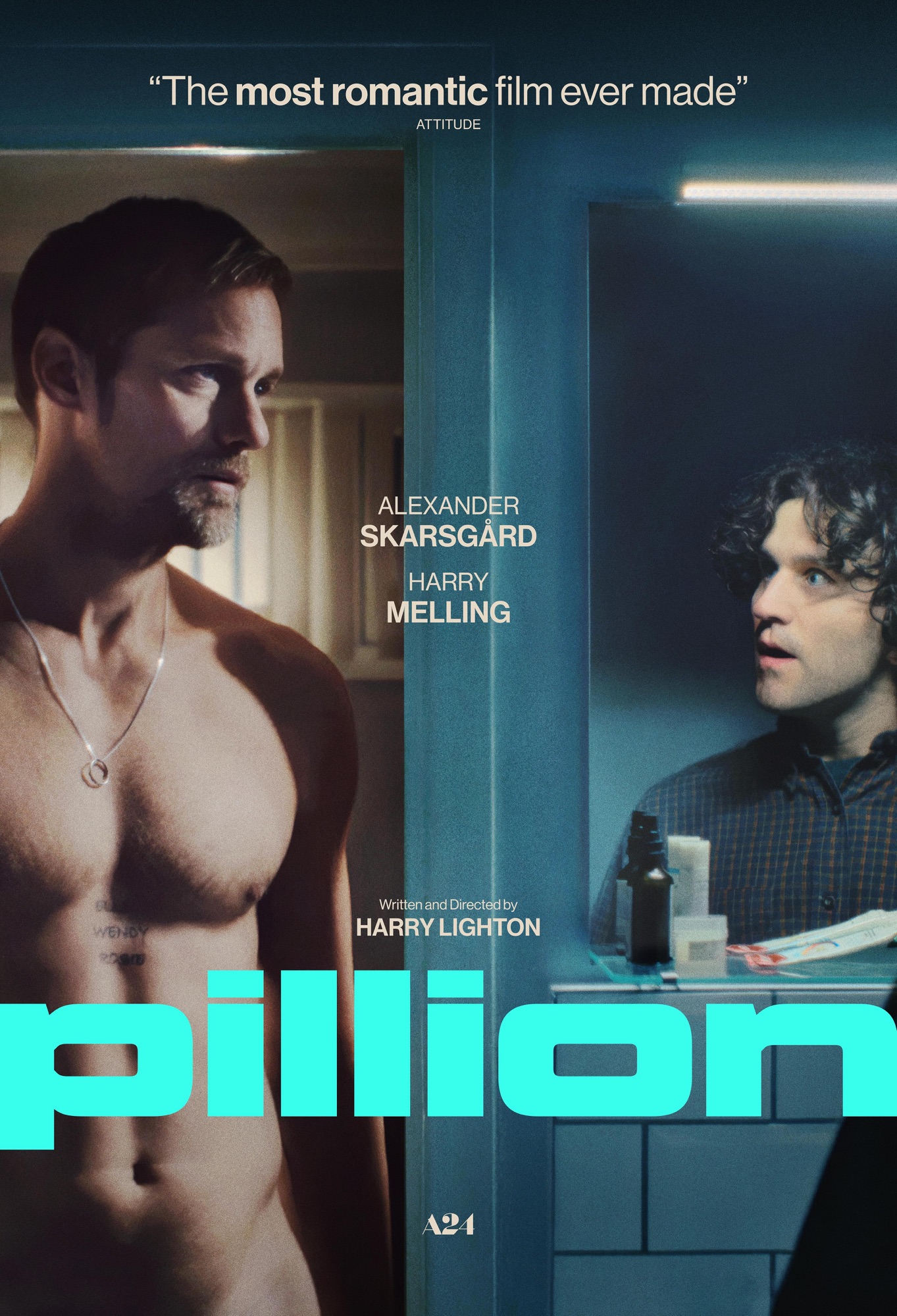


The charge of Pillion begins in the alley where Ray first bends Colin’s life into a new shape, and Harry Lighton keeps that voltage humming through every scene. The film opens on a man who has never been chosen and a man who chooses with ruthless precision, and the tension between those forces gives the movie its hard pulse. Alexander Skarsgård’s Ray enters the frame with a presence that narrows the air, and Harry Melling’s Colin receives him with a hunger that borders on relief. The dynamic is erotic, but it is also architectural: the film builds its world on the pressure between control and surrender.

Lighton refuses to soften the edges of this relationship. Colin’s obedience is not framed as pathology or tragedy; it is treated as a fact of his desire, a truth he has been waiting to inhabit. The chores, the floor-sleeping, the padlock—each detail tightens the film’s grip on its own logic. Yet the movie never lets these rituals stand alone. Every act of submission is paired with a question about what Colin gains and what he forfeits, and the film’s best scenes sharpen that inquiry until it cuts.

Alexander Skarsgård plays Ray with a cold glamour that never tips into caricature. His stillness carries threat and allure in equal measure, and the camera studies him with the same attention Colin gives him. The performance is stripped of sentiment, which makes the rare flickers of gentleness land with force. When Ray allows Colin into his bed after the funeral, the moment feels earned not because it is tender, but because it is dangerous. The film understands that intimacy can wound even when it heals.

Melling’s work is the film’s quiet triumph. His Colin is not a victim; he is a man discovering the outer limits of his own devotion. The shaved head, the chores, the eagerness—they are not humiliations but transformations. Melling gives Colin a gaze that absorbs everything, and the film uses that gaze to track the slow shift from worship to recognition. When Colin finally asks for more—more affection, more reciprocity—the request lands with the weight of a man stepping into his own body for the first time.

Lighton’s direction is sharpest in the community scenes. The biker gang, the lakeside picnic, the lineup of subs on the table—these moments expand the film’s world without diluting its focus. They show Colin that his desire is not aberrant but shared, structured, even communal. Jake Shears’s brief turn as a fellow submissive adds warmth to a film that often runs cold, and the contrast deepens the story rather than softening it.

The dinner with Colin’s parents is the film’s most excruciating sequence. Peggy’s fury, Ray’s composure, Colin’s embarrassment—the collision of these forces exposes the fragility of the arrangement Colin has built his life around. Lighton stages the scene with a precision that borders on cruelty, and the result is devastating. It is the moment the film’s erotic architecture cracks, revealing the emotional scaffolding beneath.

The movie’s final act is its most daring. Ray’s sudden willingness to try a “normal” day together feels both miraculous and doomed. The cinema, the restaurant, the park—their brief attempt at couplehood carries a sweetness that unsettles more than it comforts. When they finally kiss, the moment lands with a thud of inevitability. Colin sees the sadness in Ray’s face, and the film lets that sadness hang without explanation. It is the closest the movie comes to mercy.

Ray’s disappearance is not framed as betrayal but as conclusion. The film understands that some relationships end not because they fail, but because they complete their function. Colin’s final steps toward a new dom are not a retreat but an evolution. He walks into the future with a clearer sense of his limits and his worth, and the film honors that clarity without romanticizing it.

Pillion is a story of devotion, power, and the cost of self-discovery. It is erotic without apology, tender without softness, and honest about the ways desire can both anchor and unmake a life. Lighton’s debut is not flawless—the pacing wobbles, and some scenes lean too heavily on shock—but the film’s emotional intelligence carries it through. It leaves a mark.

Letter Grade: A-.


Leave a Reply