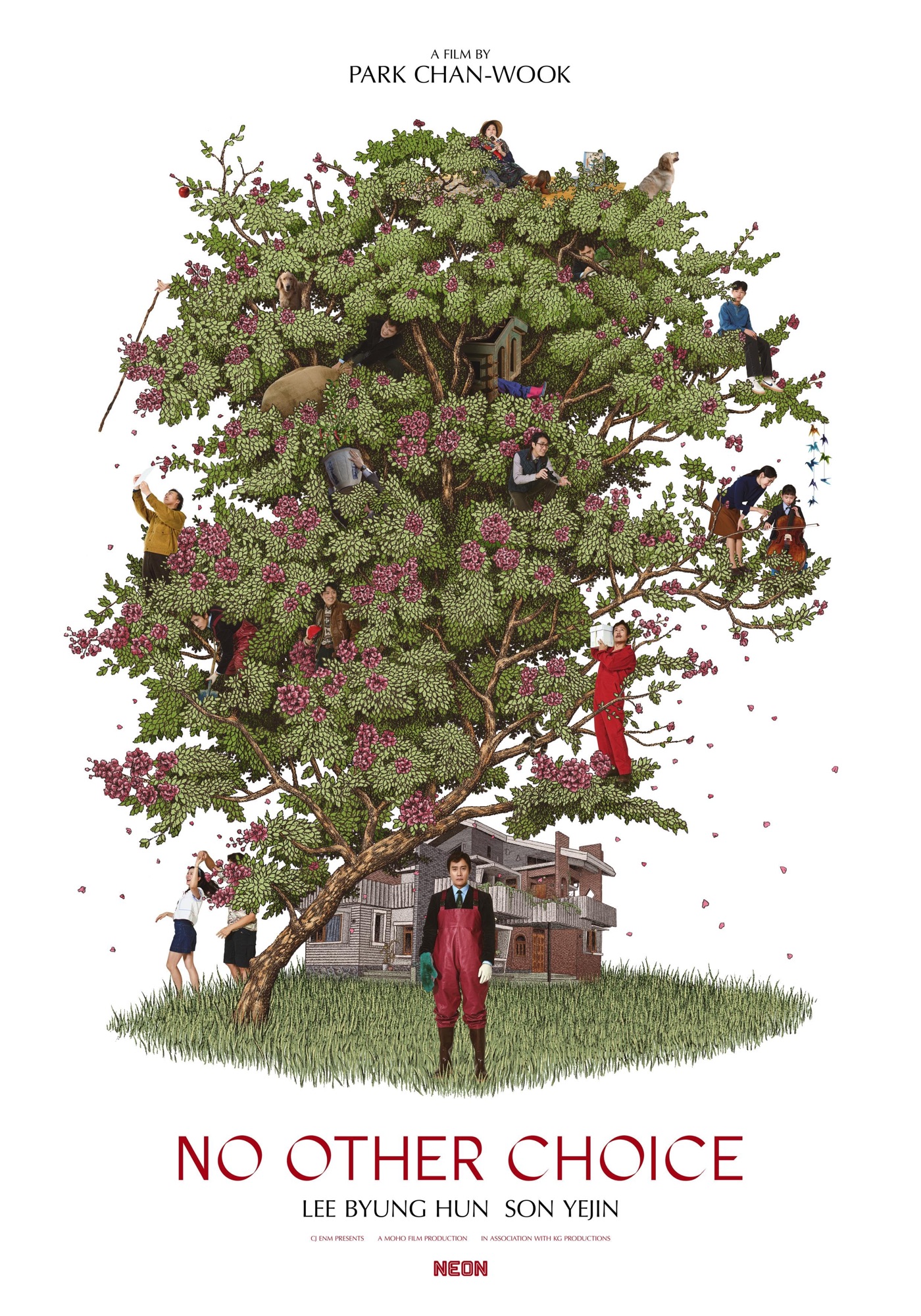


The first thing Park Chan‑wook gives you is pressure. It gathers in the corners of the frame, in the breath of a man who once believed his labor secured a future, in the tremor of a society that measures worth by output. No Other Choice turns that pressure into a dark, gleaming engine, and Lee Byung‑hun rides it with a performance that never loosens its grip. The film moves with a lyric pulse, each beat edged with dread and bitter humor, each moment sharpened by Park’s instinct for beauty born from ruin.

Lee’s Man‑su enters the story with a life built through years of steady work at a paper factory, a life that feels earned through repetition and sacrifice. When the Americans buy the plant and cast him aside, Park refuses to linger in pity. He turns the layoff into a study of humiliation engineered by corporate ritual, a spectacle of forced optimism that exposes the cruelty beneath its slogans. The comedy lands with a sting, and the sting reveals the film’s deeper argument: systems that promise stability often demand a quiet surrender of the self.

The interviews that follow are small crucibles. Park stages them with a precision that exposes the absurdity of gatekeeping labor, and Lee plays Man‑su’s unraveling with a restraint that deepens the tragedy. His toothache becomes a private alarm, a reminder of decay he refuses to acknowledge. His daughter’s cello lessons, his wife Min‑ri’s new job with a handsome dentist, his stepson’s distance—each detail tightens the vise. Park’s direction turns domestic space into contested territory, a place where pride and fear collide.

When Man‑su decides to eliminate the men competing for the same job, the film shifts into a darker register without losing its comic pulse. Park understands that violence born of desperation carries its own bleak logic. The men Man‑su targets are not obstacles so much as mirrors, each one reflecting a different form of defeat. Lee Sung‑min’s drunken buffoon, Cha Seung‑won’s weary shoe‑store clerk, Park Hee‑soon’s swaggering macho striver—Park gives each man a moment that reveals the cost of survival in a society that rewards only the last one standing.

The murders unfold with a chaotic energy that refuses glamour. Park leans into slapstick eruptions that expose the futility of Man‑su’s mission. A three‑way brawl becomes a grotesque dance of exhaustion. A failed attempt at stealth becomes a portrait of a man who cannot control the world he is trying to bend to his will. The comedy never softens the brutality; instead, it exposes the absurdity of a system that drives ordinary men toward extraordinary harm.

Son Ye‑jin’s Min‑ri grounds the film with a performance that radiates intelligence and quiet calculation. She sees more than she says, and Park gives her space to weigh comfort against conscience. Her scenes with Lee carry a tension that deepens the film’s emotional core. She is not a victim of Man‑su’s choices so much as a witness to the consequences of a culture that demands men carry burdens they cannot name.

Park’s production design turns Man‑su’s home into a greenhouse of curated calm, an oasis of bonsai and greenery that contrasts with the sterile Seoul outside. The bonsai work becomes a metaphor for control, patience, and the shaping of life through careful violence. It also becomes a tool, and Park uses that transformation to underline the film’s central question: what happens when the skills that sustain a man’s identity become instruments of destruction.

The screenplay—crafted by Park, Lee Kyoung‑mi, Lee Ja‑hye, and Don McKellar—threads social critique through every beat. The film honors Donald E. Westlake’s The Ax while reshaping it into a distinctly South Korean indictment of capitalist Darwinism. Park’s fury is never shouted; it accumulates in gestures, in glances, in the quiet resignation of men who believe they have no alternatives. The film’s final images carry a devastating calm, a recognition that victory in such a system leaves the victor emptied.

Lee Byung‑hun delivers one of his most controlled and haunting performances. His face holds storms he refuses to name, and Park captures the erosion of his humanity with a tenderness that refuses judgment. Son Ye‑jin matches him with a performance that reveals the strength required to live beside a man unraveling. Together, they anchor a film that understands the cost of ambition, the fragility of dignity, and the violence embedded in the pursuit of stability.

No Other Choice is a triumph of tone, craft, and moral clarity. Park Chan‑wook turns a wicked comedy of capitalism into a lament for the souls ground down by its machinery. The film cuts deep, and its wounds linger.

LETTER GRADE: A–


Leave a Reply