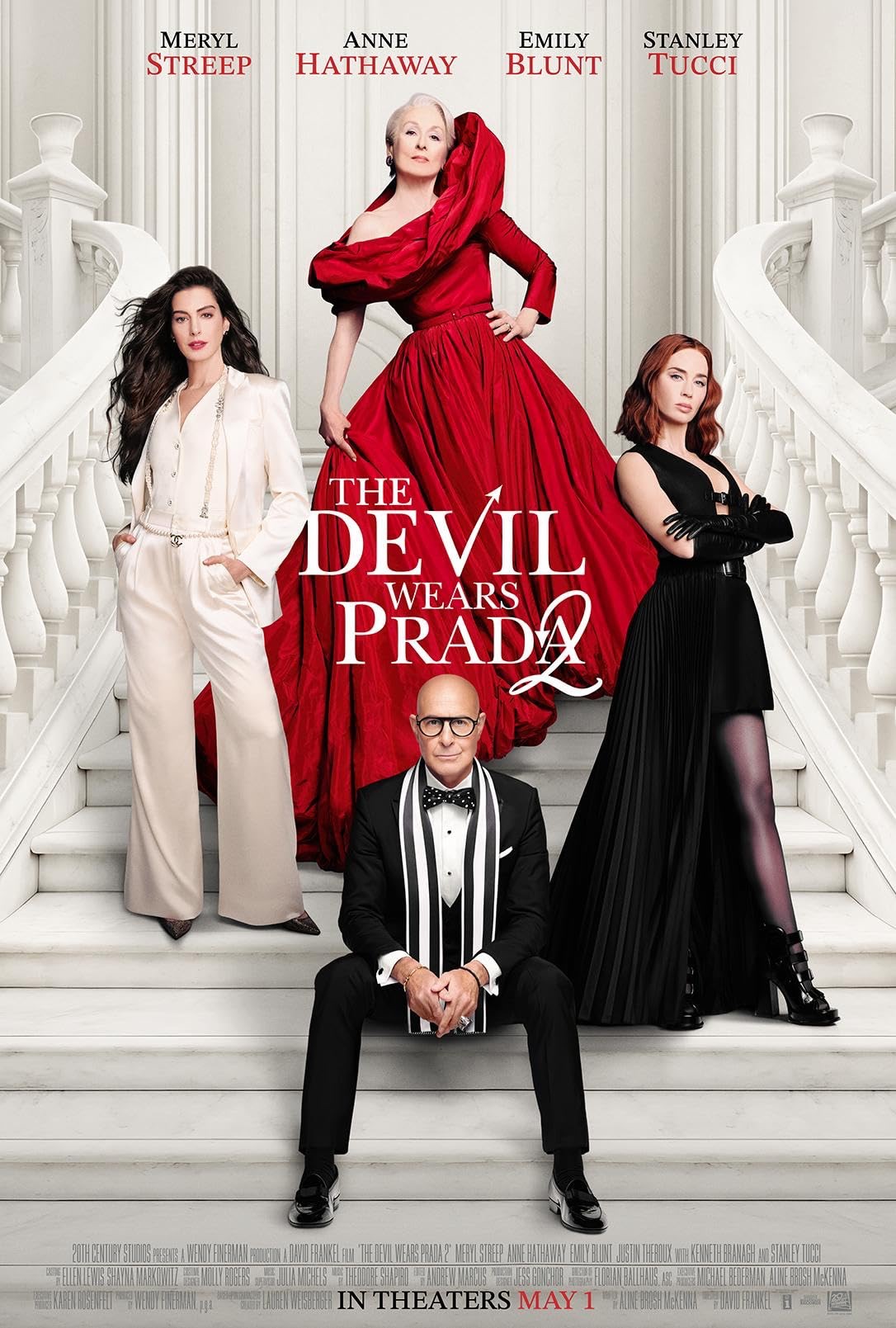


The new film opens on a world that has shed its illusions, and the review must begin there too. The Devil Wears Prada 2 carries the weight of a vanished era, and David Frankel leans into that erosion with a steadier hand than expected. The movie moves with a colder pulse than its predecessor, and that shift gives the sequel its charge. Anne Hathaway returns to Andy Sachs with a gaze sharpened by years of compromise, and the film finds its footing in that tension between ambition and the cost of staying afloat.

The newsroom layoff that sends Andy spiraling is staged with brutal efficiency, and the film uses that moment to expose the fragility of prestige. The plot point is functional, but it also deepens the film’s interest in labor, image, and the hollowing of institutions. Hathaway plays the shock with a muted fury that never spills into melodrama. Her performance grounds the film whenever its couture gloss threatens to overwhelm its stakes.

Miranda Priestly’s decline is the film’s most intriguing thread. Meryl Streep gives the character a new brittleness that never softens her authority. The script pushes her into unfamiliar territory—HR complaints, digital irrelevance, the humiliation of economy class—and Streep turns each indignity into a study in controlled collapse. The film critiques the fashion world’s dependence on spectacle while reveling in it, and Miranda becomes the axis where that contradiction tightens.

Emily Blunt’s return as Emily Charlton injects the film with a serrated energy. Her scenes with Hathaway crackle with resentment and bruised history. The Dior negotiations, the puff-piece scandal, and the escalating rivalry with Miranda all serve as pressure points that reveal how survival in this world demands a constant recalibration of loyalty. Blunt’s performance is one of the film’s sharpest pleasures, and her subplot with Justin Theroux’s tech titan adds a sinister undertow to the film’s portrait of modern power.

Stanley Tucci’s Nigel remains the film’s moral compass, though the sequel gives him a more complicated role in Andy’s return to Runway. His revelation that he orchestrated her rehiring reframes their relationship with a bittersweet edge. Tucci plays the moment with a quiet ache that lingers long after the scene ends. His presence steadies the film whenever its plot machinery threatens to grind too loudly.

The Sasha Barnes storyline, anchored by Lucy Liu’s poised performance, gives the film its most elegant pivot. Her scenes with Hathaway carry a cool intelligence, and the eventual acquisition of Elias Clark becomes the film’s most satisfying narrative turn. The movie uses Sasha to explore the shifting terrain of wealth and influence, and Liu’s restraint gives the character a commanding gravity.

Frankel’s direction remains glossy, but the gloss now carries a faint chill. The Milan gala, with Lady Gaga’s cameo and Nigel’s final flourish, becomes a showcase for the film’s fascination with spectacle as both salvation and trap. The estates, the runways, the skyline transitions—they all shimmer with a beauty that feels increasingly precarious. The film critiques the world it depicts, yet it cannot resist the seduction of its surfaces, and that tension becomes part of its texture.

The subplot involving Andy’s boyfriend Peter is the film’s weakest thread, though it serves a purpose. His frustration with her ambition echoes the first film, but the sequel uses their conflict to underline how little the world has changed for women who dare to want more. Patrick Brammall plays the role with enough warmth to keep the scenes from sagging, but the emotional weight remains elsewhere.

The final confrontation between Miranda, Andy, and Emily crystallizes the film’s themes. Power shifts, alliances fracture, and the film reveals how ambition corrodes even as it sustains. Miranda’s admission that Andy’s idealism reignited her fight gives the sequel its emotional core. It is not sentimental; it is a recognition of shared ruthlessness, sharpened by time.

The film ends on a note of renewal that carries a faint sting. Andy receives a better office, Miranda regains her throne, and Runway survives another cycle of reinvention. The world remains unstable, but the characters move through it with a hardened grace. The Devil Wears Prada 2 may not reach the fizzy perfection of the original, but it earns its place as a darker, more self-aware continuation. It understands that survival is its own kind of glamour.

Grade: B+.


Leave a Reply