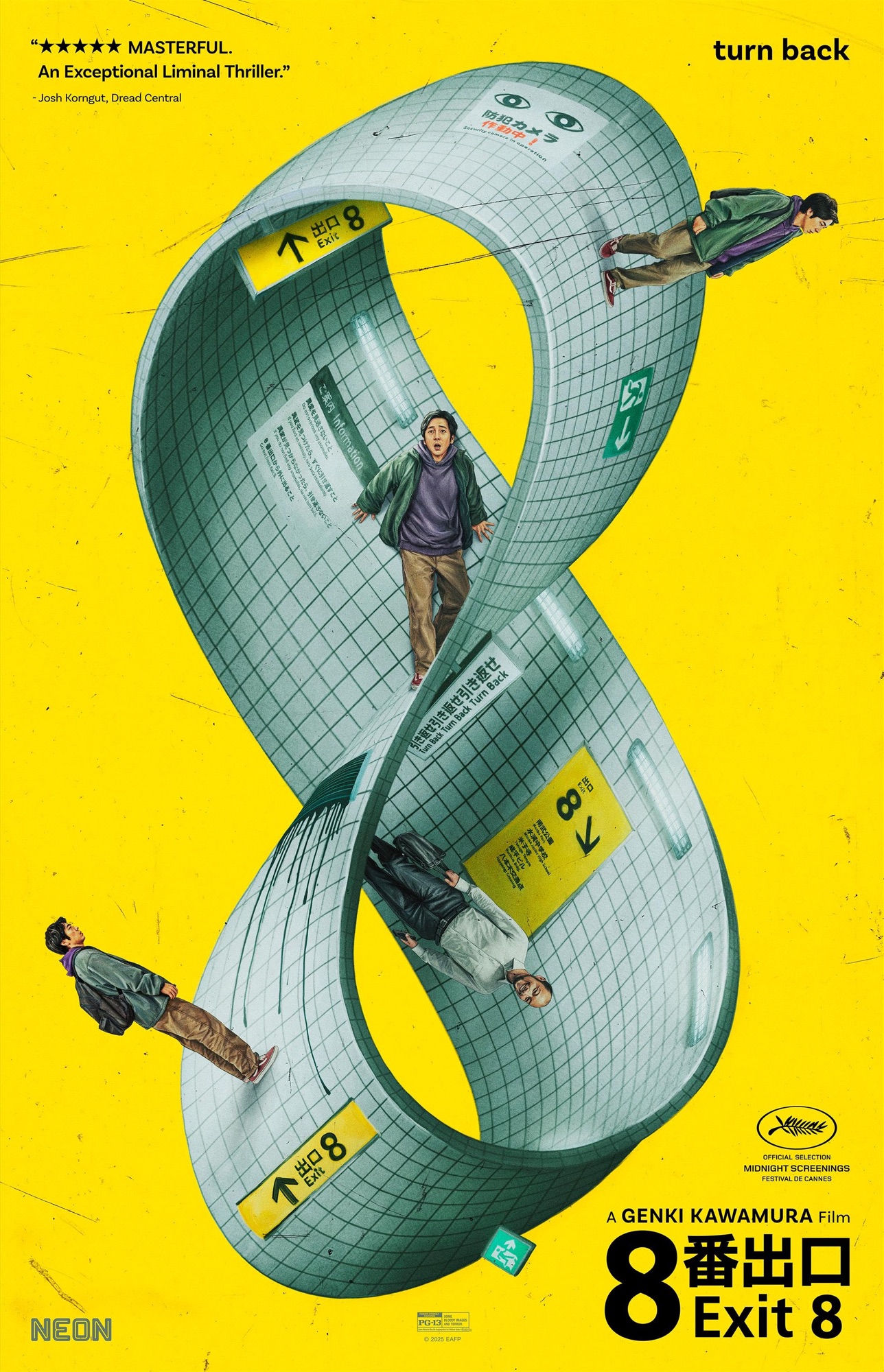


The circle of life bends into a corridor that refuses to stay still in Exit 8, Genki Kawamura’s compact, unnerving puzzle-box that keeps its focus on the small tremors of conscience. The film’s modest scale becomes a pressure chamber, and Kazunari Ninomiya’s Lost Man moves through it with a worn, inward tension that gives the looping halls a human pulse. The movie never strains for grandeur; it settles into its narrow space and lets the walls close in until the moral stakes sharpen.

Kawamura’s direction favors restraint over spectacle, which gives the film its strongest charge. The white-tiled halls feel less like a gimmick and more like a test chamber for the choices the Lost Man has avoided. The rules on the wall—turn back at anomalies, move forward when all seems normal—become a quiet indictment of the ways people drift through harm without intervening. Ninomiya’s performance deepens this reading; his hesitations carry the weight of someone who has spent years stepping aside.

The early subway confrontation, with a mother cornered by a cruel stranger, sets the film’s ethical axis. Kawamura refuses to let it fade into backstory. It echoes through every loop, every reset, every moment the Lost Man tries to outrun his own passivity. The film’s structure becomes a critique of avoidance, and the corridors turn into a ledger of what he has failed to do. This is where the movie’s existential ambitions feel earned.

When the anomalies begin—tracking eyes on posters, blood falling in sheets, the corridor bending into menace—the film’s genre instincts kick in. Yet Kawamura keeps the focus on consequence rather than shock. Each anomaly becomes a reminder of the Lost Man’s frayed interior, a record of the choices he refused to make. The tension grows not from danger but from recognition.

The introduction of the Boy, played with sharp, unforced presence by Naru Asanuma, gives the film its emotional hinge. His perceptiveness cuts through the Lost Man’s fog, and their partnership becomes the film’s most grounded thread. The Boy’s hermit crab shell, offered without sentiment, becomes a small anchor in a world that keeps erasing itself. Kawamura uses this object with discipline, letting it carry meaning without forcing it.

Yamato Kochi’s Walking Man enters the film with a rigid, uncanny rhythm that never tips into caricature. His posture, his fixed gait, his refusal to acknowledge the Lost Man—these details build a portrait of someone who surrendered to the loop long before the story began. The film’s flashback to his downfall is brief but effective, a warning delivered without melodrama.

The flooding of the corridor at Exit 6 is the film’s most ambitious sequence, and it nearly overwhelms the movie’s otherwise tight control. Yet the moment the Lost Man lifts the Boy above the rising water restores the film’s balance. The gesture is simple, direct, and unadorned. It becomes the first true break in his pattern of retreat, and the film treats it with the gravity it deserves.

The final sprint toward the real Exit 8 lands with a clean, satisfying thud. The Lost Man’s doubt, his sudden recognition of the Boy’s shell, and his decision to trust the moment give the ending its force. Kawamura avoids triumphalism; he lets the return to the real world feel provisional, a beginning rather than a victory.

The closing scene on the train, with the same mother and the same cruel man, completes the film’s moral loop. The Lost Man steps forward this time. The gesture is small, but the film has prepared us to understand its cost. Kawamura ends on action rather than revelation, which gives the film its lingering strength.

Exit 8 is not a profound philosophical statement, but it is a disciplined, quietly inventive work that understands how fear, guilt, and responsibility coil around each other. Its puzzles serve its themes rather than overshadow them. Its performances stay grounded even when the world bends. It leaves you with the sense that the smallest turn can break a cycle.

LETTER GRADE: B+.


Leave a Reply