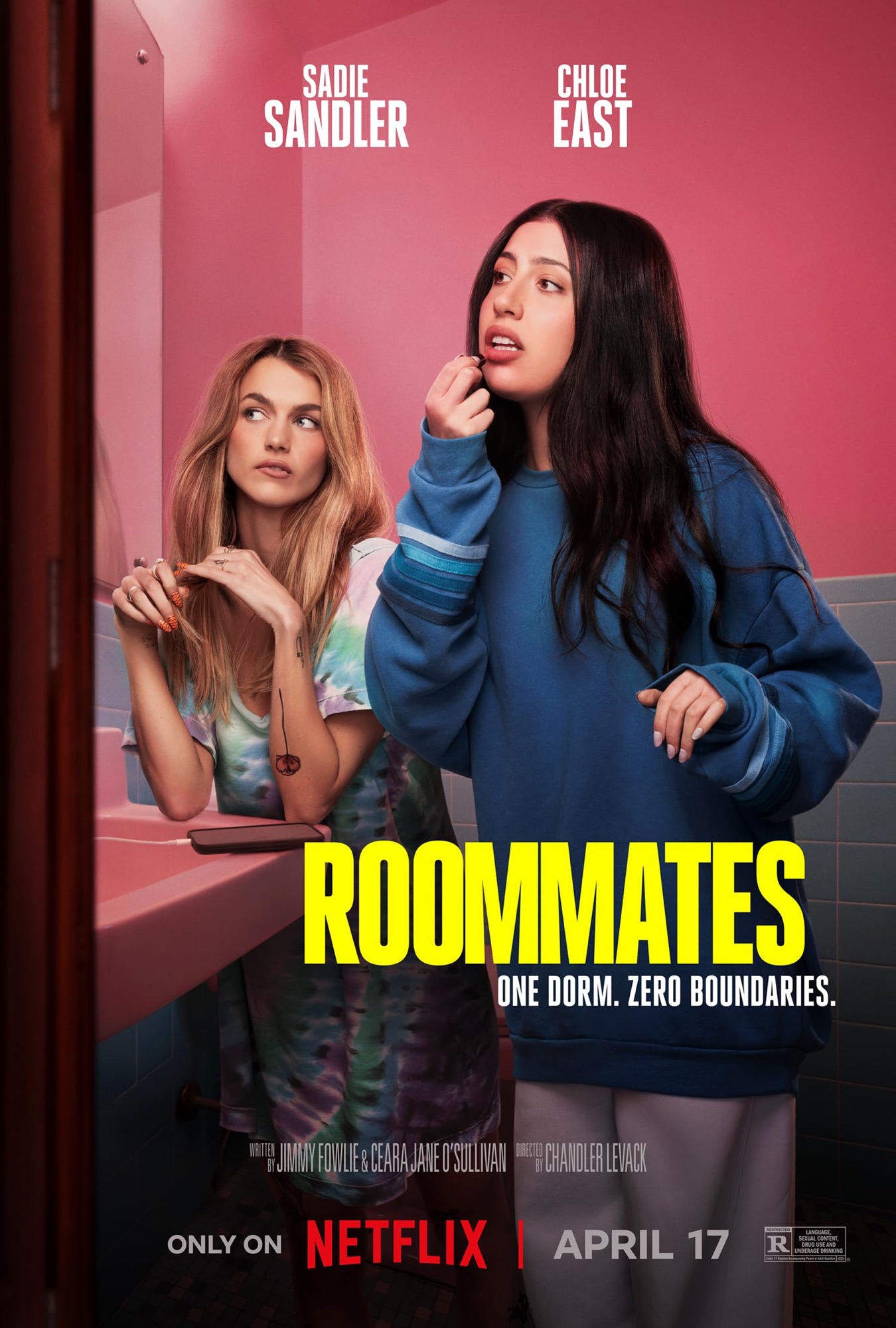


Chandler Levack’s Roommates opens in a register that feels familiar to anyone who has endured the long tail of Happy Madison comedies, yet the film keeps tugging at its own surface until something raw shows through. The premise is a campus fable told by Sarah Sherman’s Dean Schilling, a frame that lets the movie acknowledge the lineage it comes from while trying to carve out a different moral terrain. The narration sets a tone of warning and weariness, and the film’s best moments rise from that tension between the story being told and the story being lived.

Sadie Sandler’s Devon anchors the film with a performance that carries a steady pulse of yearning. She enters Walton University with the hope of shedding the weight of her high school years, and the film treats that hope as something fragile. Levack doesn’t let Devon drift into caricature; every anxious gesture has consequence, every attempt at generosity becomes a hinge the plot turns on. The movie’s critique of the Happy Madison tradition begins here, in the way Devon’s vulnerability is treated as a real condition rather than a punchline.

Chloe East’s Celeste is the film’s most volatile presence, and the script gives her a shifting center that keeps the audience unsettled. Her charm, her cruelty, her invented biography, her genuine pain—each emerges in sharp bursts. The film’s darker undercurrent gathers around her, and Levack lets that darkness accumulate without turning it into spectacle. The Panama City sequence, the poetry‑class ambush, the Thanksgiving explosion, the final confrontation in Robyn’s room—each moment pushes the film toward a reckoning with the harm these characters inflict on one another.

Levack’s direction finds its strongest footing when the film leans into ambiguity. The script by Jimmy Fowlie and Ceara O’Sullivan keeps every gesture suspect, every kindness double‑edged. The movie’s moral inquiry becomes its most compelling feature. It asks whether cruelty can hide inside generosity, whether friendship can curdle into something corrosive without anyone noticing until the damage is done. The film’s willingness to sit in that uncertainty gives it a depth most Happy Madison projects avoid.

The comedy, however, rarely lands with force. The jokes feel scattered, and the film’s tonal shifts sometimes leave them stranded. Sherman’s narration is sharp but underused, and the supporting cast—Natasha Lyonne, Nick Kroll, Carol Kane—bring texture without ever being allowed to reshape the film’s rhythm. The movie wants to be funny, but its heart is elsewhere, and the mismatch shows.

Still, the film’s emotional pressure builds in unexpected ways. Devon’s unraveling, Celeste’s unraveling, the slow collapse of their shared space—Levack treats these as architectural problems. The dorm becomes a structure stressed by secrets, resentments, and small betrayals. When the fire finally consumes it, the moment feels earned. The destruction is not a gag; it is the physical consequence of everything the film has been tracing.

The epilogue, delivered by Sherman, lands with a bittersweet thud. The fates of Devon, Celeste, Michael, and Alex are absurd, tragic, and oddly tender. Devon’s prison sentence, her friendship with Louise, and her eventual design firm gesture toward a future built from wreckage. Celeste’s fall into the very corporate world she pretended to escape gives the story a grim symmetry. These outcomes deepen the film’s critique of the Happy Madison universe, where consequences are usually erased by the next punchline.

Levack’s film is not fully cohesive, but it is far more self‑aware than its lineage suggests. It interrogates the cruelty embedded in certain comedic traditions and refuses to let its characters off the hook. Sandler and East carry the film with performances that keep the emotional stakes taut. The movie’s flaws—uneven humor, occasional slack pacing—don’t erase its ambition. They simply mark the edges of a film trying to grow beyond the machinery that produced it.

Roommates may not be a triumph, but it is a work of genuine curiosity. It peers into the shadows cast by its predecessors and tries to understand what lives there. In doing so, it becomes something stranger and more affecting than expected.

Grade: B. On Netflix.


Leave a Reply