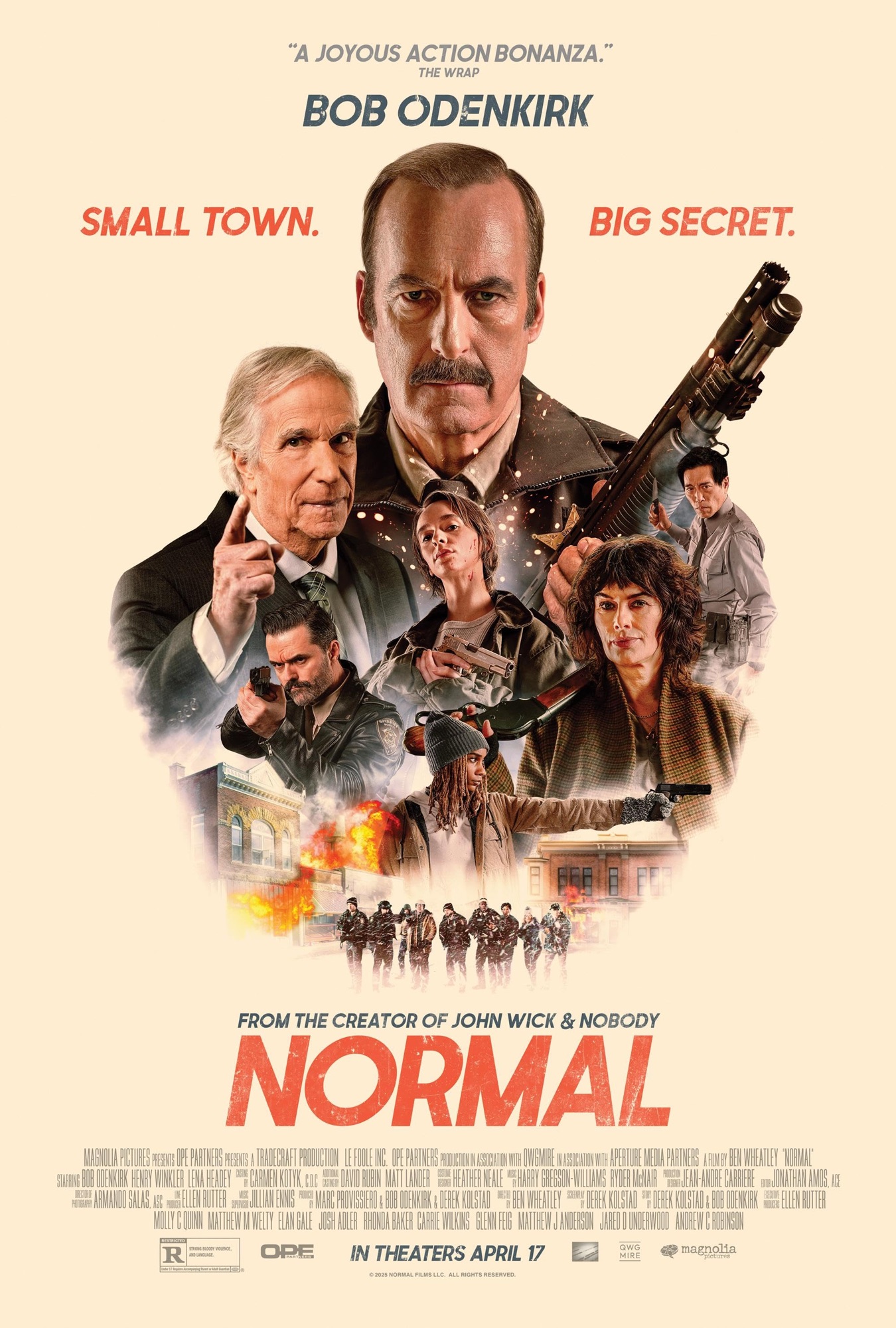


The first movement of Normal carries a quiet charge, a sense of a man stepping into a town that greets him with warmth that never settles into comfort. Bob Odenkirk’s late‑career shift into bruised, reluctant action has given him a new register, and the film leans into that register with a steady pulse. His Ulysses arrives in winter, carrying a history that never needs to be spoken aloud, and the film uses that weight to anchor its early calm.

Ben Wheatley’s direction introduces a grain that resists polish. His fondness for texture and ambivalence gives the film a wandering energy that works best before the bullets fly. The geniality of the townspeople has a faint distortion, a hum beneath the surface, and Wheatley lets this hum build without rushing toward revelation. The result is a first act that feels alive with possibility, even when the script’s machinery begins to show.

The bank robbery becomes the hinge on which the film turns, and the turn is abrupt enough to jolt the viewer into a new temperature. The deputies’ betrayal, the vault’s impossible hoard, the sudden shift from welcome to hostility — each beat pushes the film into a harsher register. Wheatley embraces the chaos, letting the violence unfold with a rough, physical immediacy that gives the action a grounded force. The film’s unevenness becomes part of its identity, a deliberate refusal to smooth its edges.

Odenkirk thrives in this shift. His performance carries a blend of calculation and fatigue, a man who reads danger in the smallest details and responds with a precision born from old wounds. His alliance with Lori and Keith gains momentum from its improvised nature, and the film uses their partnership to explore the strange intimacy of survival. Reena Jolly and Brendan Fletcher bring a jittery energy that sharpens the film’s middle stretch.

The Yakuza thread widens the film’s scope without overwhelming it. The coded message, the private jet, the ritual calm of the operatives — these elements introduce a global shadow that contrasts with the town’s insular paranoia. Wheatley treats this intrusion with a deadpan steadiness, allowing the absurdity and the menace to coexist. The film gains a strange buoyancy from this collision of worlds.

Lena Headey’s Moira adds another layer of tension. Her scenes with Odenkirk carry a charge that hints at deeper histories the film never fully explores. Wheatley uses her presence to thicken the atmosphere rather than to resolve anything, and this restraint strengthens the film’s sense of a place where every gesture hides a contingency. Jess McLeod’s Alex becomes the film’s emotional pivot, the character who turns Ulysses from a temporary outsider into a reluctant partner in the town’s unraveling.

The long night of preparation — the explosives, the negotiations, the storm that seals the town — gives the film a brief moment of communal purpose. Wheatley lets this moment breathe, allowing the absurdity and sincerity to sit side by side. The uneasy alliance between Ulysses, Alex, the deputies, and the remaining townspeople becomes a study in desperation, a temporary order built on fear and necessity.

The dinner sequence is the film’s boldest gamble. The shotgun’s fall, the sudden eruption of violence, the collapse of every fragile agreement — Wheatley stages this chaos with a grim humor that feels both inevitable and tragic. The carnage that follows is swift and merciless, yet the film never loses sight of the human stakes beneath the spectacle. The room becomes a crucible where every concealed motive burns through its disguise.

The aftermath leaves Ulysses and Alex standing in a silence that carries both exhaustion and resolve. Their move to Texas in the final moments suggests a cycle that will continue, a life built on temporary authority and permanent vigilance. Wheatley ends on a note of weary continuation rather than triumph, a choice that suits the film’s fractured spirit.

Normal is uneven, but its unevenness is part of its character. Wheatley’s instincts pull the film toward texture, ambivalence, and tonal fracture, while Derek Kolstad’s script pushes toward momentum and mythmaking. The collision produces something rough‑edged and intermittently thrilling, a crime story that keeps slipping into stranger shapes. Odenkirk remains its strongest force, a performer who turns weariness into voltage and gives the film a center that never collapses.

LETTER GRADE: B+.


Leave a Reply