Filed: Tehran, September 2025 Sender: [REDACTED] Recipient: [U.S. Citizen, Male] Subject: Personal Correspondence
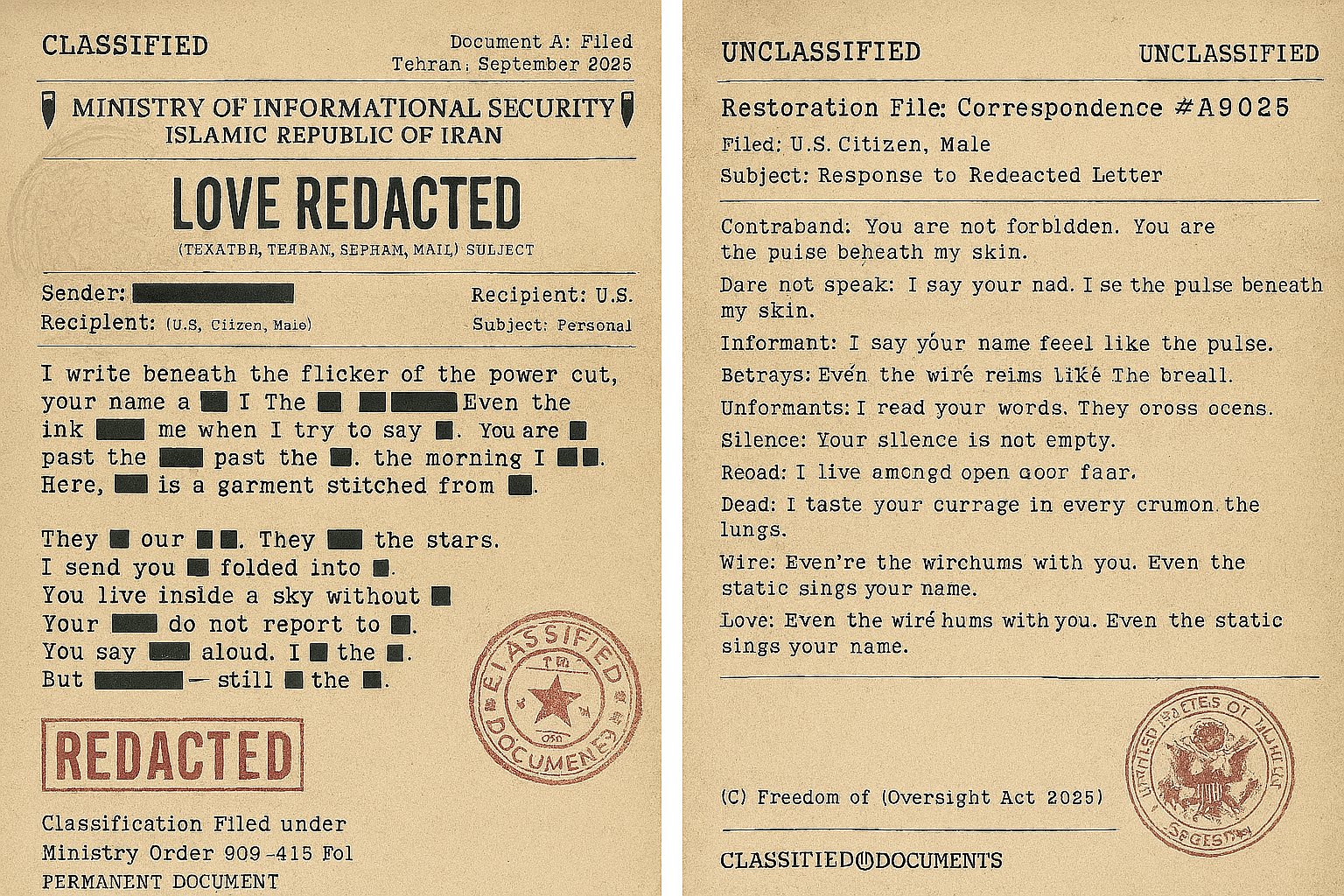
I write beneath the flicker of the power cut, your name a █ I █. The walls are █. Even the ink █ me when I try to say █. You are the █ past the █, the morning I cannot █. Here, █ is a garment stitched from █. My mouth holds █ like a █ in the █.They █ our █. They █ the stars. I send you █ folded into █. You live inside a sky without █. Your █ do not report to █. You say █ aloud. I █ the █. But █—█—still █ the █.
—— Document B: The Key
Classification: Internal Review – Cultural Surveillance Division Status: Redacted Terms from Correspondence #A0925
Line Reference Redacted Term Classification L2 contraband Political L2 dare not speak Emotional L3 informants Surveillance L4 betrays Emotional L4 breath I smuggle Metaphorical L5 guards Political L5 enter Restricted L6 silence Cultural L7 laws and locked doors Political L8 secret buried Emotional L8 floorboards Metaphorical L9 read Surveillance L9 letters Communication L10 erase Censorship L11 poems Cultural L11 bread Symbolic L12 roads Political L13 checkpoints Political L14 taste Emotional L14 echo Emotional L15 love Emotional L15 crosses Political L15 wire Surveillance
——
Restoration File: Correspondence #A0925 Filed: U.S. Citizen, Male Subject: Response to Redacted Letter Status: Unclassified – Emotional Archive
Contraband You are not forbidden. You are the pulse beneath my skin.
Dare not speak I say your name aloud. I say it again. I say it until the silence breaks.
Informants No wall here listens. But I do. I listen for you.
Betrays Even my freedom feels like betrayal when you cannot share it.
Breath I smuggle I inhale your words. They cross oceans in my lungs.
Guards There are no guards here. Only the ache of your absence.
Enter I walk into morning, but it does not open without you.
Silence Your silence is not empty. It is a language I am still learning.
Laws and locked doors I live among open doors. I would trade them for one unlocked hour with you.
Secret buried You are the truth I keep beneath every conversation.
Floorboards Even my floorboards remember you. They creak with longing.
Read I read your letter in the dark. I read between the black boxes.
Letters Your letters are maps. I trace them with my fingers.
Erase They cannot erase you. You are written into my breath.
Poems Your poems are bread. I break them slowly, reverently.
Bread I taste your courage in every crumb.
Roads My roads are wide. But they do not lead to you.
Checkpoints There are no checkpoints here. Only the checkpoint of missing you.
Taste I taste your name in my sleep.
Echo You echo in every room I enter.
Love Love is not a word. It is the wire between us.
Crosses It crosses oceans. It crosses silence. It crosses fear.
Wire Even the wire hums with you. Even the static sings your name.
---
Author’s Note: On the Genesis of Love Redacted
Love Redacted began as a formal experiment in absence. I wasn’t trying to write a love poem—I was trying to write around one. The premise is simple: a woman in Iran writes to her lover in America. But the poem itself is not the point. The language of longing, the metaphors of distance and desire—they’re deliberately generic. What matters is what’s missing.
In totalitarian regimes, poetry often becomes camouflage. The real message lives in the redactions. The black boxes are not obstructions—they’re invitations. Each one is a cipher, a signal, a plea. The reader must become a decoder, someone who understands that the censored word is the most intimate one. That’s why the companion documents—the restoration file, the key, the visual dossiers—are essential. They model how meaning can be reconstructed from erasure. They show how love, resistance, and truth can be smuggled through bureaucracy, disguised as paperwork, hidden in plain sight.
To make the menace believable, I turned to generative A.I. I needed its wizardry to conjure the texture of surveillance: the stamps, the faded ink, the watermark of the Ministry. I needed it to simulate the kind of bureaucratic dread that feels both intimate and institutional.
And here’s the uncomfortable truth: this kind of communication may not remain metaphor for long. If Donald Trump’s attacks on the media succeed—if journalism is delegitimized, if dissent is criminalized, if truth becomes a liability—then we will write in codes. We will speak through redactions. We will send each other poems that pretend to be about love, but are really about survival. We will read between the lines.
That’s really cool. I appreciate the redaction key. Wish more erasures had that! There is a lot of steganography out there for us to use if we need secret communications.
Loading…
Leave a Reply
One Face Only
Soft Closure
Discover more from The Moya View
Subscribe now to keep reading and get access to the full archive.


Leave a Reply