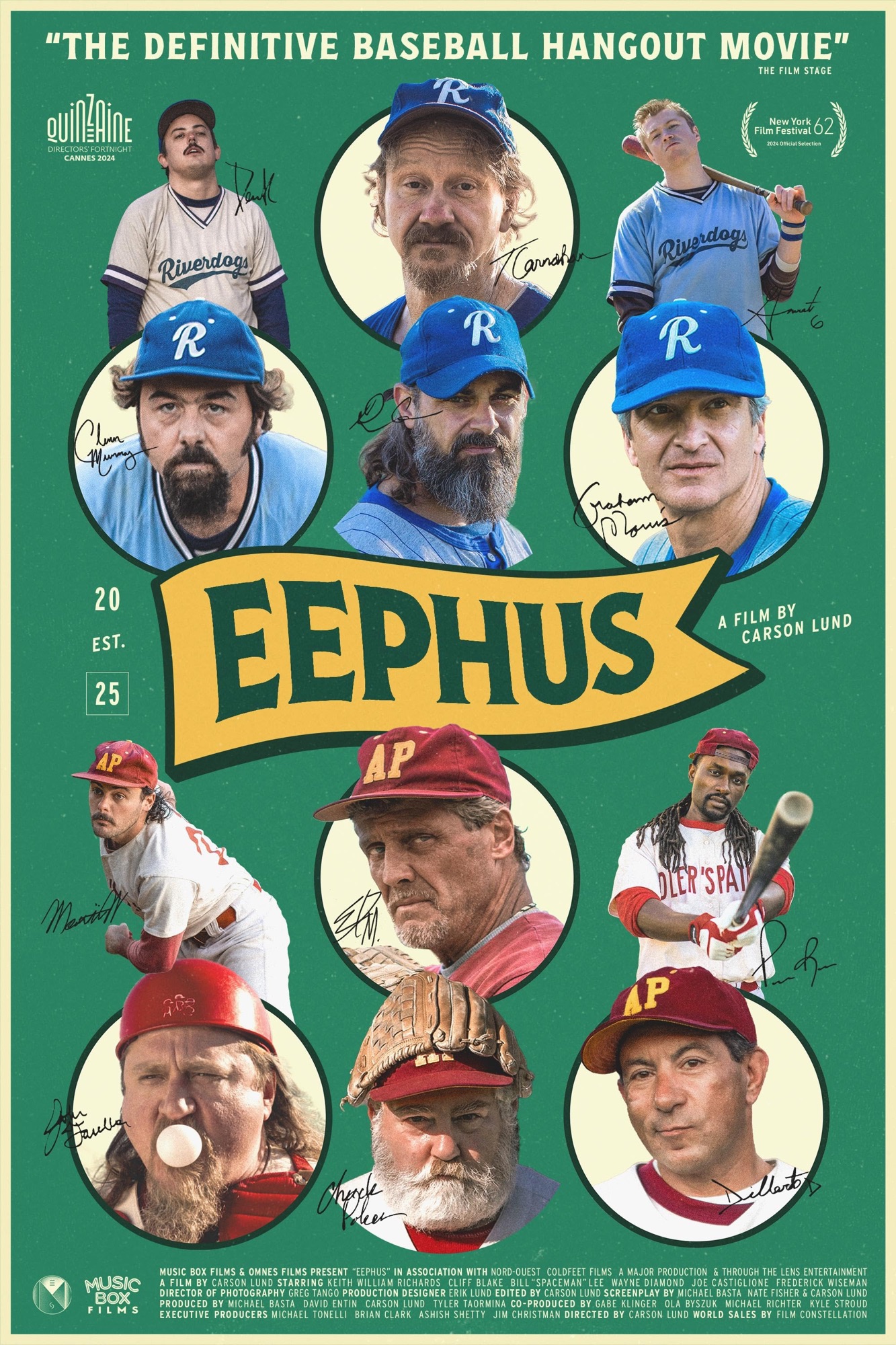


In Eephus, director Carson Lund paints baseball not as spectacle but as ritual—fleeting, dusty, and tender. The film unfolds like the final breath of summer in a small Massachusetts town, where Adler’s Paint faces down the Riverdogs in one last showdown before bulldozers claim their field for a school. What emerges isn’t your typical sports flick. It’s a windblown elegy to time, team, and towns that vanish not in headlines but in silence. If you’re expecting plot-driven drama, swing again. Eephus is less about the inning-by-inning tension and more about the solemn wonder of a game nearing extinction.

Keith William Richards leads the charge as Ed Mortanian, a manager who seems less concerned with victory than with preserving something vanishing—tradition, camaraderie, even identity. His performance isn’t flashy, but it’s exactly right: a weathered hand guiding a ship that’s more memory than motion. The ensemble is sprawling and uneven, but dotted with sparks. Bill “Spaceman” Lee channels a kind of cosmic nostalgia as Lee, and Cliff Blake’s Franny feels born from some long-lost baseball card come to life. Not every cast member gets their at-bat with emotional depth, but there’s warmth in their sheer presence—like locals gathered for one more game under waning summer light.

The film’s plot is barely a plot at all—more a lazy arc, like the namesake eephus pitch: slow, looping, strange. The tension between Adler’s Paint and the Riverdogs matters only insofar as it gives structure to the day. There are flickers of interpersonal conflict, old grudges, and moments of absurdity (Wiseman’s Branch Moreland wanders through scenes like a ghost of the sport’s past), but Lund keeps the pulse low. Sometimes frustratingly low. The stakes feel featherlight, and that’s where the film risks alienating viewers craving dramatic payoff. Still, the quiet is part of the point.

As a thematic effort, Eephus delivers a wistful home run. Lund’s direction is meditative, almost reverent. You feel the rustle of infield dirt, the distant thump of a ball against glove. The theme of impermanence threads through every frame: buildings crumble, bodies age, traditions fade. The field’s demolition is more than a plot point; it’s an act of cultural erasure. Lund’s camera lingers on faces and gestures like relics—not lost yet, but already fading.

Visually, the film recalls the sun-bleached stylings of The Sandlot and the melancholy of Field of Dreams, but with less fantasy and more grit. Where those films chased magic, Eephus chases memory. It’s stubbornly analog: shots hang long, edits are rare, and there’s a tactile love for the imperfections of the game. This is baseball as ritual theater, not commercial product. In comparison to its genre siblings, Eephus is far more poetic, but less pulse-raising. It’s unlikely to inspire standing ovations; it’s more likely to leave you quiet for a while.

Where the film falters is in pacing and clarity. Some scenes drift too far from narrative cohesion, and the sheer size of the cast overwhelms, especially with many characters barely sketched. The film asks you to follow the game and the souls within it, but doesn’t always offer a clear path. There are moments when emotion swells, only to be undercut by sluggish transitions or scenes that feel indulgently long. A few characters—David Pridemore’s Troy Carnahan and Keith Poulson’s Derek Dicapua—hint at deeper stories that never fully land.

Yet there’s undeniable heart here. Carson Lund doesn’t just direct; he curates a mood. The game itself, the real-time unfolding of innings, becomes a kind of slow-burning poem. We watch the rituals—the chewing of sunflower seeds, the windup, the chatter, the stretching shadows—with something approaching reverence. This is baseball played not for scouts or glory, but for memory, for closure. It’s the kind of final game that could only happen in a town like this, and in a film brave enough to let silence and nostalgia do the heavy lifting.

As the final innings draw near, you feel the slow ache of farewell—not just to the field, but to a whole way of living. Lund’s direction favors the sentimental over the urgent, the poetic over the polished. It’s a risky choice, and not every pitch lands. Some viewers will wish Eephus had swung harder, cut deeper. But if you surrender to its rhythm, there’s beauty in its lopsided grace. The last baseball of all time, perhaps, deserves a film like this: humble, flawed, and oddly transcendent.

Letter Grade: B+.


Leave a Reply