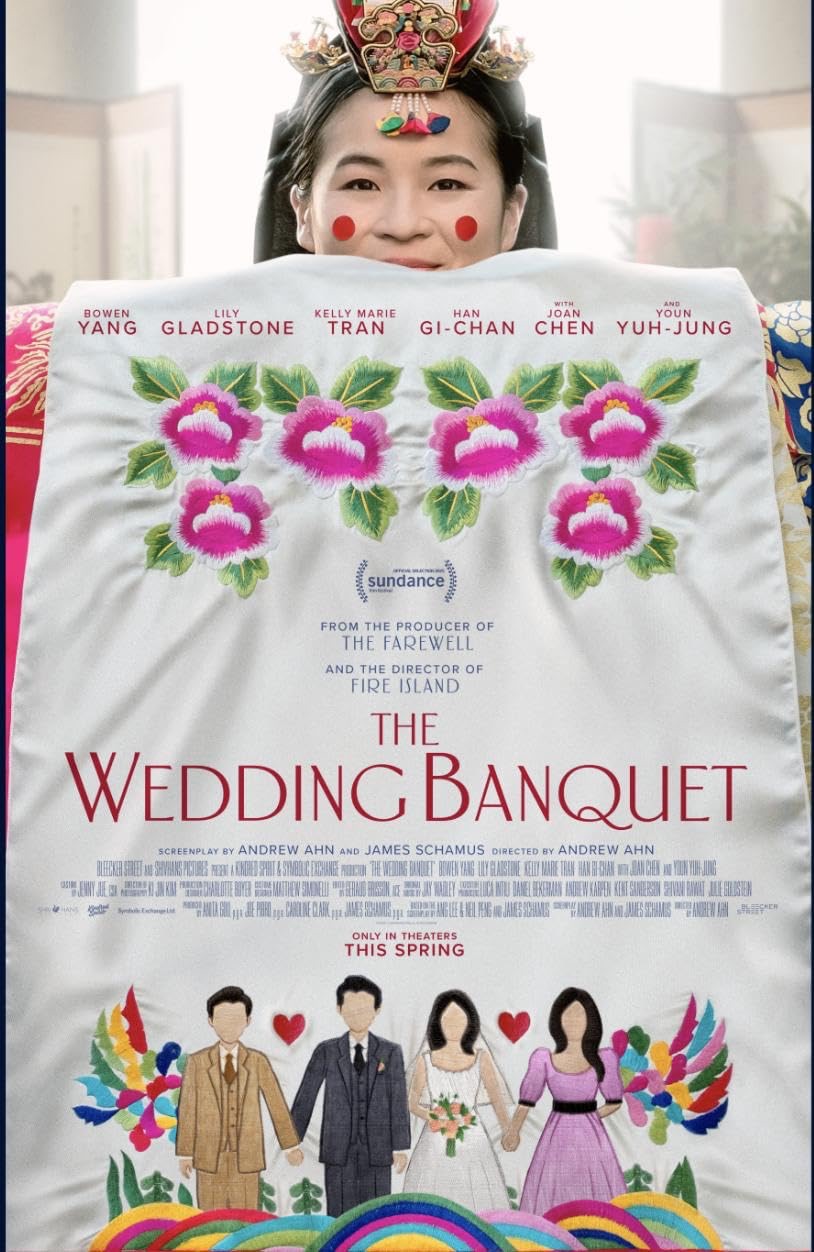


Andrew Ahn’s The Wedding Banquet, a loose reimagining of Ang Lee’s 1993 classic, arrives with a modern ensemble and gentler tonal brushstrokes—less biting satire, more soft-spoken longing. Bowen Yang leads a vibrant cast that honors the original’s emotional stakes and stumbles through some of the newer melodrama. The film is a rich visual diary of queer family-making, cultural compromise, and the quiet revolt of choosing authenticity over inheritance.
The narrative bends into familiar rom-com shapes: mistaken partners, fake weddings, surprise pregnancies—but here, cliché is not mocked so much as massaged into something intimate and lived-in. Chris and Min’s relationship, drawn with delicate tension, sways between genuine devotion and strategic hesitancy. Yang brings depth to Chris, portraying him not as comic relief but as a man trapped between tenderness and avoidance. His delivery is often understated, a quiver behind the smile, and this restraint gives the film much of its emotional ballast.

Kelly Marie Tran’s Angela is less consistently written, but Tran finds flashes of truth in the character’s contradictions—stoic, impulsive, caretaking, defiant—her scenes with Lily Gladstone’s Lee brim with unsaid history and yearning. Gladstone remains one of the film’s quiet strengths; her gaze carries both the ache of love and the exhaustion of motherhood deferred. The IVF subplot—one of the more tender threads—grounds the film in real stakes, even as it occasionally loses focus amid the more theatrical beats.
Han Gi-chan’s Min risks feeling ornamental, but in Ahn’s hands, he emerges as something more—a romantic paradox between longing and filial duty. His scenes with Chris, though sparse, sparkle with unspoken tension, especially when juxtaposed against the performative grandeur of the Korean wedding. And Youn Yuh-jung’s Ja-Young, commanding as ever, steals every scene with her sly restraint and quiet grief. Her exchanges with Chris and Min are some of the film’s emotional high points.
The film falters in pacing and tone. The second act often lingers too long on contrivance: drunken sex, hidden paraphernalia, last-minute ceremonies. These narrative turns don’t always feel earned, and though they echo rom-com rhythms, they can disrupt the film’s quieter mood. Still, Ahn’s direction has a painterly confidence, treating domestic interiors and the absurdity of rituals with equal care.

Compared to Ang Lee’s original, this version eschews acerbic cultural clash in favor of gentle confrontation. It’s less concerned with satire and more invested in empathy, yet loses some edge in that process. The themes—legacy, identity, the pragmatics of queer partnership—are present but not intensely interrogated. The film gestures toward complexity without always landing there.

Visually, the film is lush with soft light and muted palettes. Seattle’s foggy, quiet backdrop creates uncertainty, and Ahn cleverly uses domestic space: living rooms that blur boundaries and bedrooms that echo with secrets. The staging is elegant, but not always in the narrative transitions.

Ultimately, The Wedding Banquet feels like a hymn to the chosen family—sung slightly off-key but with heart. Its stumbles are forgivable, its affections sincere. It understands that every wedding is part farce, part blessing, and that love—especially queer love—often arrives in unorthodox arrangements.

Grade: B+.


Leave a Reply