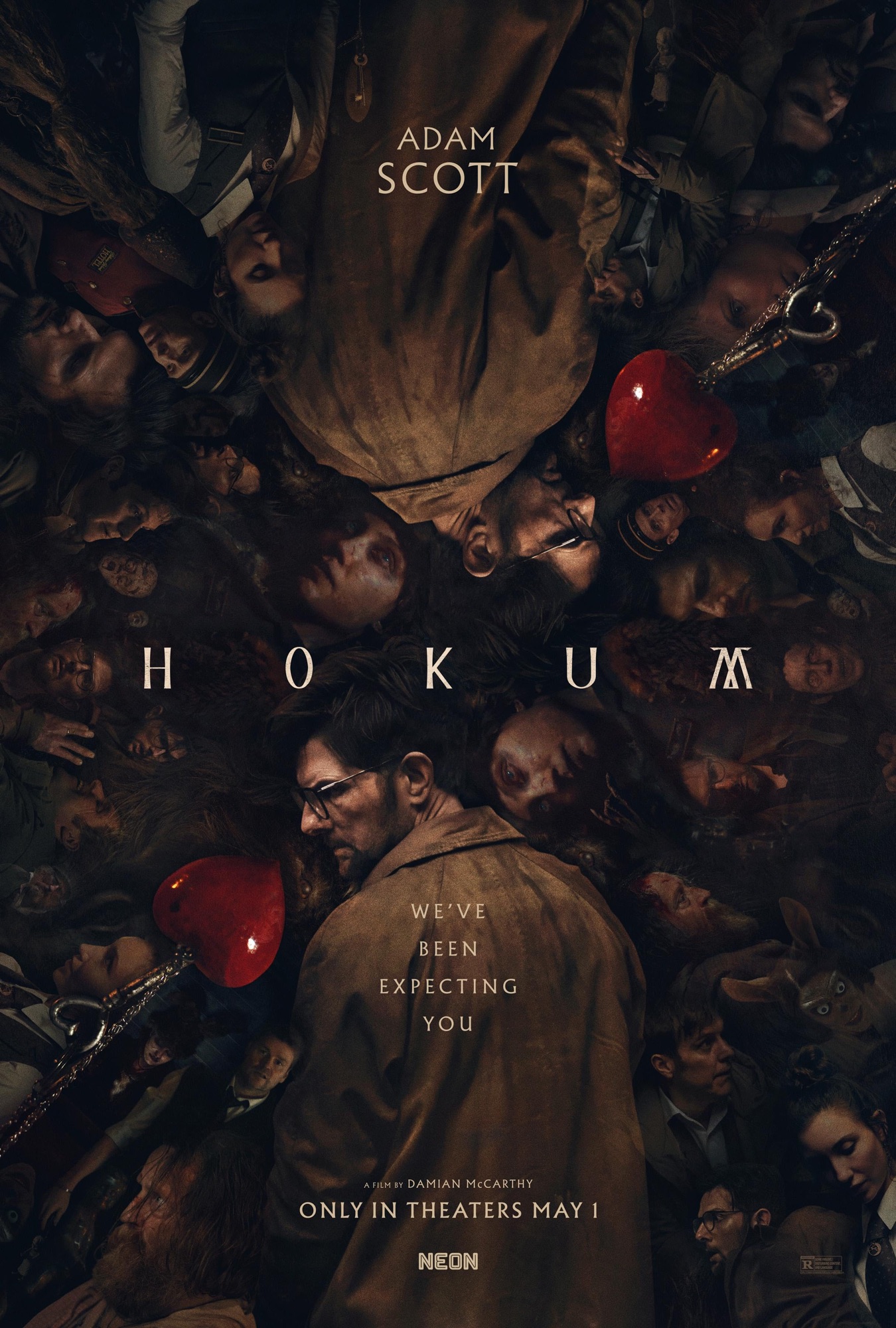


Damian McCarthy has earned a reputation for gently unsettling audiences, leaving them unsure whether to scream or laugh. Hokum carries that distinctive spirit forward with an affection for the strange and unexpected. Like his genre contemporary Osgood Perkins, the Irish filmmaker takes familiar horror conventions apart and reshapes them into something crooked, eerie, and often funny. The film invites viewers not to take everything at face value. Even its title offers a knowing shrug, gently challenging audiences to look beyond first impressions. That invitation becomes the film’s heart.

Adam Scott delivers one of the most affecting performances of his career as Ohm Bauman, a successful novelist struggling to move forward as guilt takes root in his life. Still carrying the pain of his family’s violent breakup when he was a child, Ohm arrives at the Bilberry Woods Hotel with more than his parents’ ashes: he brings years of grief and unresolved hurt. The hotel seems shaped by secrets, resentments, painful choices, and old folklore. Its hallways feel heavy with memories, and every employee appears to know something they can’t bring themselves to say aloud.

Scott recognizes that Ohm isn’t meant to be immediately likable. He can be abrasive, dismissive, and arrogant, worn down by emotional exhaustion. His treatment of Alby, the hopeful young bellhop played by Will O’Connell, is especially harsh in the film’s early stretches. Still, Scott never lets him become wholly contemptible. The performance reveals the desperation beneath Ohm’s cutting remarks—a man struggling to keep going when he has little left to give.

McCarthy introduces his unusual cast with patience and care. Brendan Conroy’s hotel owner, Cob, shares local folklore about the Cailleach, a witch said to drag children through the underworld in chains. Florence Ordesh brings warmth and gentle melancholy to Fiona, the bartender who gradually becomes Ohm’s most trusted ally. Michael Patric’s Fergal remains at the edges, a quiet groundskeeper who seems unable to escape the hotel’s mysteries.

Then there is David Wilmot’s Jerry, whose unpredictable energy gives the film much of its spark. Beneath his eccentricity and teasing ambiguity, Jerry can seem both a sincere helper and an unwitting hindrance. He drinks mushroom-laced milk, speaks earnestly about spirits, lives in a van, and carries the troubling reputation of a murderer. Each scene invites us to reconsider him as the screenplay moves him from suspect to confidant to clown to prophet. Wilmot handles these shifting sides with empathy and nuance, making Jerry a compelling and fascinating presence.

The film’s most daring turn comes at the end of the first act, gently unsettling expectations and inviting different interpretations of what follows. What first seems to be a story about a grieving writer investigating a haunted hotel gradually shifts into something darker and more uncertain. The question is no longer simply whether ghosts are real, but whether reality itself can be trusted.

That shift is both the film’s greatest strength and, at times, a source of strain. McCarthy brings supernatural visions, childhood trauma, Irish folklore, elements of a murder investigation, hallucinations, and metafictional fragments together in one story. At its best, the blend is captivating. At times, though, it can feel like a lot to hold at once. Hokum sometimes seems swept up in its own mysteries, introducing new angles before earlier ones have had room to breathe.

Still, the messiness has its own unusual appeal. McCarthy isn’t trying to make things neat; he invites viewers to sit with uncertainty, balanced between skepticism and belief, as each revelation gently gives way to another question.

Peter Coonan gives a quietly compelling performance as Mal, the hotel’s desk clerk and hidden monster. His unassuming presence makes the revelations about Fiona all the more painful. The discovery of Fiona’s body and the gradual exposure of Mal’s crimes are among the film’s most heartbreaking moments. What first appears to be supernatural horror reveals a deeply human tragedy. The ghosts may haunt the hotel, but its cruelty is already painfully real.

Visually, McCarthy continues to shape the atmosphere with remarkable care. The Bilberry Woods Hotel feels both comforting and unwell, its narrow corridors closing in like traps. Each room carries its own emotional weight, and the darkness feels less like concealment than a gradual gathering of sorrow. Grief seems woven into the wallpaper.

The final act ventures into increasingly surreal territory, bringing together chains, witches, the underworld, burning hallways, spectral visitations, and supernatural reckonings in a rush of imagery. At times, the film comes close to feeling absurd, but that uncertainty adds to its appeal. McCarthy gently balances sincere emotional catharsis with moments of gleeful nonsense.

What ultimately gives the finale its emotional strength is its sincerity. Beneath all its twists, detours, and narrative feints, Hokum is a story deeply concerned with forgiveness. Ohm’s journey isn’t simply about solving a mystery; it’s about finding a way to live with himself. His visions of his mother, played by Mallory Adams, gradually become less frightening and more like chances for understanding and reconciliation. The film doesn’t dismiss or erase his pain. Instead, it gently lets him begin to set it down.

That choice gives the ending its lingering power. Hokum hews closer to hope than cynicism, suggesting that people spend too much of their lives dragging old burdens across impossible distances. McCarthy’s cheeky approach to the uncanny remains one of his defining signatures. He happily turns gasps into giggles and giggles into gasps. If asked whether audiences should fear his ghosts or laugh at them, he would probably insist that both reactions are equally valid.

The film occasionally loses its balance, though its ambitions remain clear. Some supporting characters disappear for long stretches, and the mythology is only partly explained. A few twists seem to prioritize surprise over clarity, leaving the screenplay at times caught in a maze of its own making.

Even so, Hokum leaves a mark that many more polished horror films never manage. It feels haunted and funny, wounded and frantic, yet held together by a tender, stubborn sentimentality. It stumbles, finds its footing, and carries on. By the time the smoke clears and Ohm begins to rewrite both his novel and his future, the film has gently shifted from a story of punishment to one of release. The chains are still there, but they no longer get the last word.

B+. Hulu.


Leave a Reply