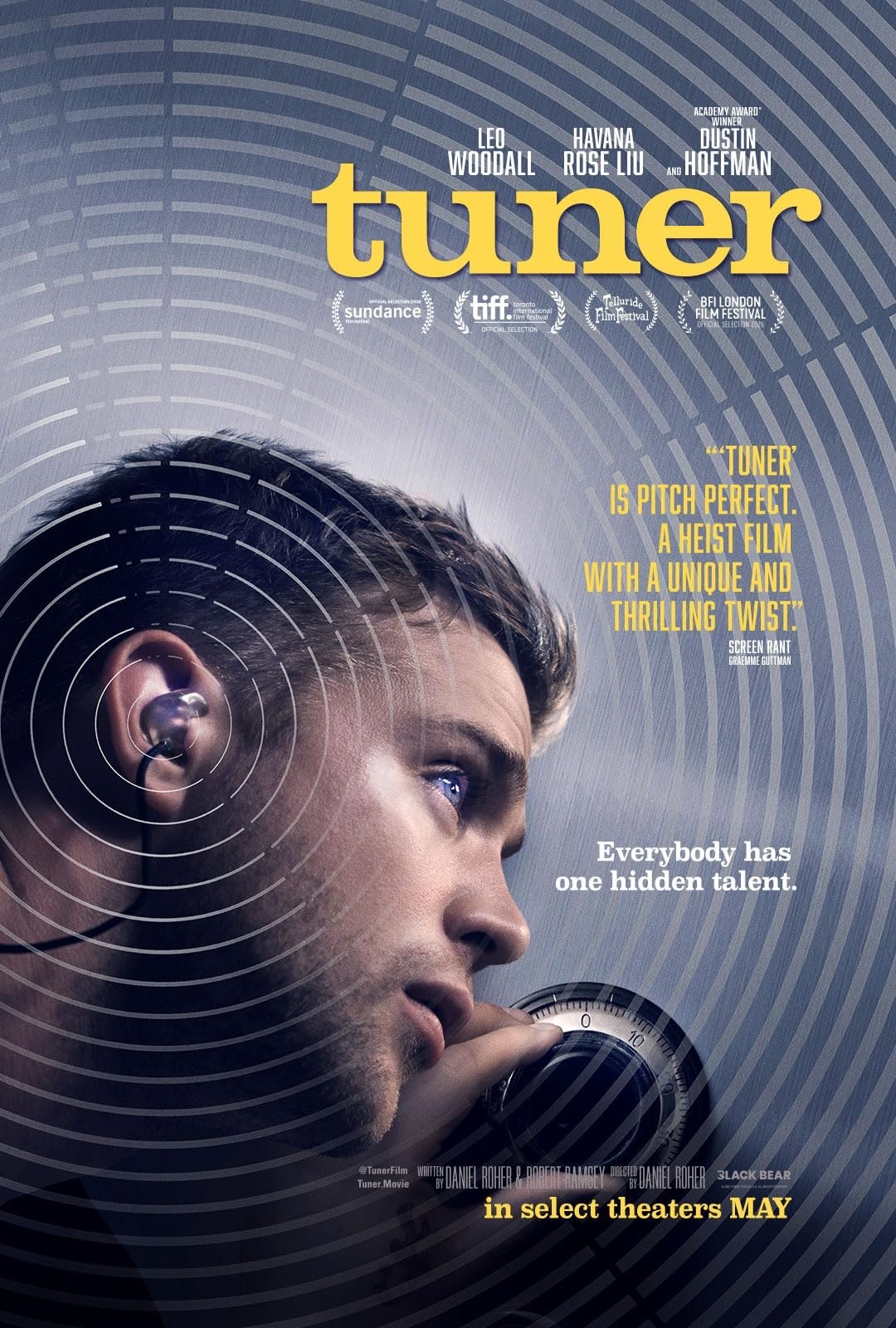


Daniel Roher’s Tuner begins in a register so restrained it nearly disappears into itself. It is a film about listening, about waiting, about measuring risk one sound at a time. For long stretches, it carries the intensity of a silent drama. Then, without warning, it erupts. A gunshot. An air horn. A criminal scheme spiraling out of control. A confrontation fueled by grief. The contrast gives Tuner much of its peculiar energy.

This is, if it isn’t clear already, a somewhat strange creature of a film, balancing an armload of genres: a New York romance, briefly a buddy movie with Dustin Hoffman, a heist picture, and a drama about pained artistry. The remarkable thing is that it never feels awkwardly assembled. That it remains vibrant and breezy is a credit to Leo Woodall’s grounded charisma, the chemistry he finds with Havana Rose Liu and Hoffman, and Roher’s punchiness behind the camera.

Roher approaches the material with a pleasing photographic eye, strong sound design, and a colorful editing style that lifts genre elements that have grown stale in the streaming era. Every sequence involving Niki’s relationship to sound feels especially considered. The audience becomes aware of noises that most people ignore. Conversations become obstacles. Ordinary spaces become threatening. The film’s best moments emerge from this sensory perspective.

Tuner gets a lot of things right about hyperacusis. Niki’s ears ring, at least sometimes. He constantly scans his surroundings for hazardous sounds. He struggles to function amid background noise. He finds himself repeatedly explaining his condition because nobody around him fully understands it. These details carry the weight of observed reality rather than dramatic invention. It is obvious that Roher and his collaborators consulted people who understand the condition.

The film becomes less convincing when it explores the severity of hyperacusis and the ease of reinjury. Hyperacusis exists along a continuum, but even relatively mild cases can feel devastating. Some sufferers improve through time, caution, and gradual exposure. Yet recovery remains fragile. One serious noise insult can erase years of progress. Tuner occasionally acknowledges this reality, then bends it whenever the plot requires Niki to keep moving.

That compromise becomes most visible once Niki is pulled into criminal activity. He encounters two of the most frightening experiences imaginable for someone with hyperacusis: surprise noise and weaponized noise. There is a barking dog. There is an air horn. There is a gunshot. Niki winces, recoils, and clutches his ears. Then he recovers quickly enough for the story to continue. In reality, those incidents could permanently worsen his condition and leave him severely incapacitated. The film asks viewers to accept a considerable amount of poetic license.

To be fair, making an entertaining movie about a hero with hyperacusis seems nearly impossible without bending reality. A strictly realistic version might involve a man spending much of his life avoiding sound and recovering from setbacks. That film would likely be admirable and exceptionally difficult to watch. Tuner finds a workable middle ground. It sacrifices precision for momentum, yet never loses respect for the disability at its center.

The screenplay occasionally invites an obvious comparison. You can call it a piano man’s Good Will Hunting. Instead of a mathematical prodigy hidden inside a janitor, here we get a secret musical virtuoso concealed within a piano tuner and gifted safecracker. A derivative setup should not work this well. Several developments are predictable. Several emotional beats arrive exactly when expected. Yet Woodall’s performance provides enough emotional texture to make those moments land anyway.

Woodall’s turn in Tuner, which he anchors with remarkable confidence, makes a compelling argument that he is one of Hollywood’s most promising rising stars. Not in the vein of a young Matt Damon. A different comparison comes to mind. There is a quality to Woodall’s screen presence that recalls Brad Pitt. Not the glamour, not the movie-star mystique, but the ability to make stillness feel active.

Woodall does not rely on a chiseled image or overwhelming magnetism. Instead, he possesses a constant, subtle charm expressed through small facial adjustments, attentive reactions, and carefully calibrated body language. He understands that Niki spends much of the film absorbing information rather than delivering speeches.
Woodall, in other words, is magnetic when he simply listens.

That gift serves him especially well opposite Havana Rose Liu, whose Ruthie avoids becoming merely an inspirational love interest. Their relationship develops through artistic friction, mutual admiration, and occasional resentment. The scenes work because both performers recognize the insecurity hiding beneath their confidence.

Dustin Hoffman provides warmth without overwhelming the film. His presence gives the early sections emotional grounding, making later developments resonate more strongly. Even when Roher pushes the story toward larger dramatic gestures, the emotional foundation remains sturdy because the relationships feel lived-in.

The biggest weakness is that Tuner occasionally wants to have everything at once. It wants crime-thriller suspense, romance, disability drama, artistic yearning, redemption, and crowd-pleasing uplift. Most of the time Roher juggles those elements successfully. A few transitions feel abrupt. A few revelations arrive too neatly. The final stretch leans heavily on emotional satisfaction rather than strict plausibility.

Still, the film’s strengths outweigh its shortcomings. Roher understands how to move a story. Woodall proves capable of carrying one. The hyperacusis material remains thoughtful even when it sacrifices realism. The romance works. The heist material entertains. The artistic themes retain genuine feeling.

Tuner never fully resolves the tension between authenticity and audience appeal. Yet that tension also makes it memorable. It spends much of its running time listening carefully to the world, then occasionally decides to shout. More often than not, those sudden bursts of volume hit their mark.

Grade: B+. Paramount Plus.


Leave a Reply