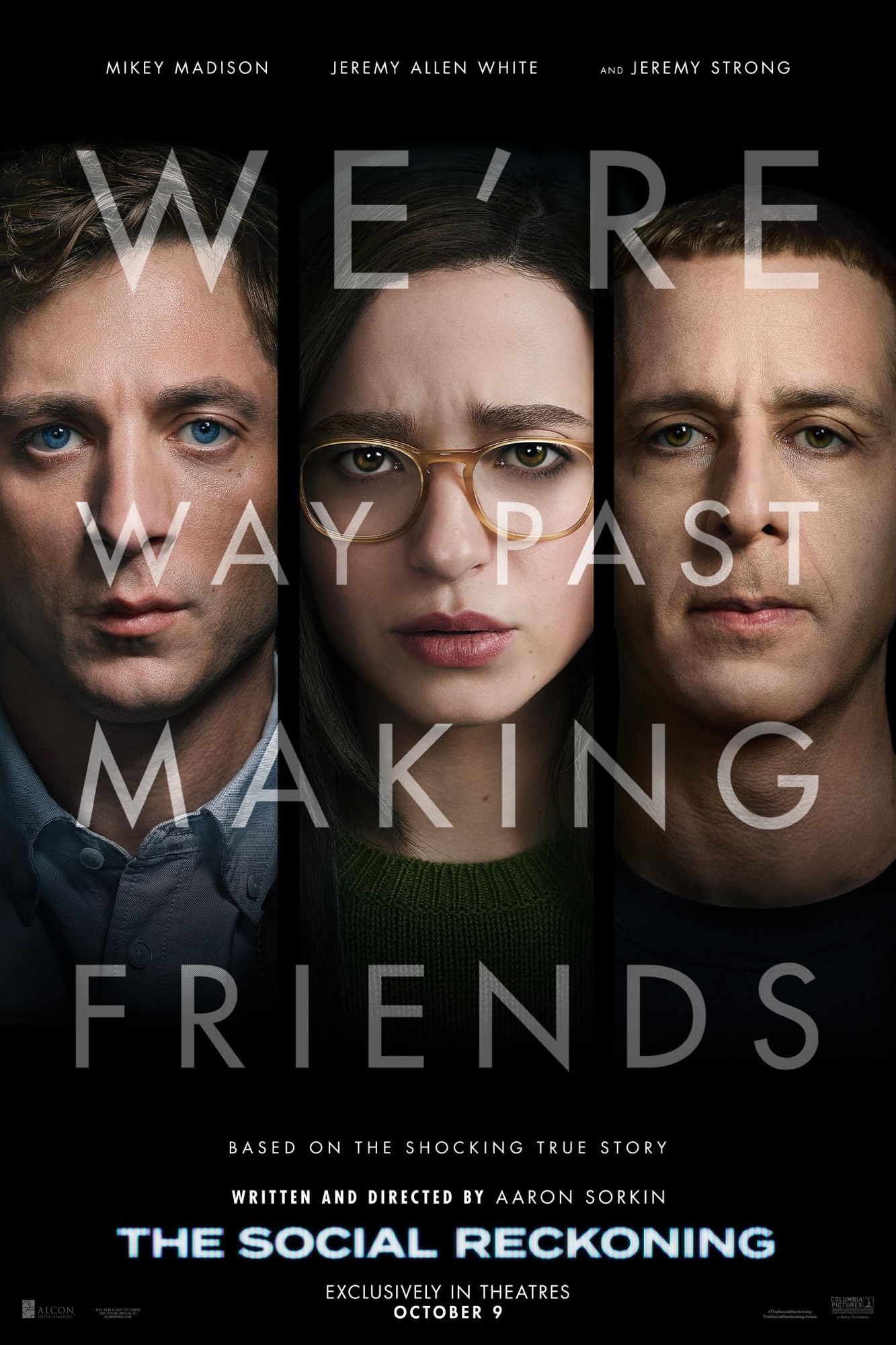


Aaron Sorkin’s The Social Reckoning arrives with the weight of its predecessor and the painful legacy of the events it revisits. Rather than returning to Facebook’s intoxicating rise, Sorkin focuses on the harm left in its wake: weakened civic trust, algorithmic manipulation, and a corporate culture that seemed to regard public suffering as a manageable business expense. The film’s indignation is understandable, and its alarm feels sincere. At times, though, it struggles to turn documented outrage into a moving drama. Even so, it remains an slightly less engaging and worthwhile follow-up to The Social Network, if not an essential one.

Much of The Social Reckoning’s momentum comes from Jeremy Allen White’s performance as Wall Street Journal reporter Jeff Horwitz. White recognizes that righteous anger can be most powerful when held in check. He brings a steady, dogged persistence to the investigative scenes, carrying the story through mountains of research, confidential meetings, and corporate evasions. Sorkin’s screenplay sometimes asks Horwitz to serve mainly as a vehicle for exposition, but White brings warmth and subtle texture to the role. His performance gives Horwitz a welcome sense of humanity, especially as the script grapples with its broader political concerns.

Sorkin’s sharpest observations come through in the film’s compassionate portrayal of institutional self-preservation. Its most unsettling scenes unfold not through explosive revelations, but in meetings and presentations where people acknowledge problems and harms before retreating behind metrics and growth targets. The film recognizes how systems can encourage indifference, shifting attention away from individual blame and toward the pressures and incentives that shape decisions. This perspective gives *The Social Reckoning* a timely urgency, especially as it explores the widening gap between what powerful companies know and what the public is allowed to know. At times, however, Sorkin leans on familiar moral certainties, simplifying questions that might benefit from greater complexity.

Mikey Madison’s Frances Haugen serves as the film’s emotional and ethical center. Her performance is quietly affecting, capturing the deep fatigue of someone caught between loyalty to her colleagues and a sense of responsibility to the public. The film is most compelling when it follows her gradual realization that meaningful change from within may not be possible. Jeremy Strong’s Mark Zuckerberg hangs over the story more as a symbol than a fully developed character—a choice that is both effective and limiting. Strong gives a careful, nuanced performance, though the film rarely ventures beyond its early thesis, leaving some of its dramatic possibilities unexplored.

The central frustration with The Social Reckoning is that its conclusions can feel settled before the story has had room to breathe. Sorkin’s determination to sound the alarm sometimes leaves little space for ambiguity, making the film’s dramatic mechanics more visible than they might otherwise be. Still, there is real value in its reporting-minded approach and its belief that technology companies should be held accountable for the consequences of their decisions. Though it may not have the electrifying precision of The Social Network, it remains a thoughtful and provocative work of mainstream political filmmaking. It raises difficult questions, delivers several powerful moments, and leaves us with a sobering sense that the institutions shaping modern life still receive far too little scrutiny.

Grade: B.


Leave a Reply