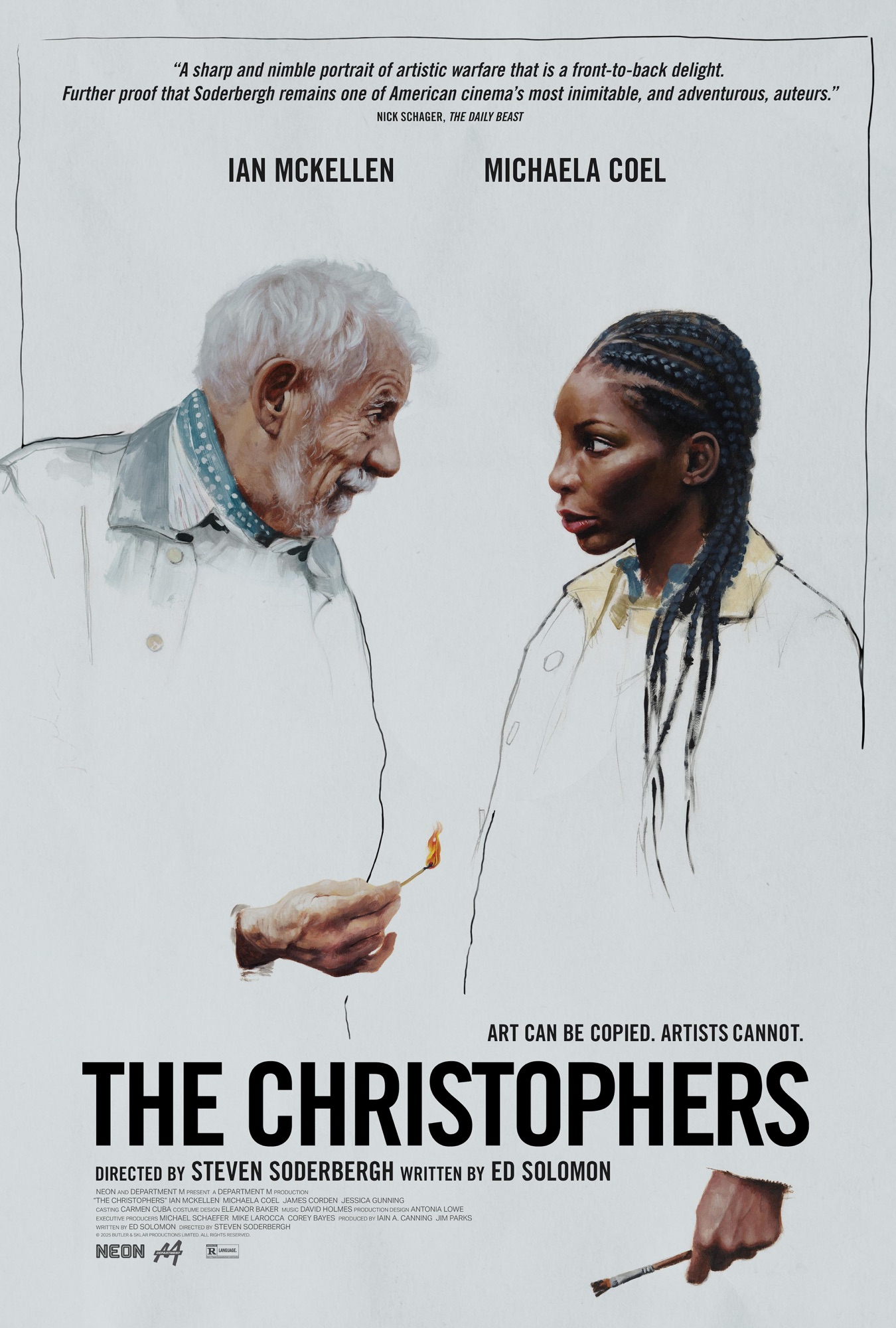


The strongest truth in The Christophers is that Stephen Soderbergh refuses to treat painting as a sanctuary. He treats it as a pressure chamber. His film moves with a painter’s hand—slow strokes, sudden ruptures, a surface that reveals its depth only when you lean in. Ian McKellen’s Julian Sklar stands at the center of this chamber, a figure whose late-life bravado masks a lifetime of bruised

Julian’s rowhouses, filled with decades of cherished mementos, serve as the film’s poignant installation. Soderbergh captures the space with a gentle reverence that avoids nostalgia, allowing each object to convey the echoes of past successes and sacrifices. When Lori Butler enters this world, Michaela Coel brings a keen intelligence that enriches every exchange. Their early conversations, often tense beneath a veneer of banter, reveal the underlying tensions between generations of artists — one captivated by fame’s allure, the other navigating the hardships of gig work and survival. The film’s visually expressive tone emerges from these encounters, each scene a complex tapestry woven with ego, fear, and hesitant admiration.

The forging scheme that drives the story acts as a lens through which Soderbergh explores the economics of legacy. Lori’s technical skill is never dismissed as simple plot device; it serves as a critique. Her ability to duplicate Julian’s work forces him to face the uncomfortable truth that artistic value is not innate but fabricated. The film’s most compelling moments occur when Julian and Lori start analyzing each other’s choices—brushwork, palette, compositional risks. Their debates are not trivial; they are the film’s heartbeat, showing how artists evaluate themselves against their own histories and the people who challenge them.

Soderbergh’s direction shines especially in these moments of tension, allowing McKellen to portray Julian’s complex contradictions with nuance: the arrogance that masks his underlying insecurity, the cruelty that conceals his deep need for validation, and the wit that helps him cope with despair. Coel responds with equal depth. Her performance is rooted in the tangible realities of creating art—the cramped studio, the exhaustion from restoration work, the quiet humbling of answering a business phone while standing in a food truck apron. Her presence transforms the film into a heartfelt dialogue about the sacrifices and resilience involved in artistic pursuit in a world that often values spectacle over genuine craft.

The film’s painterly tone deepens as Julian chooses to destroy the unfinished Christophers. Soderbergh presents this scene as a contemplative reflection on artistic resistance. The act is not driven by spectacle but by weariness. Lori’s decision to refrain from destroying the works becomes a pivotal moment, highlighting her belief that even imperfect creations merit a final acknowledgment. When Julian finally re-engages with the canvases, adorning them with glitter, feathers, and expressive ornamentation, the scene is not meant to be humorous but rather a powerful statement that art can be liberated from commercial constraints through intentional ugliness and deliberate choices that resist monetization.

The rupture between Julian and Lori that follows marks one of the film’s most emotionally impactful moments. Julian’s criticism of her work—delivered with the precision of someone aware of exactly where to wound—lays bare the vulnerability hidden beneath her polished exterior. Soderbergh chooses not to soften the blow, instead allowing the silence and distance to speak for themselves. This approach invites the audience to genuinely feel the pain of artistic judgment and how it can deeply affect a person’s life.

Julian’s death comes quietly, without added drama, and Soderbergh presents it as a tender, unfinished gesture. The paintbrush in his hand is not symbolic; it reflects the honest truth of a man who worked tirelessly until his body could no longer continue. Lori’s choice to complete the Christophers in Julian’s original, uncommercial style is the film’s most compassionate act. She transforms forgery into a heartfelt homage, turning commerce into a quiet act of rebellion. Her final installation—merging Julian’s Cameo videos into a single, contemporary piece—serves as a touching portrait of an artist whose legacy is fragile, humane, and strangely radiant.

The museum sequence that concludes the film is a poignant expression of tone. The Christophers, now lacking commercial appeal, radiate a quiet, authentic vitality. They are no longer mere objects; they have become powerful statements. Lori’s presence in the gallery is gentle, steady, and well-earned. Julian’s unfinished self-portrait, signed “for Lori,” arrives like a heartfelt blessing. It is the film’s final touch—a tender gesture that recognizes how artists profoundly influence each other’s lives through critique, conflict, and the courage to persevere.

Soderbergh has created a film that thoughtfully captures the harsh realities of the art world’s brutal economics while remaining compassionate and human. The Christophers is radiant, insightful, and profoundly moving—a heartfelt exploration of two artists committed to valuing their work beyond market forces. It stands as one of his most compassionate and meaningful achievements.

Letter Grade: A=. Hulu.


Leave a Reply