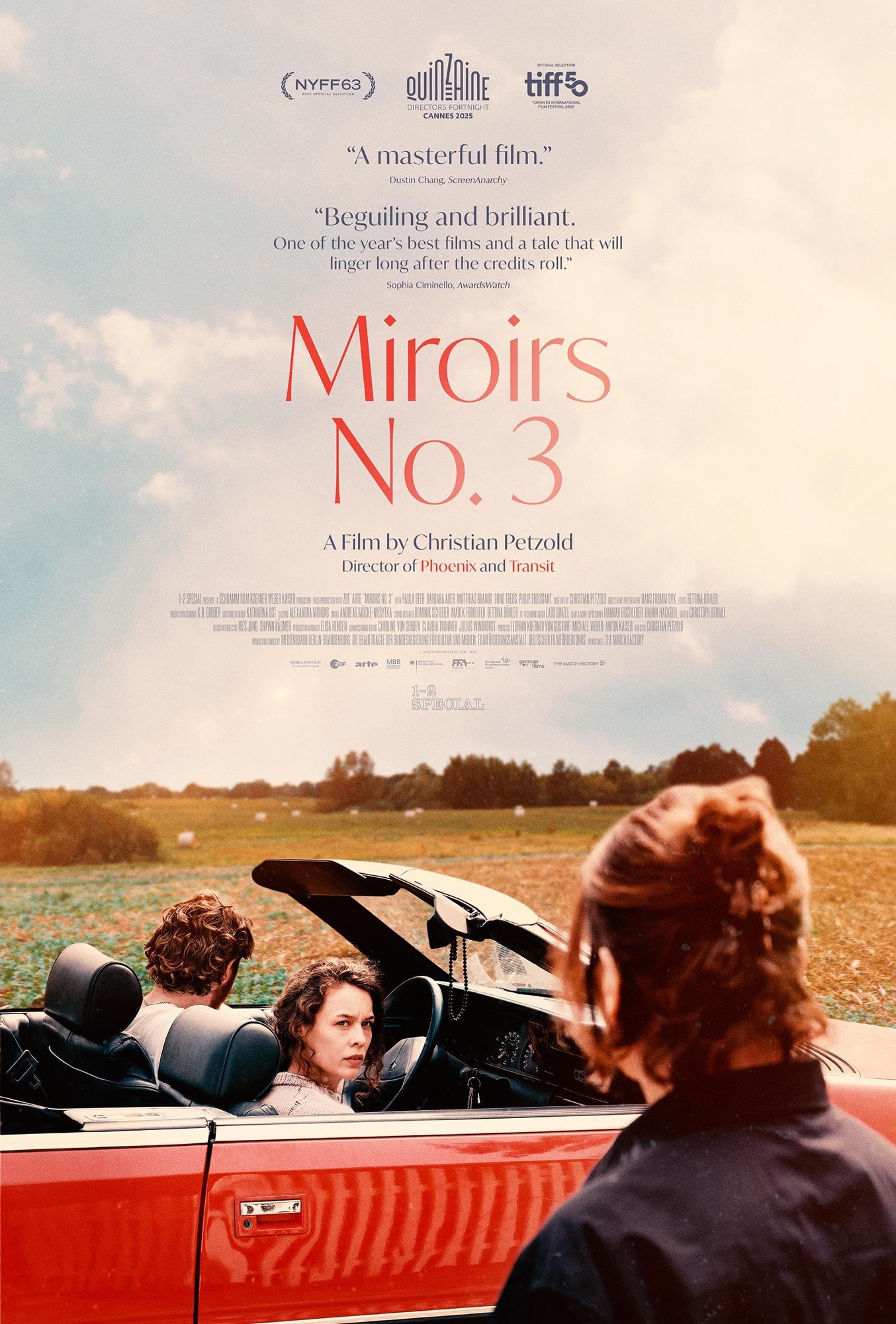


A subtle yet pervasive sense of gentle affirmation washes over Miroirs No. 3, Christian Petzold’s newest exploration of doubled identities and the delicate boundary between care and control. The film opens abruptly with an accident, catching viewers off guard before introductions are made. The sudden shock resonates deeply, amplified by the surrounding rural silence that intensifies the disturbance. Petzold masterfully uses this rupture to craft an emotional landscape where serenity and violence coexist, constantly intertwined without ever fully resolving.

The red convertible at the scene subtly stirs a cinephile’s curiosity. It evokes the cherry-hued car that once zipped through Godard’s Contempt, and Petzold weaves that echo with quiet restraint. The reference never feels like a mere tease; instead, it deepens the film’s exploration of doubled realities—an enduring motif in his work. Even the casting reinforces this sense of duplication, with Paula Beer’s presence reminiscent of Nina Hoss, a familiar collaborator. The film’s universe feels alive with reflections and echoes rather than straightforward originals.

Petzold’s admiration for Vertigo shines through unmistakably. He describes the Hitchcock masterpiece as a constant presence in his imagination, and this influence is deeply woven into the structure of Miroirs No. 3. Laura Beer’s performance stands at the heart of the film. Her restrained demeanor in the early scenes creates an almost hypnotic suspended atmosphere, making it feel as if she’s drifting through a world just slightly out of sync. The moment she awakens in Betty’s cottage after a long sleep is charged with a subtle, yet powerful shift in her presence. Petzold masterfully uses this awakening to delve into how trauma can heighten perception, illuminating rather than dulling the senses.

Betty’s cottage, vibrant and meticulously maintained, transforms into a backdrop of emotional tension. Petzold artfully sidesteps sentimentality, rendering the scenes calm and authentic without slipping into softness. The cottage’s inviting warmth masks an underlying pressure. Laura’s borrowed clothes, her makeshift room, and her borrowed sense of belonging all contribute to a subtle, persistent unease. The film’s melancholy arises less from a single revelation and more from this cumulative weight. Petzold’s steadfast control over tone ensures the narrative remains compelling, refusing to overstate the emotional stakes, which only deepens the viewer’s engagement.

The mechanics—Richard and Max—introduce an extra layer of tension. Their terse exchanges and quiet demeanor create a fog around Laura, which Petzold masterfully uses to craft a slow-burning, compelling mystery. The film avoids rushing to explain everything, instead allowing fragmented glimpses of the past to influence the present subtly and thoughtfully. This restraint is a hallmark of Petzold’s style. The lingering unease feels natural and pervasive, captivating the audience without forcing a single interpretation.

When Laura starts to play the piano, the film’s emotional core comes alive. The music, deeply connected to Betty’s daughter, fills the cabin with a haunting presence of absence. Petzold delicately navigates this double meaning, steering clear of melodrama and instead highlighting how Betty’s grief transforms Laura’s role within the family. Here, the film’s sorrow deepens—not through grand spectacle, but through a poignant acknowledgment of how we reshape others to fill our emptiness. Laura’s playing becomes a powerful bridge between past and present, a gesture that both offers comfort and unsettling truth.

The cinematic references—Ravel, Godard, Hitchcock—never overpower the film’s emotional core. Petzold weaves them subtly like gentle currents rather than glaring signals. They add richness without turning the story into a puzzle. This delicate balance is key; while Petzold sometimes risks overemphasizing the theme of replacement, he mostly keeps it in check. The true emotional depth shines through Laura’s slow realization of her place in Betty’s world and the heartbreaking acceptance that her presence has been shaped by someone else’s grief.

The confrontation with Max, where he sharply rejects Laura’s unintentional role as a stand-in for his sister, stands out as one of the film’s most gripping moments. Petzold presents it simply and without theatrical flair. His brief but intense reaction shakes the fragile balance of the cottage, making Laura’s subsequent departure feel almost inevitable. Rather than portraying her exit as a dramatic upheaval, the film depicts it as a vital step for her to reclaim her true identity, free from the misplaced projections that have been cast upon her.

The final act, centering on Laura’s audition, stands out as one of Petzold’s most compelling recent sequences. Her performance is sharp, controlled, and quietly heartbreaking. Betty’s presence in the audience adds a layer of complexity without disrupting the moment. Laura’s subtle recognition at the end carries a gentle, poignant weight. Petzold ends the film on a subdued, reflective note of reconciliation—neither triumphant nor despairing. The film leaves a lasting impression through its textures and echoes, showcasing a careful exploration of how people occupy the spaces left behind by others.

Miroirs No. 3 may not stand as one of Petzold’s grandest achievements, but it emerges as a beautifully crafted and emotionally compelling piece. Its sadness is steady and poignant without overwhelming, its lyricism subtle yet powerful, and its craftsmanship impeccable. The film leaves a lasting impression by embracing quietness, trusting the viewer’s intuition, and allowing its emotional depths to unfold naturally and unapologetically.

Letter Grade: B+. On Mubi.


Leave a Reply