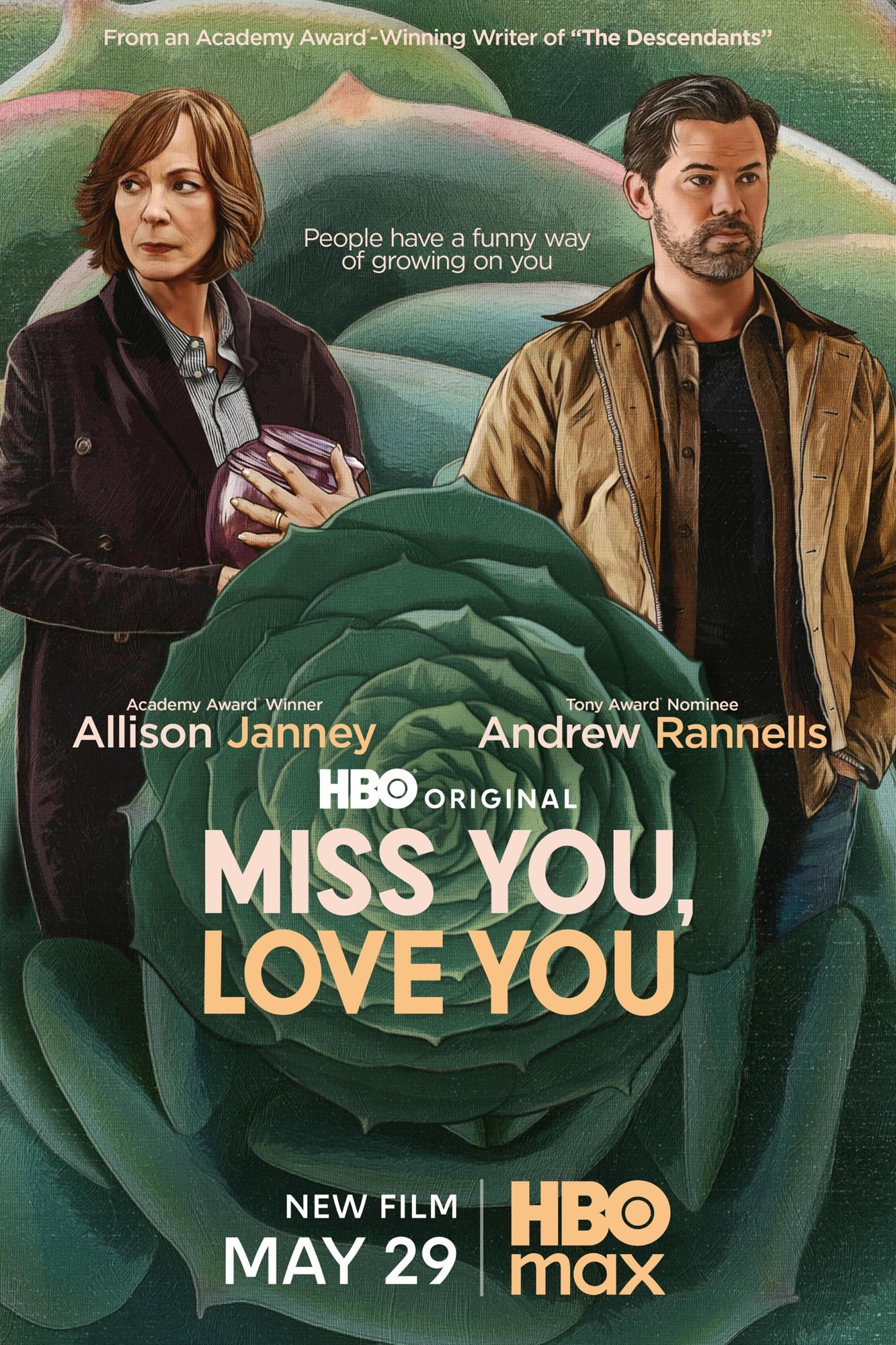


In Love You, Miss You, grief enters the film as a force that refuses containment, and Allison Janney meets it with a performance that keeps widening the frame. Her Diane storms through the early passages with a volatility that feels earned, even when the script strains to justify the speed of her turns. The film depends on that volatility, and Janney gives it a pulse that keeps the material from collapsing under its own heaviness.

Jim Rash directs with an intimacy that exposes both the strengths and the limits of his stage‑born structure. Long takes hold Diane in place, letting her mourning settle into the corners of the room, yet the theatrical roots show in the dialogue’s tendency toward explanation. The tension between cinematic quiet and theatrical declaration becomes the film’s central friction, and it produces moments of genuine emotional pressure.

The arrival of Jamie, played with steady restraint by Andrew Rannells, introduces a counterweight that the film needs. Their scenes together often hinge on confession and recoil, and while the writing leans too hard on rupture‑repair cycles, the performances carve out a more complicated emotional terrain. The film’s best stretches emerge when Rash allows silence to do the work that exposition cannot.

Some sequences push toward camp, and the film seems aware of this without fully embracing it. Diane’s furious completion of her late husband’s painting teeters on the edge of absurdity, yet Janney’s commitment turns the moment into a portrait of grief’s wild improvisations. The film benefits from these tonal risks, even when they threaten to unbalance the narrative.

Bonnie Hunt’s Judith enters as a burst of unguarded optimism, and her presence exposes the film’s ambivalence about hope. Judith’s warmth unsettles Diane more than it comforts her, and the film uses that discomfort to question the usefulness of forced uplift. Rash’s direction sharpens here, letting the clash of temperaments reveal the emotional stakes more clearly than the dialogue does.

The script’s reliance on symbolic gestures—plants that wilt, paintings that demand completion—can feel too deliberate, yet the actors keep grounding these choices in lived emotion. The plant becomes less a metaphor than a measure of Diane’s capacity to care for anything at all. The film’s imagery works best when it stays tethered to character rather than theme.

Rash’s background in comedy surfaces in unexpected places, offering relief without undercutting the seriousness of Diane’s grief. A few scenes flirt with broadness, but the film never abandons its central emotional inquiry. Instead, it uses humor to expose the absurdity that often shadows mourning.

The New Mexico setting gives the story a sense of isolation that suits Diane’s emotional state. Rash resists postcard beauty, favoring interiors where grief can echo. The result is a film that feels contained yet unsettled, a chamber piece that keeps letting in drafts.

The film’s flaws—expository dialogue, predictable emotional beats, a few overdetermined symbols—never fully eclipse its strengths. Janney’s performance anchors everything, and the supporting cast builds a world that feels bruised but not broken. The film earns its tenderness through abrasion.

Miss You, Love You becomes a study in emotional endurance rather than emotional revelation. It may not transcend its theatrical origins, but it finds a steady rhythm in the interplay of anger, regret, and reluctant connection. The film leaves a lingering ache, and that ache feels honest.

Letter Grade: B+ . HBO MAX.


Leave a Reply