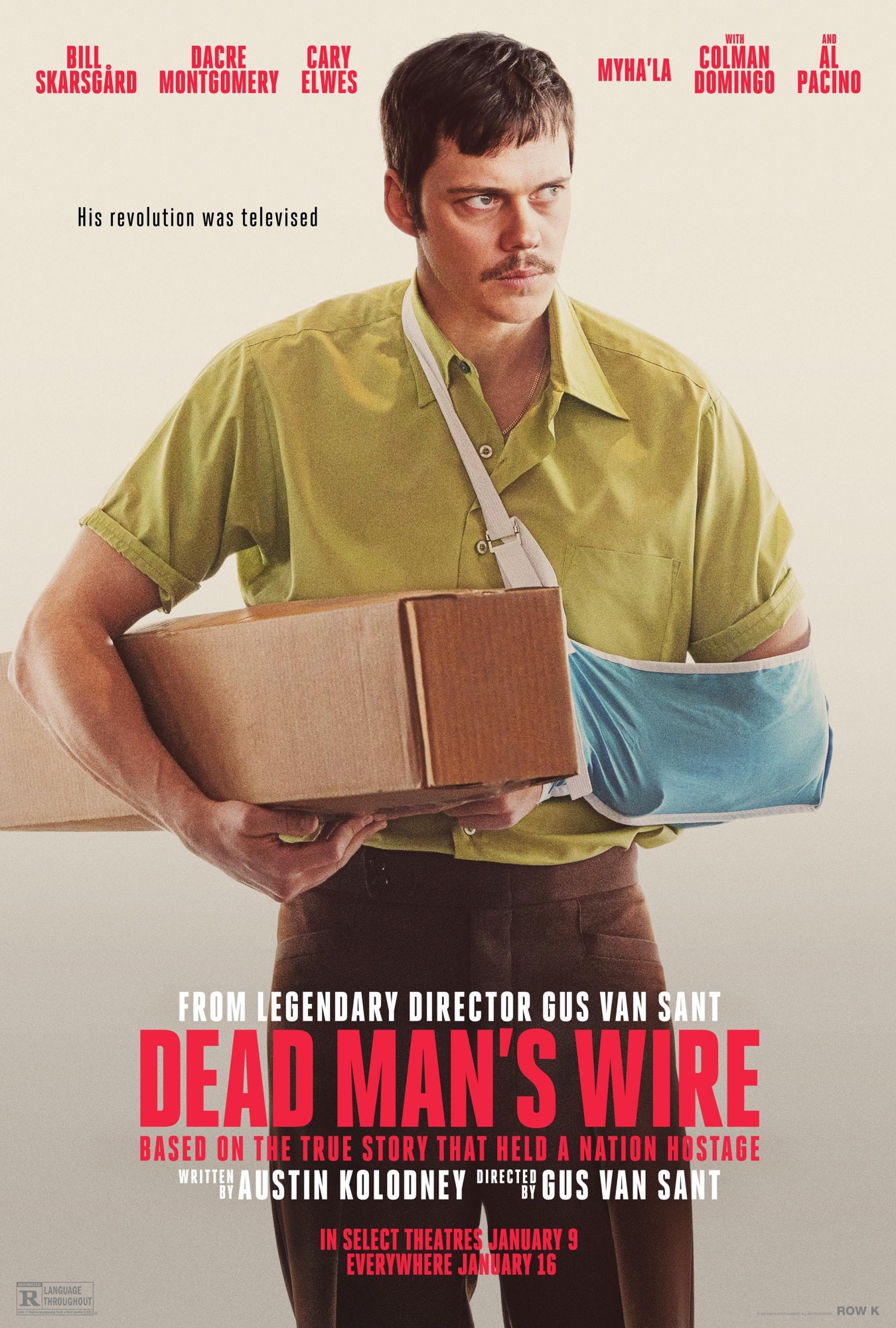


Gus Van Sant turns the Kiritsis standoff into a pressure study in public harm and private grievance, and Dead Man’s Wire carries a charge that never dissipates. The film opens on the blunt fact of Tony Kiritsis (Bill Skarsgård) walking into Meridian Mortgage and discovering that the man who wronged him has fled to vacation. From that moment, the movie commits to the tension between personal desperation and the machinery that feeds on it. Van Sant refuses to sentimentalize Tony’s rage, yet he refuses to trivialize it. The film’s first movement establishes the stakes: a man cornered by a system that insists it has done nothing wrong.

Skarsgård gives Tony a volatile, wounded intelligence that keeps the film’s moral field unsettled. His performance is a study in pressure—every gesture edged with the knowledge that he has been dismissed one time too many. The hostage setup becomes more than a plot device; it becomes the film’s argument about who gets heard and who gets crushed. Van Sant uses the booby‑trapped shotgun rig not as spectacle but as a structural hinge, a way to expose the asymmetry between a man with nothing left and a family whose wealth insulates them from consequence.

The apartment sequence deepens the film’s critique. Tony wires the doors with explosives, anchors Richard Hall (Dacre Montgomery) to the kitchen table, and forces the world to look at what it prefers to ignore. Montgomery plays Richard with a steady dread that never collapses into caricature. His fear is not only of Tony but of the father who refuses to acknowledge any wrongdoing. The film’s tension sharpens here: the hostage is endangered by both the man holding the gun and the man who believes he is above apology.

Colman Domingo’s Fred Temple becomes the film’s unexpected conscience. His radio calls with Tony give the standoff a strange intimacy, a public confession broadcast to a city that cannot decide whether to condemn or understand. Domingo grounds the film’s media critique: the airwaves become a battleground where truth, performance, and desperation collide. Myha’la’s Linda Page enters as a young reporter hungry for a story, yet her presence reveals how the media apparatus metabolizes suffering into opportunity. Van Sant threads these perspectives without moralizing, letting the contradictions accumulate.

Al Pacino’s M.L. Hall appears only briefly, yet his scenes carry the film’s coldest weight. His refusal to apologize, even when his son’s life hangs in the balance, exposes the rot at the center of the American business myth. Pacino plays him with a clipped, imperious disdain that makes Tony’s fury legible. The film’s class politics sharpen here: the hostage crisis becomes a referendum on who is allowed to demand justice and who is expected to swallow humiliation.

The Wednesday escalation—FBI involvement, the failed phone call, the summoning of Tony’s brother Jimmy—pushes the film into a darker register. Van Sant keeps the camera close, letting the emotional stakes eclipse procedural detail. The film critiques the state’s instinct to manage, contain, and neutralize rather than understand. Jimmy’s presence briefly humanizes Tony, yet it also underscores the isolation that drove him to this point. The film never excuses Tony’s violence, but it refuses to pretend it emerged from nowhere.

The Thursday press conference is the film’s most electric sequence. Tony steps into the glare of national attention, believing he has forced the world to acknowledge his grievance. Van Sant stages the moment with a brutal clarity: the documents, the cameras, the trembling hostage, the man who believes he has finally bent the system to his will. The film’s critique lands hardest here. Tony thinks he has won. The audience knows he has only been momentarily indulged.

Tony’s arrest, Richard’s release, and the shotgun fired into the air form a triptych of disillusionment. The film refuses triumph. It refuses catharsis. It shows a man who demanded accountability and received only a brief performance of it. The aftermath—trial, insanity verdict, public ambivalence—extends the film’s argument: the system absorbs disruption, punishes the disruptor, and continues unchanged.

The epilogue, with Tony and Richard crossing paths years later in a bakery, is the film’s quietest blow. No reconciliation, no confrontation, only two men carrying the residue of an event that reshaped their lives. Van Sant ends on the knowledge that harm lingers long after the world stops paying attention. The film’s final text—Tony’s institutionalization, Richard’s alcoholism, the company’s bankruptcy—renders the whole saga a ledger of unresolved debts.

Dead Man’s Wire is a jagged, morally charged work that refuses easy answers. Van Sant shapes the historical record into a meditation on grievance, power, and the hunger for acknowledgment. Skarsgård delivers one of his most volatile performances, and the ensemble sharpens the film’s critique without softening its edges. The film insists that harm demands reckoning, even when the world insists otherwise.

Letter Grade: A‑. On Netflix.


Leave a Reply