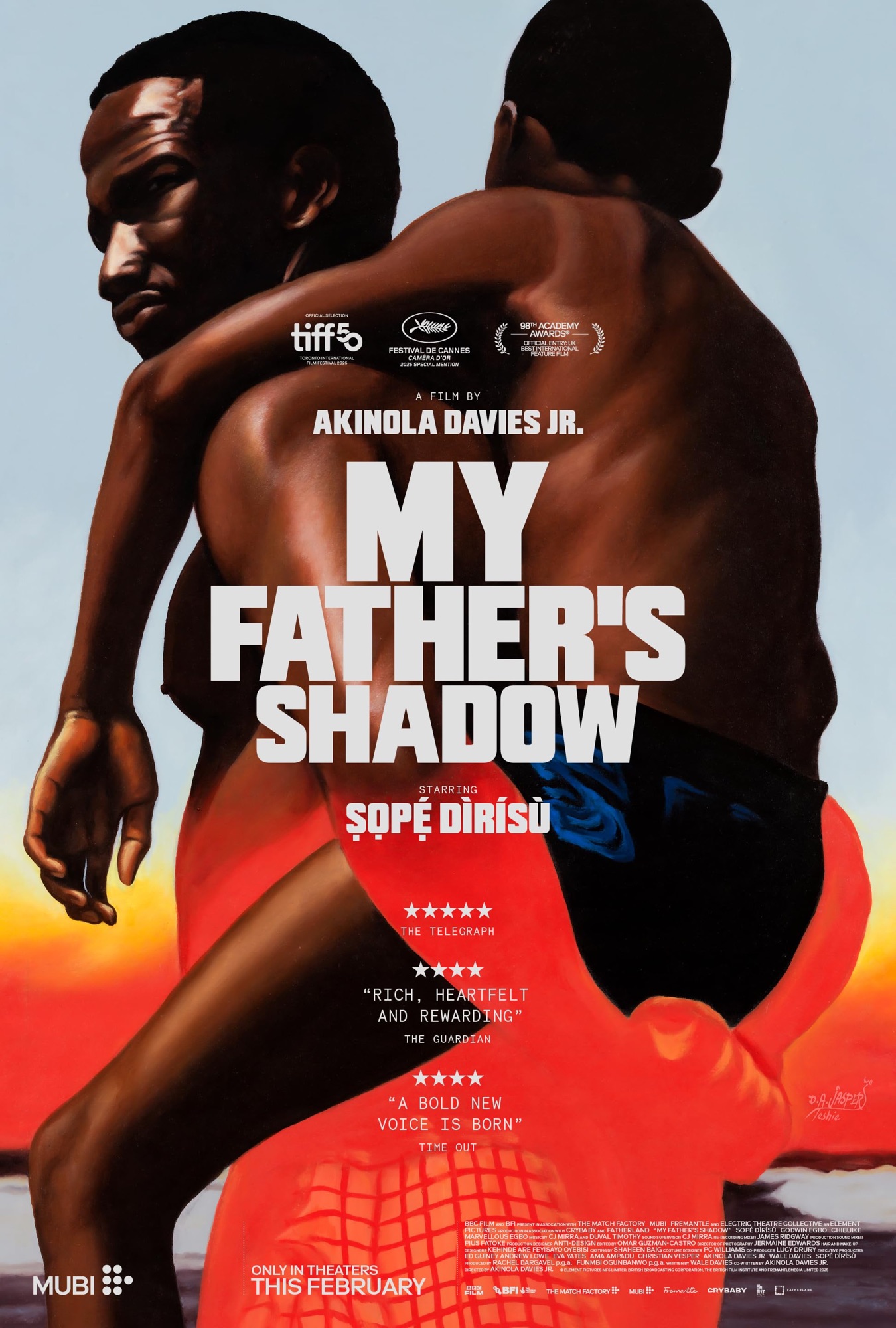


Akinola Davies Jr. builds My Father’s Shadow on the charge of remembered heat, the kind that never leaves the skin. The film opens on a morning that seems harmless, yet Davies threads a faint tremor beneath it, a signal that childhood can pivot without warning. This early quiet is not ornamental; it primes the viewer for the film’s central tension—how a single day can hold both tenderness and rupture without contradiction.

When Folarin (Sope Dirisu) announces his sudden trip to Lagos, the boys’ disappointment carries a muted ache, and Davies uses that ache to expose the emotional distance that has grown in the father’s long absences. The film does not linger on this gap for pity. Instead, it treats the distance as a living force that shapes every gesture between father and sons. Dirisu’s performance deepens this force; his presence radiates warmth and buried grief in equal measure, and the camera studies him with a reverence that never slips into sentiment.

The journey to Lagos becomes a corridor through which the film tests its own memory logic. The stalled minibus, the hitchhiking, the boys’ restless excitement—each moment is rendered with a child’s immediacy, yet Davies overlays that immediacy with the adult consciousness that remembers what danger feels like in retrospect. This duality gives the film its pulse. It is not nostalgia; it is the adult mind returning to a day that refuses to dim.

Once in the city, the boys witness the strain of their father’s life. His unpaid wages, his tense exchanges with colleagues, the military presence threading through the streets—these details are not plot machinery but emotional scaffolding. They reveal the weight Folarin carries, a weight the boys cannot name but instinctively sense. Davies uses these encounters to critique the political volatility of 1993 Nigeria without turning the film into a lecture. The politics remain embedded in the father’s body, in the way he watches soldiers, in the way his nose bleeds without warning.

The Lagos excursions—street food, amusement rides, the beach—are not diversions. They are the father’s attempt to reclaim something fragile before it slips from him. The boys’ joy is real, yet Davies keeps the frame alert to the father’s exhaustion. This tension gives the film its emotional torque. The day becomes a vessel for everything Folarin wants to give his sons and everything he fears he cannot.

The café sequence intensifies this torque. The televised announcement of the annulled election fractures the room, and Davies stages the chaos from the boys’ vantage point, where sound overwhelms and bodies blur. Yet he also threads in the adult knowledge of betrayal—political, personal, familial. Remi’s discovery of his father’s affair is not treated as melodrama. It becomes another shard of the father’s unknowability, another truth the adult Remi will carry long after the day ends.

The military checkpoint crystallizes the film’s dread. The soldier’s accusation, the father’s bleeding, the boys’ terror—Davies binds these elements into a single moment where the father’s past, the nation’s instability, and the children’s innocence collide. The scene is not spectacle; it is revelation. The father’s life contains shadows his sons will never fully understand, and the film honors that unknowability.

The beach conversation in the late afternoon is the film’s emotional summit. Davies shifts into an impressionistic register, letting the memory blur at its edges. Remi’s question about love and distance pierces the father, and Dirisu’s face holds the wound without theatrics. This moment is not a resolution. It is an opening, a recognition that love can wound and console in the same breath. The film earns this moment through its restraint, its refusal to flatten the father into a symbol.

The final movement, which acknowledges Folarin’s eventual death, does not seek closure. Instead, it affirms the film’s thesis: the memories that hurt most fiercely are the ones that return to steady us. Davies understands that childhood is not a sequence of events but a constellation of impressions—heat, fear, laughter, the weight of a father’s hand, the shock of seeing him as a flawed man. My Father’s Shadow captures that constellation with rare clarity.

Davies and cinematographer Jermaine Edwards craft an image-world that feels both intimate and haunted. The shifting eye-lines, the partial overheard conversations, the sudden bursts of color and sound—these choices create a sensory architecture that mirrors the instability of memory. The film’s lyricism never softens its political or emotional stakes. Instead, it sharpens them. My Father’s Shadow becomes a testament to the way a single day can echo across a lifetime, carrying both the warmth of a father’s presence and the sting of his absence.

Letter Grade: A‑. On Mubi.


Leave a Reply