
Roadside Attractions
,
Lionsgate Films

Roadside Attractions
,
Lionsgate Films
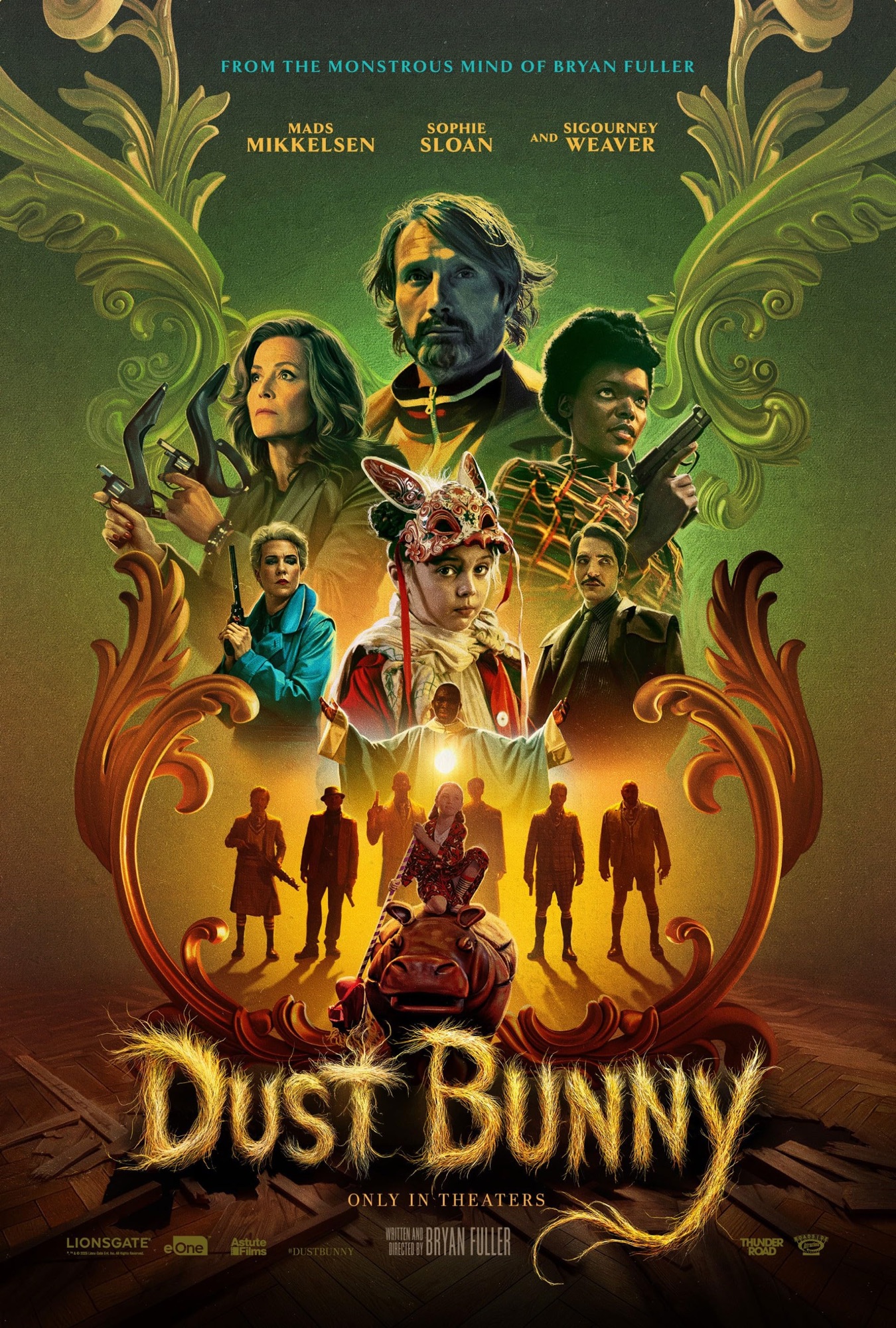
Bryan Fuller’s Dust Bunny opens with a child’s dread and a city’s ornate glow, and the film never stops tightening its grip on the tension between wonder and threat. The world he builds for Aurora is a gilded trap, a place where beauty carries an undertow, and the film’s early movements sharpen that contradiction with purpose. The Klimt‑touched apartment, the fire escape where she studies the night, the dragon‑dance gang in Chinatown that collapses under Resident 5B’s precision — each detail signals Fuller’s intent to fuse fairy‑tale logic with the mechanics of a hitman thriller. The fusion works because he treats Aurora’s fear as a real force, not a decorative flourish.

Roadside Attractions
,
Lionsgate Films
The film’s strongest current runs through the partnership between Aurora and Mads Mikkelsen’s Resident 5B, a man who moves through the world with a guarded stillness that suggests a lifetime of violence held in reserve. Fuller refuses to let their bond drift into sentiment. Instead, he shapes it through action, suspicion, and the slow recognition that both characters understand abandonment in different registers. When 5B dismisses the monster under the bed and insists her parents were collateral damage meant for him, the film gains a second layer: Aurora’s fantasy and 5B’s pragmatism grind against each other until they form a shared reality neither can fully control.

Roadside Attractions
,
Lionsgate Films
Fuller’s visual imagination remains the film’s most immediate pleasure. The Budapest locations, the Art Nouveau curves of Aurora’s building, the hen‑shaped lamp laying its glowing egg — these touches create a sealed world where danger feels ornamental until it erupts. Nicole Hirsch Whitaker’s cinematography deepens this effect, bathing the apartment in warm tones that turn cold at the edges, hinting at the monster’s presence long before it bursts through the floor. The film’s design team understands that fairy tales thrive on surfaces that deceive, and they commit to that principle with exuberance.

Roadside Attractions
,
Lionsgate Films
The Chinatown sequence, where Aurora witnesses 5B dismantle the dragon‑dance gang, becomes a hinge for the film’s tone. Fuller stages it with a child’s awe and an adult’s awareness of brutality, letting the moment hover between myth and fact. The ambiguity strengthens the film’s emotional stakes. Aurora believes she has found a champion, yet the scene also reveals the violence that shadows 5B’s life. The film’s later revelations — the assassins, the handler, the contracts — echo through this moment, turning it into a prophecy of the chaos to come.

Roadside Attractions
,
Lionsgate Films
Sigourney Weaver’s Laverne enters the story with a cultivated menace that enriches the film’s moral landscape. Her scenes with Mikkelsen crackle with a history that Fuller only hints at, and the eventual revelation of their relationship reframes the film’s power dynamics. Weaver plays Laverne with a controlled ferocity that never slips into caricature. Her final stand against the monster becomes one of the film’s most striking images, a confrontation staged with operatic calm rather than spectacle.

Roadside Attractions
,
Lionsgate Films
Sheila Atim’s Brenda adds another layer of tension, her shift from child‑protection agent to FBI presence tightening the film’s sense of surveillance. Fuller uses her character to question the narratives adults impose on children, and the film’s mid‑credits reveal grants her a wry resilience that fits the story’s tone. David Dastmalchian’s brief appearance as the Conspicuously Inconspicuous Man injects a twitchy unpredictability that suits the film’s escalating danger.

Roadside Attractions
,
Lionsgate Films
The climactic apartment siege demonstrates Fuller’s command of rhythm and chaos. The firefight, the converging assassins, the FBI intrusion, and the monster’s eruption from the floor all collide in a sequence that refuses to settle into a single genre. The giant bunny — absurd, terrifying, and strangely tender in its connection to Aurora — becomes the film’s emotional fulcrum. Fuller treats it not as a twist but as an inevitability, the physical manifestation of everything Aurora has carried alone.

Roadside Attractions
,
Lionsgate Films
The film’s final movement, with Aurora and 5B leaving the city and the monster’s shadow running beside their car, lands with a quiet conviction. Fuller suggests that survival does not erase fear but reshapes it into something companionable. The ending honors the film’s fairy‑tale roots without surrendering to neatness. Aurora’s command over the monster signals growth, yet the image of its shadow insists that childhood terror never fully disappears; it simply learns to travel with you.

Roadside Attractions
,
Lionsgate Films
Dust Bunny is not without excess. Fuller’s delight in ornament occasionally overwhelms the narrative’s emotional clarity, and some sequences lean too heavily on visual flourish. Yet the film’s commitment to its own strangeness, its refusal to flatten Aurora’s inner world, and its trust in Mikkelsen’s restrained performance give it a pulse that lingers. The film stands as a testament to Fuller’s belief in the elasticity of fantasy and the seriousness of childhood fear.

Roadside Attractions
,
Lionsgate Films
LETTER GRADE: B+. Streaming on HBOMAX.

Roadside Attractions
C,
Lionsgate Films55


Leave a Reply