

When I first saw Jean-Luc Godard’s Breathless, I felt cinema break apart in front of me. The jump cuts, the fractured rhythm, the refusal of illusion—it was all daring, all intellect, all style. Michel and Patricia were not people I could know; they were figures assembled from the memory of movies, noir gestures replayed with detachment. I admired the audacity, but I felt cold. Godard wanted me to reflect on cinema, not to be carried away by it.

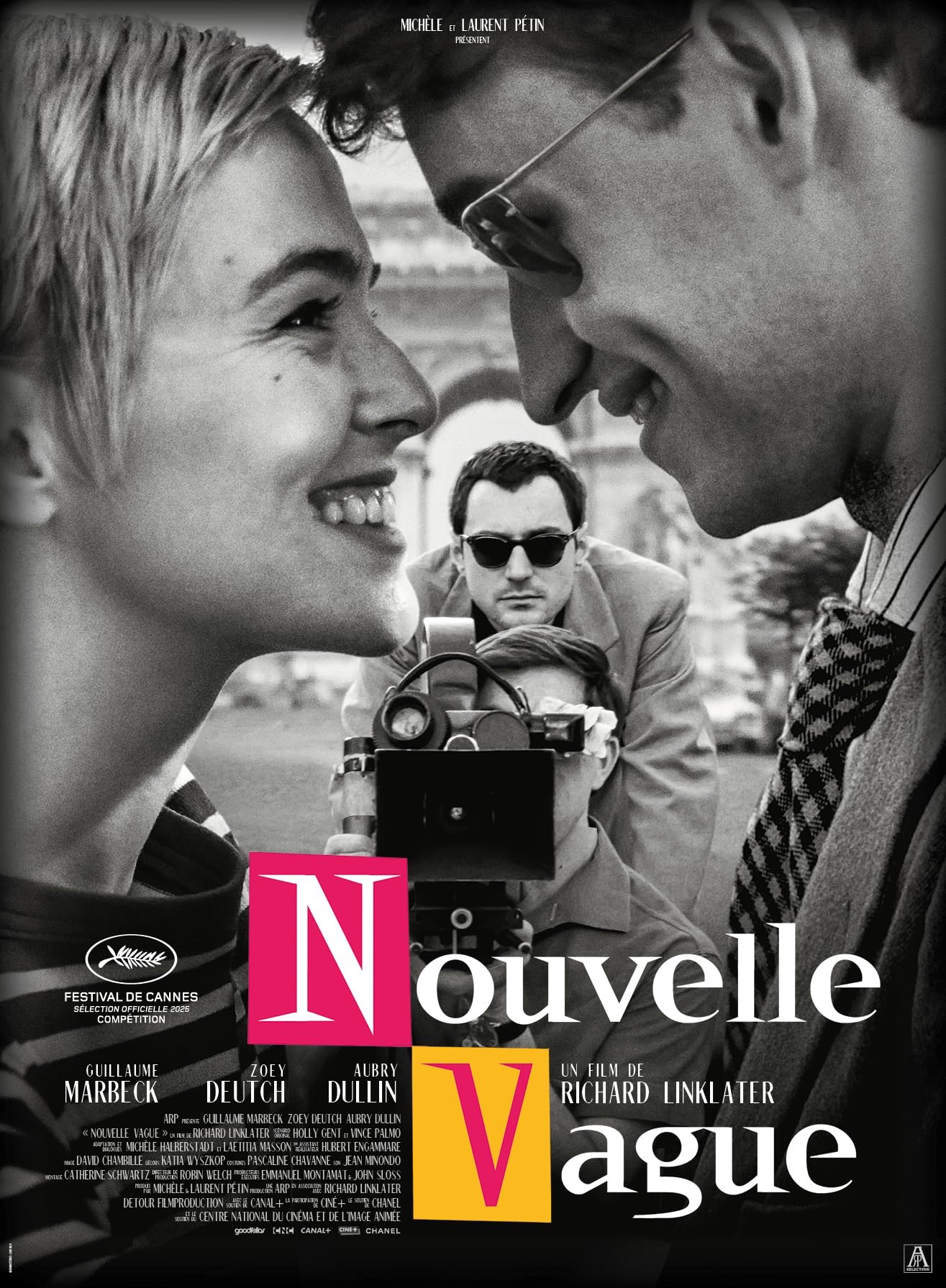
Years later, Richard Linklater’s Nouvelle Vague brought me back to that moment, but through a different lens. His dramatization of the making of Breathless is not a history lesson. It is a meditation on myth, on the French New Wave as an idea that still shapes filmmaking today. Linklater doesn’t bother with the exact details of Godard’s shoot; he shows instead the atmosphere, the humor, the improvisation, the way Godard turned criticism into creation. Watching it, I realized that Linklater was documenting not the film itself but the enduring power of the New Wave—the way it continues to haunt directors, including himself.

I thought of Linklater’s earlier Blue Moon, his dramatization of Lorenz Hart’s life. That film was not about cinema but about rhythm, language, and the melancholy of creation. Hart bent words into music; Godard bent cinema into philosophy. Linklater treated Hart’s biography as a meditation on recurrence—the way a song can return, the way a phrase can haunt. In that sense, Blue Moon and Nouvelle Vague are linked: both are about artists who fracture convention yet leave behind something enduring. Linklater is drawn to figures who break rules, who reimagine their medium, who pass into myth that outlasts them.

It is tempting to see Linklater as Truffaut’s American heir. His Before trilogy, with its devotion to memory, experience, and the passage of time, echoes Truffaut’s insistence that cinema can be intimate, tender, and authentic to life. Like Truffaut, Linklater builds films from lived detail rather than from gesture. He trusts conversation, he trusts the rhythms of ordinary existence, he trusts time’s accretion. Watching Jesse and Céline age across decades recalls Antoine Doinel’s journey through Truffaut’s films. Both directors return to characters, both honor memory, both treat cinema as a vessel of experience.

And yet Linklater chose to make a film about Godard, his opposite. He could have dramatized Truffaut’s directing process, his autobiographical tenderness, his devotion to memory. Instead, he turned to Godard, the filmmaker of rupture, of intellect, of style. The reason is simple: Godard embodies the challenge and provocation that moves cinema beyond comfort. To dramatize Truffaut would have been to affirm what Linklater already embodies. To dramatize Godard is to confront the other pole, the cinema of distance, the cinema of intellect. Linklater’s Nouvelle Vague is not a mere homage; it is also a dialogue. By staging Godard’s myth, he tests his own.

For me, this decision illustrates where we place Linklater in film history. He is Truffaut’s descendant here in America—carrying on the cinema of memory, of experience, of time. But he is also willing to wrestle with Godard, to dramatize the cinema of rupture, to admit there is another pole. In doing so, he demonstrates that the New Wave isn’t just a French movement but a global inheritance, one that still guides filmmakers who weigh memory and style, intimacy and intellect.

Watching Breathless, I admired the rupture but didn’t feel in sync with its figures. Watching Before Midnight, I saw myself in those moments of exhaustion, in the tenderness and tenacity of love. I was not in Godard’s film; I was stuck outside it, analyzing. Linklater’s film asked something of me: to remember.

Both filmmakers are daring. Godard dared to take a hatchet to cinema. Linklater took the risk of allowing cinema to breathe in real time. Godard made me think about cinema. Linklater made me feel through it.

In the end, I remain a willing admirer of Truffaut and Linklater, and a reluctant admirer of Godard. I admire Breathless for its intellect, for its rupture, for its refusal of illusion. But I love Linklater’s cinema for its memory, for its endurance, for its truth. Godard gave me cinema as a style. Linklater gave me cinema as life. And for me, cinema will always be more than gesture—it will be experience, memory, and the resonance that makes us human.

Grade: B+. Nouvelle Vague is streaming on Netflix.


Leave a Reply