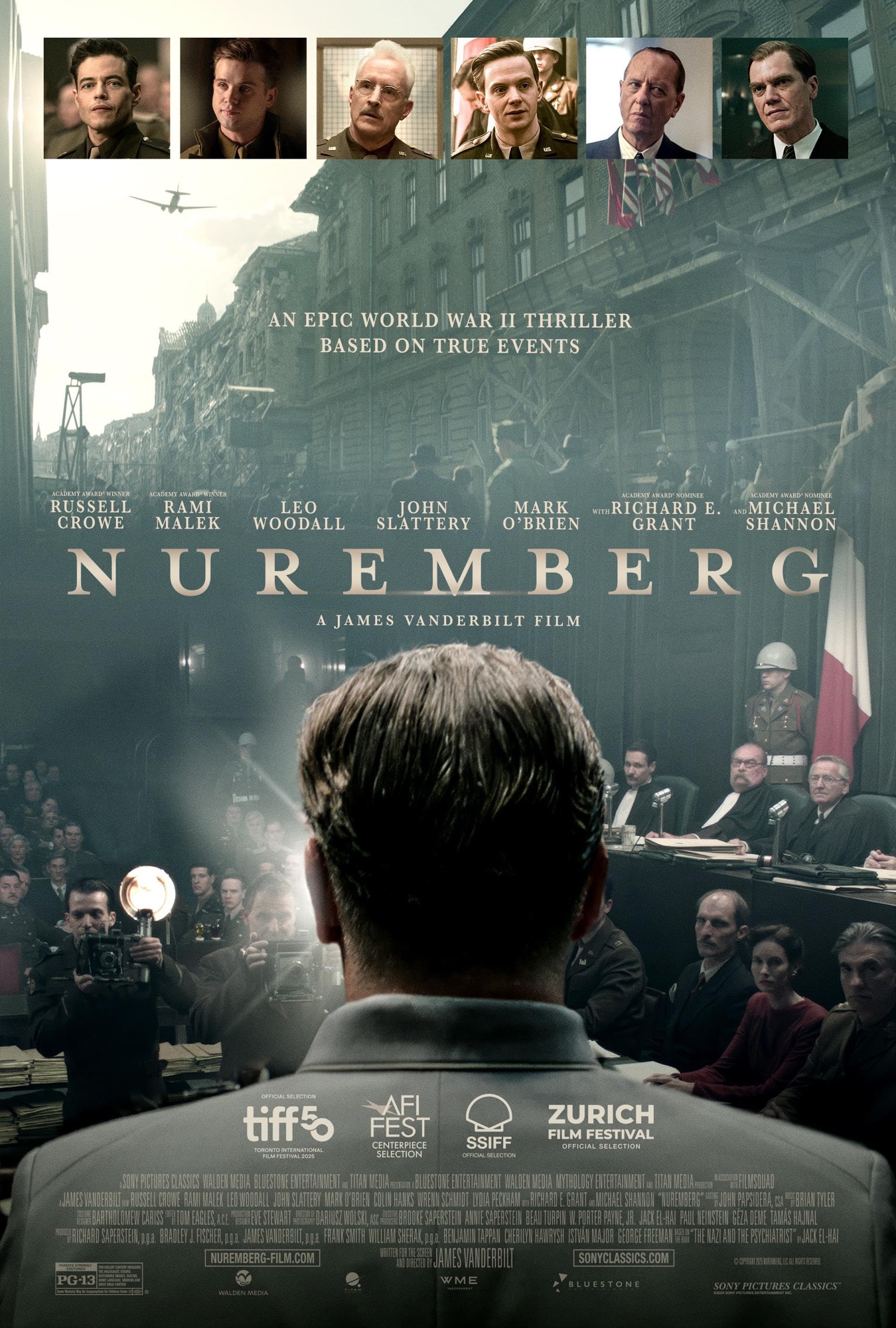


James Vanderbilt’s “Nuremberg” is a film that takes the stand, distilling an epic of atrocity and survival into a courtroom drama with flesh on its bones; it will not allow history to evaporate into abstraction. The great Russell Crowe as Hermann Göring fills the screen with work that is equal parts magnetic and revolting, a reminder of how charisma can be weaponized. The prison psychiatrist, Douglas Kelley (Rami Malek), emerges as the face of the film’s fragile conscience, repelled yet beguiled, sliding into a slippery subjectivity that is mirrored in the tribunal, crumbling under its task to contain evil. Michael Shannon’s Robert Jackson, jaded but resolute, personifies the weight of Justice in the absence of historical precedent. At the same time, Richard E. Grant’s David Maxwell Fyfe sharpens the edge of cross-examination with surgical precision.

The movie is at its most persuasive when it stays close to the tribunal itself: the charged silences, the documentary film of concentration camps, the set-to between Göring’s defiance and the court’s need for order. These are the moments that stem from Nuremberg as commentary on the Holocaust — with in-your-face confrontation of evidence and denial. The title is both place and symbol, a judgment, an appellation of a ritual, at which civilization itself was on trial, where law was called upon to meet atrocity in kind.

But the movie stumbles when it spends too much time on Kelley’s personal entanglements and his rapport with Göring’s family, as well as his off-hours romance with journalist Lila. These strands humanize him but attenuate the tribunal’s urgency. There’s some unevenness in the balance between courtroom rigor and psychological portraiture, never without consequence. Crowe-Göring is allowed to be a little too charming, and Jackson’s case feels undercut until Fyfe cross-examines him, putting the tribunal back in its rightful seat of authority. The third act, with Göring’s suicide and Kelley’s subsequent breakdown, leaves viewers feeling there is a lack of closure — justice is never complete but only temporary, in the face of recurrent denial and memory.

The film is riveting as a courtroom drama, sobering as Holocaust testimony and imperfect but necessary as an act of history. Nurenberg argues that judgment is not just about verdicts but the survival of truth against a machinery of lies.

Grade: B+.


Leave a Reply