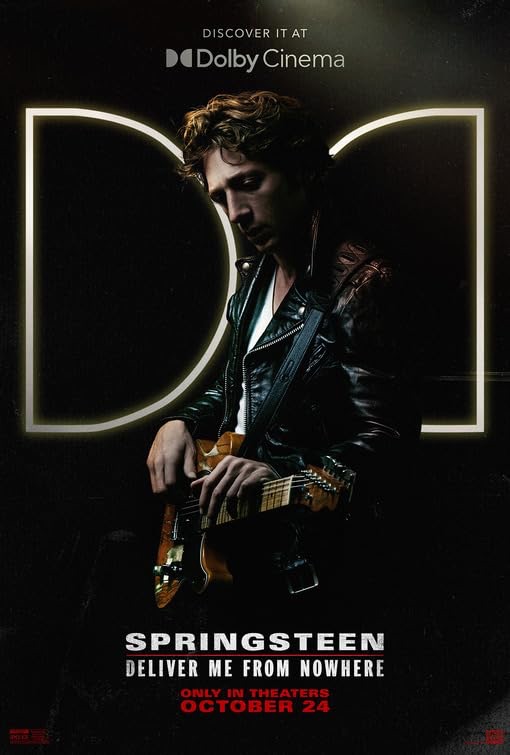


He walks offstage in 1981, sweat still saturating his forehead, the sound of applause wafting away— a train leaving town. The River Tour is over, the gold ring already seized, and Bruce Springsteen — depicted with ache and restraint by Jeremy Allen White — is heading into the woods, to Colts Neck, silence. To Nebraska.

Scott Cooper’s Springsteen: Deliver Me From Nowhere rubs the King’s crown. Cooper has tuned the film to the hum behind the music, the static between radio stations on the car radio, tuned it to the loneliness that made the man before it made the myth. It’s a movie that knows intimately the lyric “deliver me from nowhere” and hears a prayer for transcendence. And it answers that prayer with circumspection, toughness, and a sort of bruised grace.

The film begins with thunder and ends with a whisper. Bruce, 31, wrung dry, stares into the abyss of success. The E Street Band recedes into the background. The spotlight dims. What is left of Bruce Springsteen, then, in this small film’s crawl space? A man (the actor Stephen Graham, all clenched sorrow) pursued by his father and drawn to the ghost towns of Malick’s Badlands and made to cut a demo upon which he’d hang Nebraska — his most haunted album, his most solipsistic confession.

Jeremy Allen White inhabits Springsteen’s ache. His face is uneven and magnetic, that of a man unable to express what he’s feeling but able to sing it. His silences are thunderous. His sitting perfectly still has a rhythm of sorts. The film trusts him to bear the weight of becoming, and he does — without sentimentality, mimicry, or false catharsis.

The supporting cast buzzes. The dialogue reaches. Jon Landau, played by Jeremy Strong, is a man of conviction and burden. Odessa Young’s Faye, a polyamorous lover, flashes past, a kind reflection of what Bruce might have desired but was never able to cling to. Adele Springsteen and Gaby Hoffmann provide a desperation that cuts through the haze. The others — Marc Maron, Paul Walter Hauser, David Krumholtz — are texture in.

Cooper’s direction is moody, deliberate, and sometimes over-aestheticized. He leans in further to the shadows, to the Jersey bedrooms and roadside diners, to the hiss of cassettes and the burden of memory. He steers clear of the biopic’s customary sins: no montage of milestones, no parade of famous faces. Instead, he presents the man recording alone, haunted by his past and searching for a sound that might carry him forward.

The movie primarily connects. It flounders slightly in some over-explained scenes, with the sketchy women who occasionally reach for grandeur. But when it lands — when Bruce watches Badlands, pretends to play with his family or stares into the woods — it sings, about loneliness, fathers and sons, the price of bringing something to be.

Springsteen: Deliver Me From Nowhere is a lament and a hymn, a roadside prayer. It tells how he became the man who could write Nebraska. And in so doing, it also rescues him from nowhere.

Grade: A−


Leave a Reply