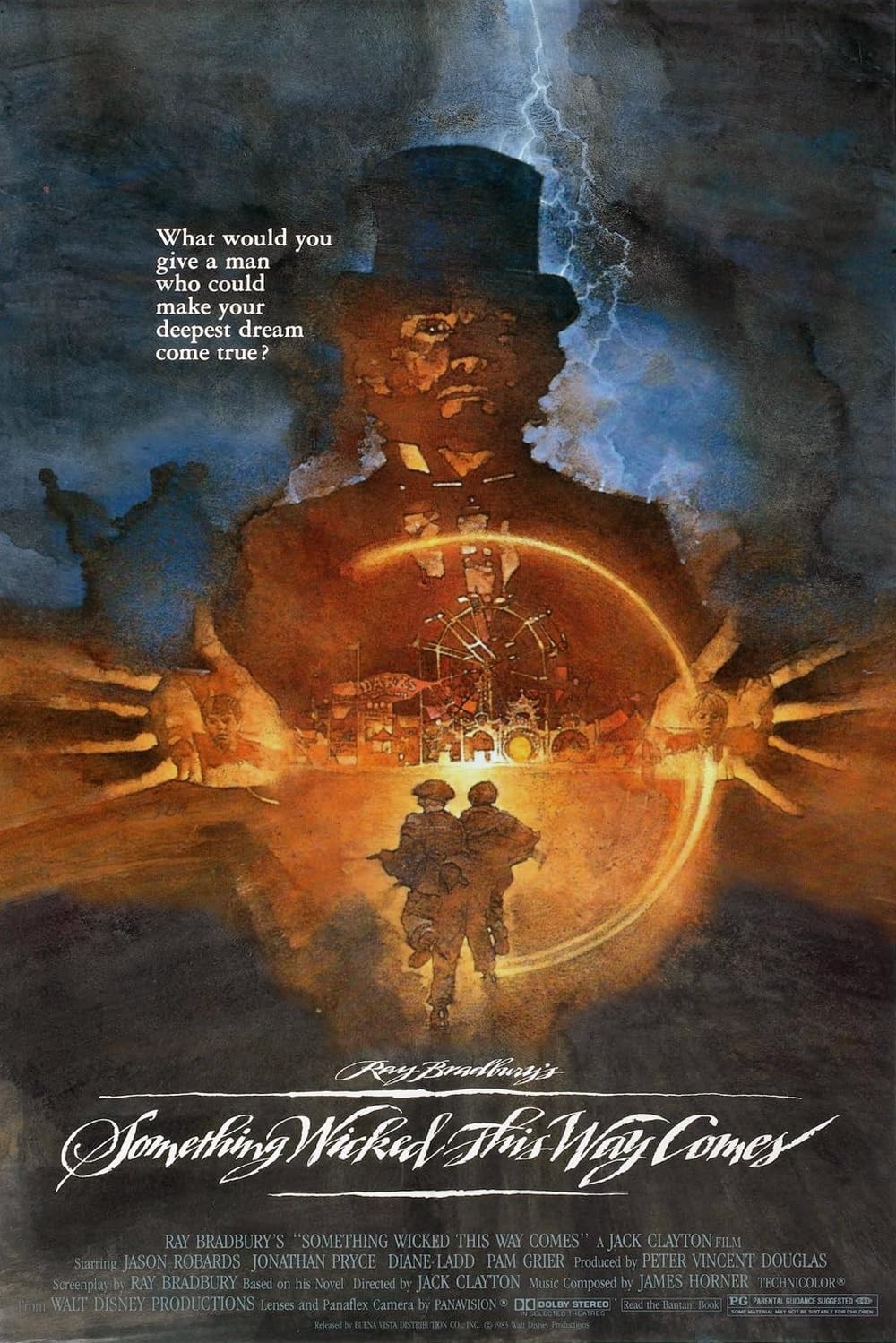


A silent terror is itching in the marrow of Something Wicked this Way Comes, a whisper that precedes the arrival of something ancient and cruel— that knows your name and longing. Jack Clayton’s 1983 adaptation of Ray Bradbury’s 1962 short story, later expanded into a novel, is one of those rare, truly haunted films that lingers and stains my cinematic memory.

The story takes place in a town that could be anywhere, at a time that could be any time. Two boys—Will Halloway and Jim Nightshade—stand on the edge of adolescence, their innocence already bruised by absence and disappointment. Into their lives rolls a carnival, late in the season, uninvited and unholy. Mr. Dark, played with icy grandeur by Jonathan Pryce, is the master of ceremonies, a collector of souls, a merchant of regret. Jason Robards, as Will’s father Charles, is the town librarian, a man who fears his own heart and the passage of time. Their confrontation is not merely between good and evil, but between despair and grace.

The film’s power lies in its dislocation. The ordinary is not safe. The magical is not kind. Only the horror is silent and patient. It is the green mist that slithers through the streets. It is the erotic menace of the woman with the tarantula— the carousel that spins backward, the way time becomes a weapon—the way the supernatural seeps deep.. The way tension builds through the slow erosion of trust, the dread of being forgotten, and the ache of desiring to be loved differently.

This is magical surrealism in American cinema before the term had currency. The film thrives on its clash between the natural and supernatural, between the sacred and the unholy bent of the surreal, in the ritual that is life’s light-dark animus. The carnival is the visitation. The Autumn People of this film are their emissaries. The film strives to exist beyond logic, live in a sacred pain that must be endured. It is wholly Christian in philosophy, but in practice and execution, thoroughly existential.

The title—Something Wicked This Way Comes—is the movie’s truth. Sure, the main wickedness is the carnival, but it is also in the town’s grief, the boys’ yearning, the father’s shame, the mirror, the wish, the hour of night when the soul forgets its name.

The production history is a tale of its own. Bradbury’s story passed through many hands—Gene Kelly, Sam Peckinpah, even Spielberg’s shadow. Jack Clayton, known for The Innocents, brought a quiet dread to the material, but Disney recoiled. Reshoots followed. Scenes were softened, others intensified. The tarantula sequence, added late, remains the film’s most visceral triumph. The final cut is uneven, but its fractures are part of its spell.

There are misses, but the hits—Pryce’s malevolence, Robards’ sorrow, James Horner’s score, the painted skies, the whispered truths—are enough.
The film exists as a neglected near masterpiece, a relic of cinema’s future rituals— and ultimately, a lonely hymn to the cost of desire.

Grade: A-. Streaming on Disney +.


Leave a Reply