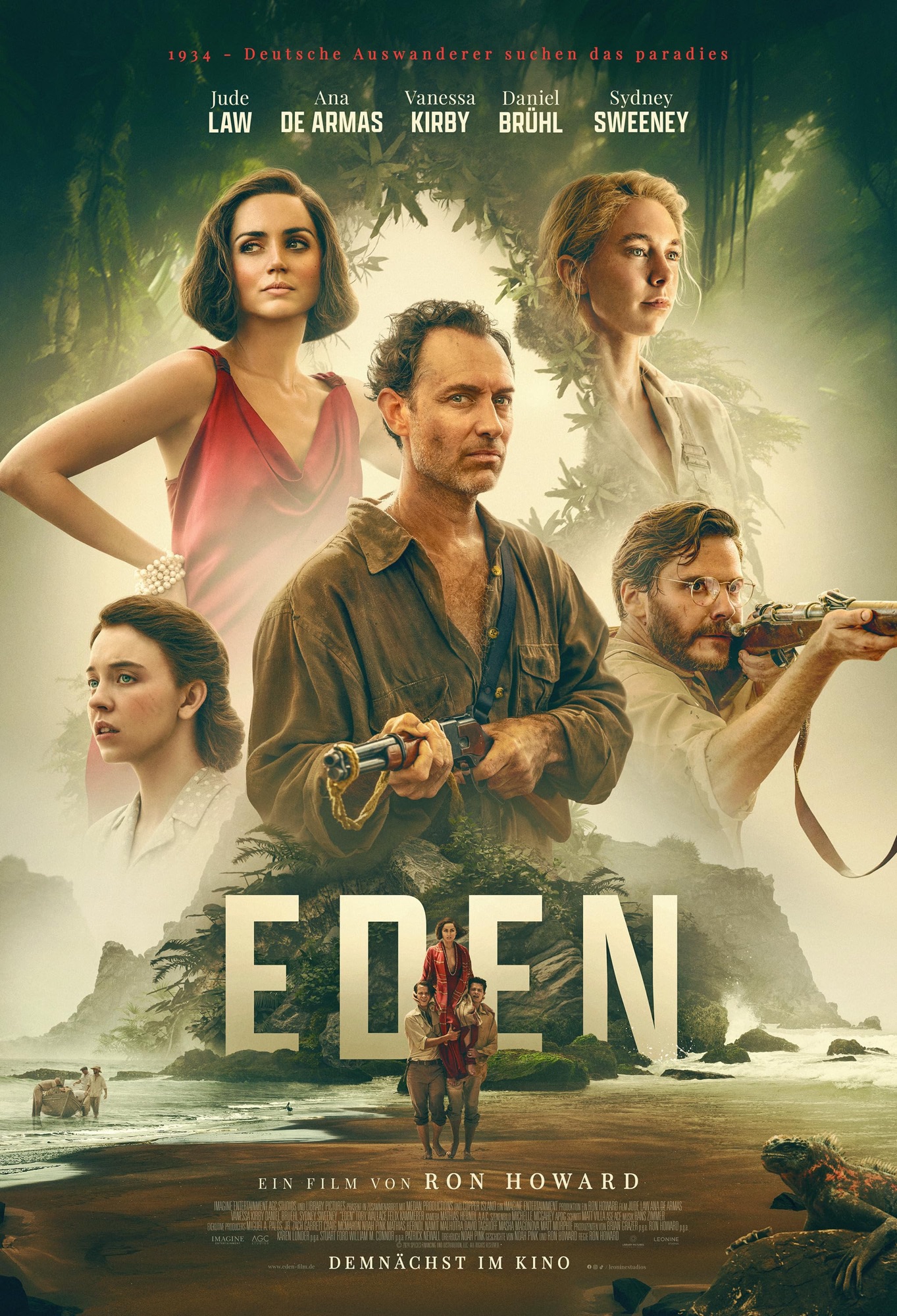


Ron Howard’s Eden is a fevered meditation on the fragility of paradise, a film that dares to ask whether utopia can survive the weight of human desire. It opens with a promise—a couple fleeing the corrosion of modernity, seeking purity on an island untouched by the world’s noise. Yet what unfolds is not a cleansing, but a slow unraveling, a study in how even the most sacred intentions can be undone by the very instincts they hoped to transcend.

Jude Law’s portrayal of Dr. Friedrich Ritter is both magnetic and mournful. He carries the film’s philosophical weight with a gaze that flickers between conviction and collapse. His manifesto, written in solitude, becomes a mirror to his own undoing. Law’s performance is tuned to the film’s pulse—never showy, always simmering. Vanessa Kirby’s Dore Strauch, fragile yet fierce, offers a counterpoint of quiet resistance. Her illness becomes a metaphor for the island’s sickness, and her meditation is a plea for grace amid chaos.

The arrival of the Wittmers, played with earnest depth by Daniel Brühl and Sydney Sweeney, introduces a rhythm of domesticity that briefly steadies the film. Their competence and warmth suggest that Eden might be possible after all. But Ana de Armas’s Baroness Eloise shatters that illusion. Her performance is a tempest—seductive, cruel, and unrelenting. She is the film’s necessary disruption, the embodiment of unchecked appetite. Her presence makes the sex and violence not gratuitous, but essential. They are the tools by which Eden is tested, and ultimately, undone.

Howard’s direction is at its best when it lingers. The camera does not rush through the island’s transformations—it watches, waits, and lets the rot bloom slowly. The violence, when it comes, is not stylized but raw. The sex, often tangled in power, is not erotic but unsettling. These choices serve the film’s thesis: that utopia cannot be built without confronting the full spectrum of human nature. The island is not a blank slate—it is a crucible.

The title Eden plays out with bitter irony. What begins as a sanctuary becomes a stage for betrayal, manipulation, and death. Yet the film never mocks its characters’ hopes. Instead, it mourns them. The intertitles at the end, revealing conflicting memoirs and lingering descendants, suggest that Eden was never a place—it was a story, rewritten by those who survived it.

The plot, sprawling and at times overburdened, does stumble. The final act, with its poisoned chicken and sudden investigations, feels rushed compared to the film’s earlier patience. But even in its missteps, Eden remains compelling. The narrative’s imperfections mirror the island’s own failed perfection. The film succeeds not by offering answers, but by refusing to simplify the questions.

The themes—utopia, decay, the cost of isolation—are well presented, though not always evenly explored. Dore’s illness, for instance, could have been given more emotional space. Still, the film’s emotional architecture holds. It builds tension not through spectacle, but through gesture and silence. The ache is allowed to settle before resolution.

Howard’s direction, while occasionally heavy-handed, is attuned primarily to the story’s rhythms. He trusts his actors, and they reward him. The ensemble cast is uniformly strong, with Felix Kammerer’s Rudolph offering a particularly haunting turn. His quiet rebellion and tragic end deepen the film’s sense of inevitability.

Eden is not a perfect film, but it is a brave one. It reaches for something sacred and finds something human. In its failures, it reveals its heart. In its violence, it shows its truth. It is a study in longing, the impossibility of purity, and the beauty of trying anyway.

Grade: B+.


Leave a Reply