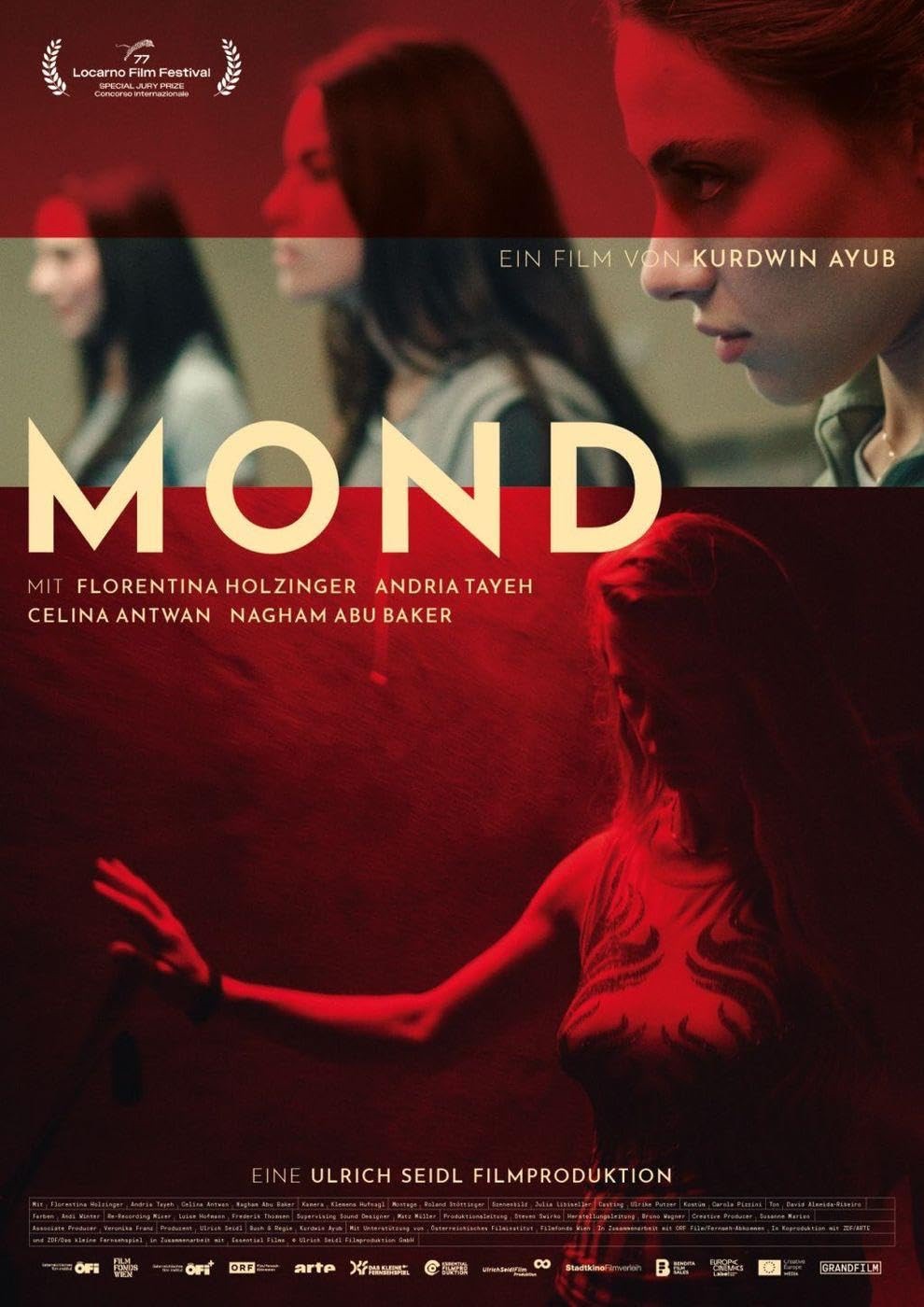


In Moon, Kurdwin Ayub directs with a quiet pulse, letting the body speak before the mouth does, letting silence stretch across gilded rooms and dusty training mats. Florentina Holzinger’s Sarah is a woman of muscle and memory, a fighter who has lost her fight, now wandering through a world that doesn’t know what to do with her strength. The film opens in a cage, and though the bars vanish, the confinement never does.

Sarah’s journey from the ring to the Jordanian countryside is not triumphant. It is tentative, bruised, and strangely tender. The job she accepts—to train three cloistered sisters in martial arts—feels like a lifeline, but quickly frays. The girls are not ready. The house is not welcoming. The rules are endless. The bodyguard watches—the power flickers. The NDA looms. Ayub builds this world with restraint, never overexplaining, never indulging in spectacle. The unease is ambient, like heat.

Holzinger’s performance is all tension and withheld emotion. She moves like someone who knows pain intimately, who has learned to carry it without complaint. Her silence is not emptiness—it’s armor. She is not there to save anyone; the film never pretends she will. Instead, it watches her try to connect, fail, try again. The sisters—Fatima, Nour, and Shaima—are not symbols. They are bored, bright, and boxed in. Their lives are curated, their freedoms conditional. The mall is a treat. The internet is forbidden. Their parents are absent. Their futures are unclear.

The film’s refusal to resolve its mysteries is its strength and risk. Viewers who crave narrative closure may find themselves adrift. But Ayub is not interested in neat arcs. She is interested in the atmosphere and the slow erosion of certainty. The car crash theme—Sarah’s obsession with watching them on TV—becomes a metaphor for impact without control. She watches destruction from a distance, unable to intervene or look away. It’s not voyeurism. It’s recognition.
Domesticity and masculinity are explored through absence. The house is full of women, but men make the rules. Abdul, played with quiet menace by Omar AlMajali, is both benefactor and gatekeeper. He offers opportunity but sets boundaries. His charm is curated. His authority is unquestioned. Sarah’s presence disrupts nothing, not really. She trains, she listens, she waits. The girls open up slowly, revealing cracks in the façade. But the house remains intact.

The plot is minimal, almost skeletal. It succeeds in what it sets out to do: observe, suggest, and linger. The themes—power, isolation, control—are presented with care, never forced. The direction is assured, even when the story drifts. Ayub knows when to hold a shot and when to let silence speak. The pacing is deliberate, sometimes frustrating, but always intentional.

Unlike other films about Western women in Middle Eastern settings—Not Without My Daughter, The Reluctant Fundamentalist, even The Swimmers—Moon avoids sensationalism. It does not paint Jordan as exotic or oppressive. It paints it as complicated, layered, and full of contradictions. The sisters are not victims. Sarah is not a savior. Everyone is trying to breathe within the limits they’ve been given.
Where the film falters is in its occasional opacity. Some viewers may feel locked out, unsure what to feel or where to land. But that confusion is part of the experience. Moon is not a guidebook. It is a mood, a meditation, a slow burn. It is about women watching each other, learning from each other, failing each other, and sometimes—briefly—touching something true.
In the end, Moon is a film that trusts its audience to listen closely. It is mixed in clarity but positive in intent. It does not crash. It glides, even when the road is uneven.

Grade: B+. Streaming on Mubi.


Leave a Reply