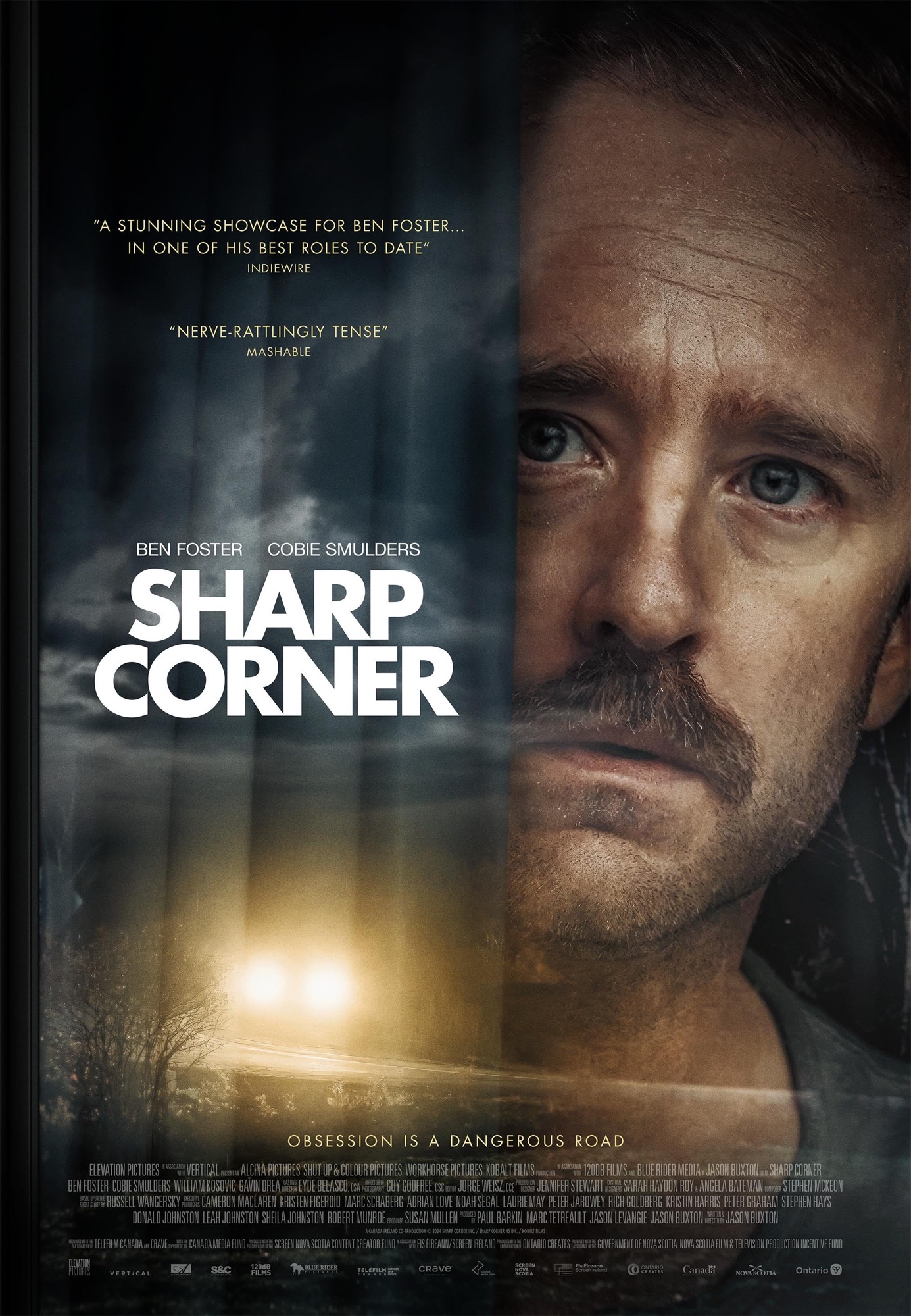


There is a quiet dread that pulses beneath Jason Buxton’s “Sharp Corner,” a film that never shouts but always trembles. It opens with a promise—a family moving into a new home, a fresh start, a clean slate. But the slate is cracked from the beginning, and the cracks widen with each passing car, each screech of tires, each shattered windshield. Ben Foster, in a performance stripped of bravado, leads us into this domestic terrain where the ordinary becomes a site of rupture, and where masculinity, once dormant, begins to claw for purpose.

The film’s central metaphor—the corner where accidents happen—is not subtle, but it is persistent. It becomes a kind of altar, a place where Josh, Foster’s character, begins to worship the idea of intervention, of heroism, of being the man who saves. The corner is both literal and psychological, a bend in the road and a bend in the mind. Buxton uses it to explore the fragility of domestic life, the thin line between protection and obsession, and the way men can lose themselves in the pursuit of meaning when the world no longer asks them to be warriors.

Foster’s Josh is a man who cannot sit still in peace. His wife Rachel, played with grounded warmth by Cobie Smulders, sees the danger early. She is the voice of reason, the one who understands trauma not as spectacle but as residue. Their son Max, played with aching vulnerability by William Kosovic, becomes the silent witness to his father’s unraveling. The performances are tuned to the film’s quiet register—no one overplays, no one explains too much. The ache is in the restraint.

Buxton’s direction is deliberate, sometimes to a fault. The pacing drags in places, and the repetition of crashes risks numbing the viewer. But there is a cumulative power in the way the film refuses to look away. It recalls the slow-burn tension of films like “Take Shelter” and “The Babadook,” where domesticity is both haven and trap. Yet “Sharp Corner” lacks the mythic charge of those films; it is more grounded, more mundane, and perhaps more honest for it.

The hero complex that overtakes Josh is not grandiose—it is pathetic, tender, and deeply human. He wants to matter. He wants to be the man who saves lives. But in doing so, he forgets the lives closest to him. The film does not mock him for this; it mourns him. It mourns the way masculinity can curdle when it has no outlet, when it is asked to be gentle but still yearns to be strong. The CPR classes, the late-night vigils, the obsessive research—all of it is a cry for relevance.

The car crashes are not just plot devices; they are ritual events. Each one marks a shift, a deepening of Josh’s descent. The sound design, sharp and invasive, ensures we feel each impact. The corner becomes a character, a presence that looms over the house like weather. It is the film’s most potent symbol, and Buxton wisely never over-explains it. We are left to interpret its meaning, its pull, its inevitability.

Where the film falters is in its final act, which leans too heavily on a twist that feels both earned and unnecessary. The emotional architecture built so carefully begins to wobble under the weight of narrative closure. The film wants to end with a bang, but its strength lies in its whispers. Still, the final shot lingers—not for its shock, but for its sadness.

Compared to other films that explore similar terrain—“Revolutionary Road,” “The Nest,” “The Father”—“Sharp Corner” is less polished but more raw. It does not seek to indict its characters but to understand them. It does not offer solutions, only observations. It is a film of gestures, of glances, of silences. It asks us to sit with discomfort, to witness without judgment.

In the end, “Sharp Corner” works more often than it doesn’t. Its themes are clear, its performances committed, its direction thoughtful. It is a film that may not resonate with everyone, but for those attuned to its frequency, it offers a haunting meditation on the wreckage beneath the surface of ordinary life.

Grade: B+. Streaming on Hulu.


Leave a Reply