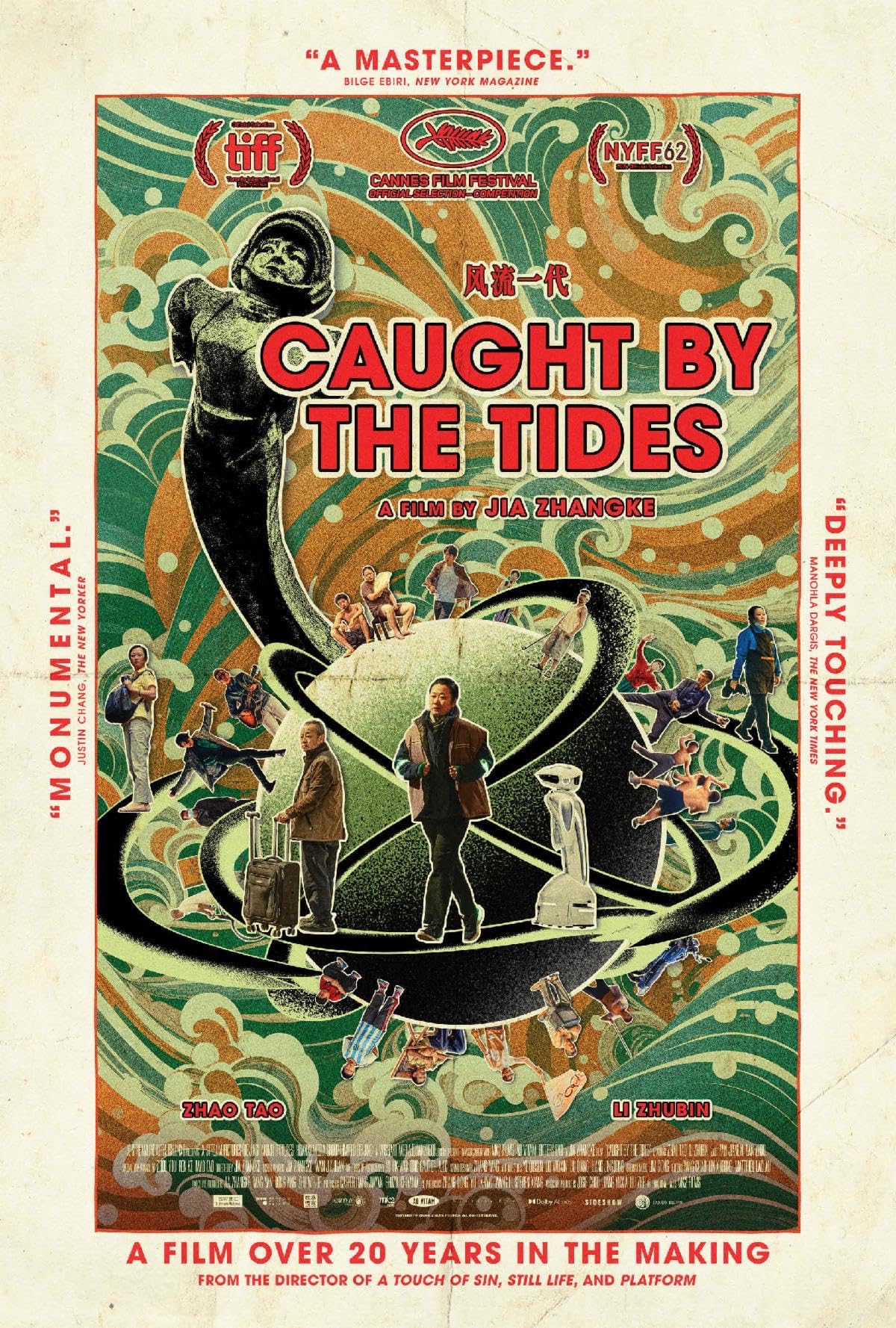


Jia Zhang-ke’s Caught by the Tides is a film of quiet persistence, a meditation on time’s erosion and the stubborn dignity of a woman who refuses to be erased. It moves not with urgency but with endurance, tracing Qiao Qiao’s journey through the shifting landscapes of China, both geographic and emotional. Shr carries the film’s weight with a gaze that absorbs and reflects the world around her. She does not perform grief; she inhabits it.

The film opens in Datong, 2001, where Qiao Qiao sings and dances in smoky clubs, her body a currency in a world that trades in fleeting pleasures. Her relationship with Bin, played with quiet calculation by Li Zhubin, is tender but transactional. When he leaves for another province, promising to return once he has money, the film begins its long walk through displacement, longing, and the slow unraveling of hope. Qiao Qiao’s decision to follow him is not romantic but existential. She moves because stillness would mean disappearance.

As Qiao Qiao travels through communities uprooted by the Three Gorges Dam, the film becomes a document of loss. Jia’s camera lingers on demolished homes, flooded fields, and the faces of those left behind. These are not backdrops; they are witnesses. The film critiques China’s relentless modernization not with anger but with sorrow. It does not argue—it mourns. And in mourning, it indicts.

The feminine in Caught by the Tides is not adorned or idealized. It is worn, bruised, and enduring. Qiao Qiao is not a symbol; she is a survivor. Her independence is not triumphant—it is necessary. The film resists the sentimental arc of empowerment.

Instead, it shows a woman who learns to live without illusions, who finds strength not in transformation but in persistence. In this way, it critiques both the past’s romanticization of feminine sacrifice and the present’s commodification of feminine resilience.

Compared to Jia’s earlier works like Still Life and Mountains May Depart, Caught by the Tides feels more elliptical, less concerned with narrative propulsion than emotional accumulation. It shares thematic DNA with A Touch of Sin, but lacks that film’s violence and urgency. Instead, it leans into the quiet ache of time, the way memory clings to places and gestures. It is more poem than plot, more elegy than drama.

The film falters in its final act, where the COVID-era reunion feels inevitable and underdeveloped. The emotional payoff is muted, not because the characters have changed, but because the film has not earned their reconciliation. Bin’s arc remains opaque, and his motivations are thin. The plot, which begins with promise, ends with a shrug. Yet perhaps that is the point: some stories do not resolve—they endure.

Directionally, Jia remains a master of atmosphere. His use of long takes and ambient sound creates a world that feels lived-in, not staged. He trusts silence, and in that trust, he finds truth. But the film’s pacing tests patience, especially in its middle stretch. Scenes linger past their emotional peak, and transitions feel abrupt. The rhythm is uneven, though never careless.

Zhao Tao’s performance anchors the film. Her face carries decades, her body remembers every betrayal. She does not act out emotion; she lets it settle. Her chemistry with Li Zhubin is strained, but appropriately so—their relationship is built on absence, not intimacy. The supporting cast, including offers brief but textured glimpses into lives shaped by the same forces that shape Qiao Qiao’s.

Ultimately, Caught by the Tides succeeds more as a thematic exploration than a cohesive narrative. It is a film that asks to be felt, not followed. Its critique of China’s transformation, portrayal of feminine endurance, and meditation on loneliness are all compelling, if unevenly executed. It is not a perfect film, but it is a necessary one.

Grade B+. Streaming on The Criterion Channel.


Leave a Reply