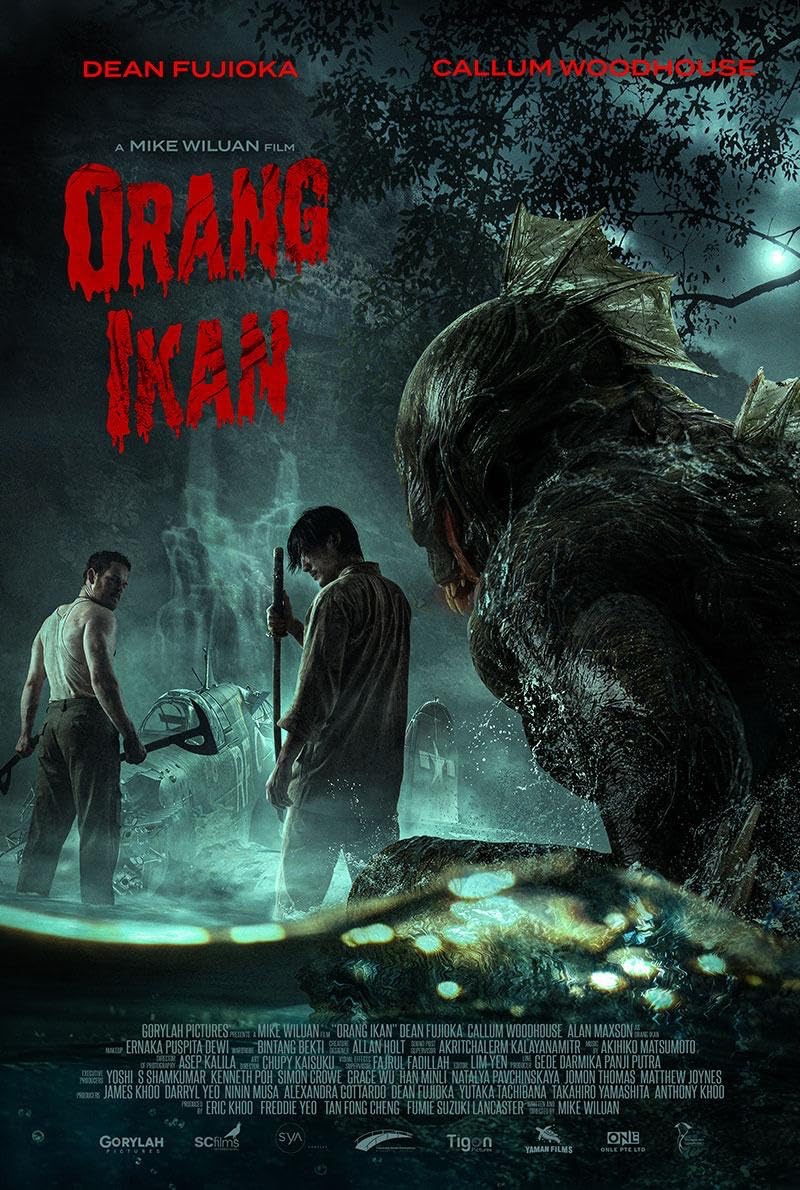


There’s a haunted hum inside Monster Island, where isolation hums against wartime trauma and something primordial stirs in the surf. Director Mike Wiluan doesn’t build a beast film as spectacle—he leans into the quiet dread of men undone by their own nations. This is not Predator, nor The Tomorrow War. There’s no military bravado or digital excess. What Wiluan gives instead is a chamber piece in the open air, with grief shared across shackles.

Set in 1944, the opening sequences crawl through corridors of punishment. We meet Saito, played with aching restraint by Dean Fujioka, a Christian Japanese officer branded a traitor. Across from him, Bronson, all ragged sarcasm and raw nerves, was rendered by Callum Woodhouse. Their introduction is a slap and a chain. Here, Monster Island walks briefly in the shadow of Hell in the Pacific, where two men speak through violence long before trust. But Wiluan expands that idea into a survival story fractured by guilt, misunderstanding, and the slow ghost of faith.

The film is no stranger to missed rhythms. The first act lingers on pain but stalls on momentum. Bronson, a prisoner bristling with contempt, remains opaque longer than necessary, and the early pacing suffers. But once the shipwreck sends Bronson and Saito into the surf, chained together, Wiluan begins to locate the emotional current. The shoreline scenes, where these two attempt to build a survival system through food, fire, and fractured language—offer the film’s most lived-in textures.

Wiluan chooses not to indulge in early monster reveals. The creature, Orang Ikan (physically performed by Alan Maxson), emerges halfway through like a memory that has finally surfaced. There is a tangible fear in its eyes, a fury beyond biology. While Creature from the Black Lagoon leaned into the myth of desire, the Orang Ikan speaks only in defense. There is no beauty to tempt it—just territory, blood, and the fury of a forgotten god.

Still, not all elements harmonize. Alexandra Gottardo and Lucky Moniaga appear briefly, but their roles are underdeveloped. Scenes involving outsiders reaching the island feel like placeholders, existing more to push the plot than deepen the theme. The movie falters when it retraces earlier scenes to stretch runtime, an unfortunate choice that undercuts the lean tension it once carried.

Woodhouse navigates Bronson’s character with a scrappy warmth, though he’s given limited psychological space to unfold. Fujioka’s Saito is the film’s quiet core, the moral spine bent but not broken. Their chemistry becomes the story’s actual arc—two men battered by nations, not monsters, learning how to hold the weight of each other.

The plot is a scaffold—minimal, at times thin—but the thematic work lands. Trust, guilt, and grief form the true predator here. Wiluan weaves his creature feature inside questions of legacy: who we become when unmoored from the machinery of war, and what it means to live beside someone formerly labeled an enemy. The monster, for all its teeth, becomes a mirror.

Direction is best when Wiluan trusts silence. The sound design excels in the jungle sequences, with every twig snap and breath speaking dread. He falters when trying to force rhythm or lean into tropes. But when he allows the film to breathe, Monster Island finds a pulse worth following.

Compared to creature fare, it’s gentler and stranger. No blockbuster sweep. No clear hero. Yet its modestness offers something else—a reflection on connection, estrangement, and the violence beneath survival. For those expecting grand stakes, it may underwhelm. But there is quiet magic here for viewers seeking a film about two men learning each other’s language in the presence of something unknowable.

Grade: B+. Streaming on Shudder.


Leave a Reply