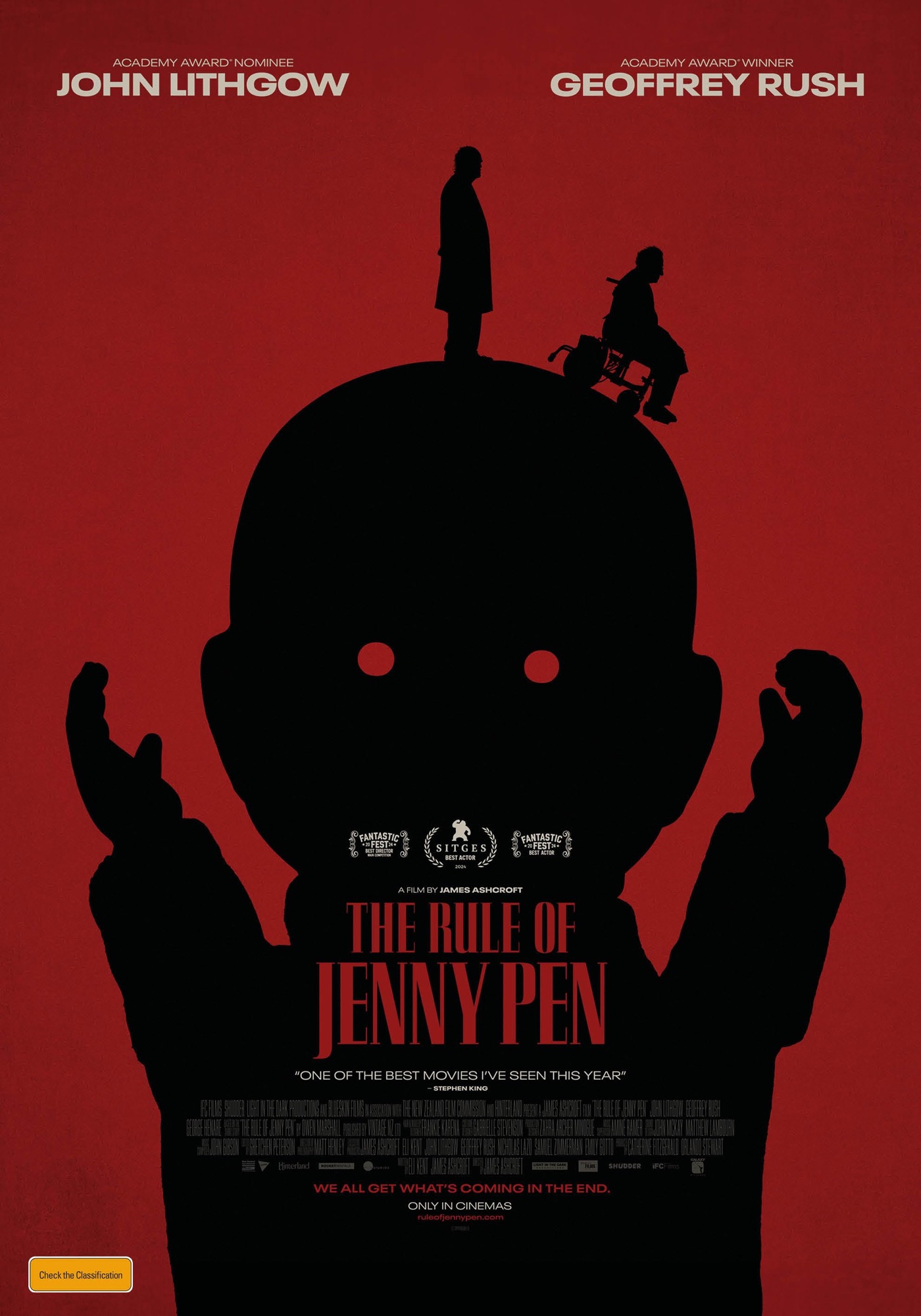


James Ashcroft’s latest offering, The Rule of Jenny Penn, now streaming on Shudder, envelops viewers in its unsettling aura. This atmosphere resembles a moth-eaten blanket infused with the odor of decay. The film is a psychological thriller, woven with foreboding and gallows humor..

*The Rule of Jenny Penn* delves into the nature of human dignity when confronted with evil. The characters each embody the struggle between vulnerability and resilience. The narrative raises questions about morality, survival, and the darkness that lurks within the human spirit. Ashcroft’s direction assures that every scene resonates with discomfort.

Set against the backdrop of a rest home that feels more penitentiary than refuge, Jenny Pen unravels the story of Stefan Mortensen, portrayed with depth by Geoffrey Rush. A once revered judge who commanded authority and respect, Stefan is now trapped within the confines of his own paralyzed body, a reminder of his lost power and freedom. Rush’s performance is quietly, hauntingly restrainted. His eyes, filled with fear and defiance, are the narrators of his plight, conveying a lifetime’s worth of regret and sorrow.

In comparison, John Lithgow delivers an unhinged portrayal of Dave Crealy, the elderly puppeteer whose seemingly cheerful demeanor conceals an undercurrent of cruelty. Lithgow transforms Crealy into a grotesque, a marionette in his own right, manipulated by his obsessions and moral depravity. The juxtaposition betwen Mortensen’s silent stoicism and Crealy’s erratic malevolence creates the film’s tension. The plot frequently flashbacks to their backstory, all the complexities of choices that have led them to this shared, lonely existence.

All the other character are echoes of Mortensen and Crealy. Nathaniel Lees Sonny Ausage, is a soul weighed down with the burdens of a life marked by struggle and resilience. Irene Wood‘s Olive Shaw sharp brittle humor and witty observations, her coping mechanisms, provides the comic relief.

Maaka Pohatu’s Dr. Neels embodies a chilling, dispassionate detachment. He is a figure of authority who, despite his title, is rendered powerless by the very systems meant to protect his charges. His interactions reveal the paradox of caring professions, where the weight of expectation often clashes with stark reality.

The caregivers, brought to life by Thomas Sainsbury as Carer Mike and Yvette Parsons as Carer Tania, navigate a delicate balance between authenticity and complicity. Their performances capture the nuances of everyday heroism, oscillating between moments of genuine compassion and the quiet moral compromises that define their roles. Amid the sterile corridors of the rest home, their struggles highlight the oppressive nature of their surroundings, mirroring the internal conflicts that leave them feeling as trapped as the residents they tend to.

The narrative unfolds around a grotesque creation that serves as its catalyst: a child’s puppet, twisted into a nightmarish version of innocence and used by the sinister Crealy to torment his fellow residents. With its painted grin twisted into a macabre parody, the puppet transcends mere objects; it becomes a haunting symbol of the power dynamics that permeate the community. Crealy wields this puppet with merciless precision, transforming it into a tool of control that instills fear and manipulates emotions.

Director James Ashcroft skillfully employs the puppet as a motif throughout the film, its presence serving as a harbinger of dread. As the story progresses, the puppet’s influence grows, reflecting the characters’ inner turmoil and the sinister atmosphere enveloping their lives. Each appearance heightens the tension. The thoughtfully crafted imagery and sound design surrounding the puppet enhance its menacing impact even more.

The cinematography elevates the rest home to a character. It’s imbued with its own stark and haunting presence. Dimly lit hallways stretch into the abyss, their shadows consuming the glimmers of hope that linger. Corridors feel like an endless void, with the pale glow of fluorescent lights casting a pallor that amplifies the oppressive atmosphere. The incessant hum of these lights resonates like a dirge, creating a backdrop that underscores the solitude and despair. Complementing this desolation is the score—a dissonant blend of strings and whispers that intrude on the consciousness. This unsettling harmony pierces the silence and lingers, a reminder of the fragility of life and memory.

Ashcroft’s direction is uncompromising. He weaves in moments of dark humor, providing fleeting lifelines amid the overwhelming sorrow. An Olive Shaw biting one-liner can also aptly apply with a slight alteration to Jenny Pen as Ashcroft’s little monster, a complex creation that, In its juxtaposition, illustrates the interplay between tragedy and wit.

The film occasionally stumbles on its pacing. The relentless tension can sometimes come across as excessive, leading to moments that feel more exhausting than thrilling. Additionally, certain characters, such as Nick Blake’s Tobias Popanovich, are not given the narrative depth they deserve and.their arcs feel frustratingly incomplete. This lack of balance between tension and character development ultimately leaves Jenny Pen feeling incomplete.

**Letter Grade: B+** Streaming on Shudder.

.


Leave a Reply