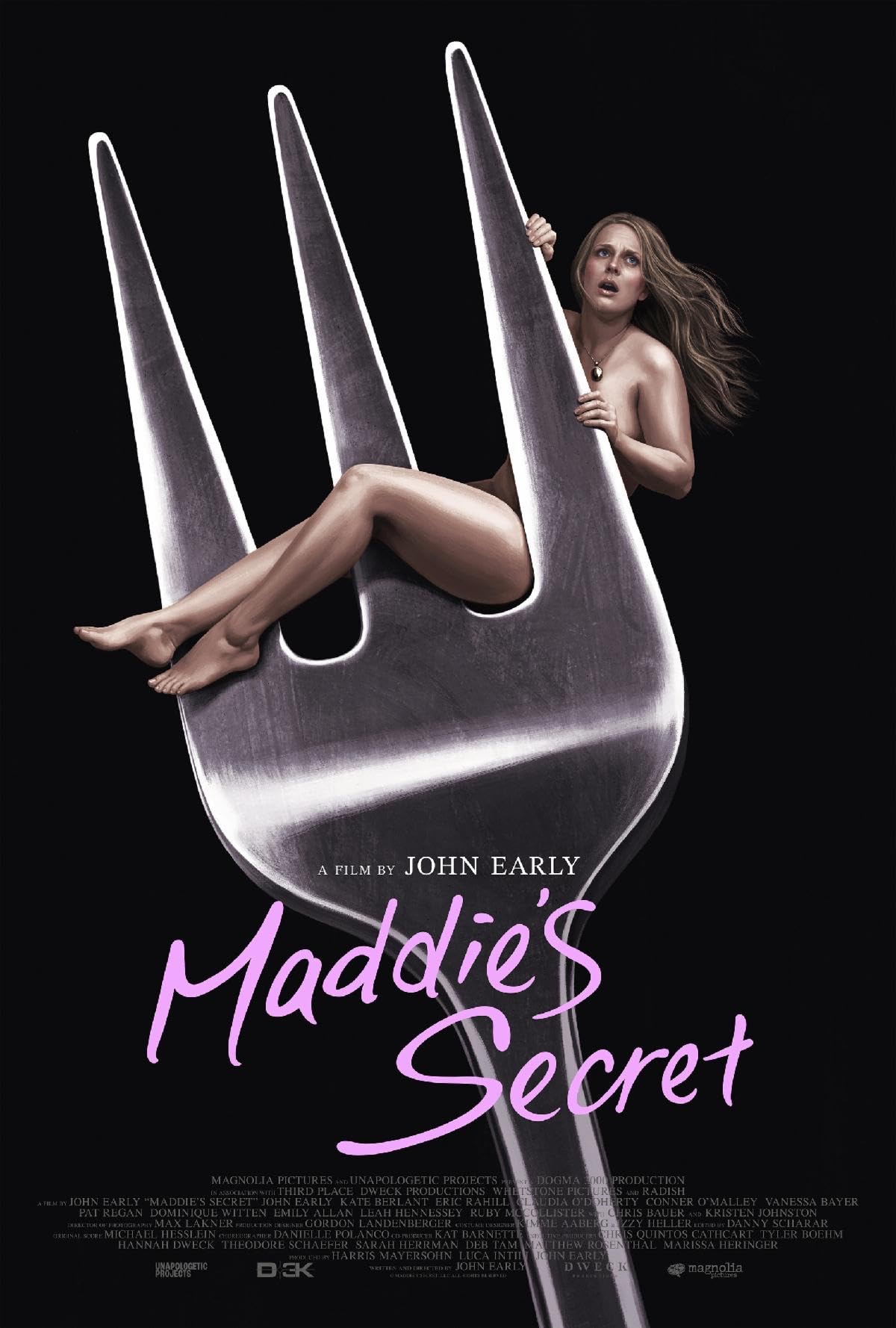


There is a moment in Maddie’s Secret when Deena (Kate Berlant) gazes at Maddie with total sincerity and says, “It’s like you’re out of some modern-day fairy tale. You’re perfect.” That line captures a great deal of what makes this odd, ambitious movie work. Maddie is constantly treated as a fantasy by the people around her, whether they want to celebrate her, profit from her, criticize her, or save her. The tragedy is that she is only human.

Written, directed by, and starring John Early, Maddie’s Secret has proved surprisingly difficult to describe. Some viewers will call it satire. Others may see it as a critique of influencer culture. A few might even classify it as a horror film because of the body horror woven into Maddie’s eating disorder struggle. Yet the simplest description may also be the most accurate: this is a loving pastiche of the made-for-TV melodrama, resurrected with glossy visuals, sharp comic timing, and a genuine emotional core.

In that respect, Early belongs alongside filmmakers such as Quentin Tarantino and Joel and Ethan Coen. Not because their styles are identical, but because all of them share a fascination with reviving neglected cinematic forms. Early takes a style often dismissed as disposable daytime entertainment and discovers new possibilities inside it. He understands every convention of these movies and embraces them without embarrassment.

John Early plays Madison “Maddie” Ralph, a dishwasher working at Gourmaybe, a trendy Los Angeles test kitchen that specializes in short-form food content. Maddie dreams of becoming a chef, but her life changes overnight when her husband Jake (Eric Rahill) uploads a video of her cooking a vegetarian recipe. The clip goes viral, turning her into an internet sensation and pushing her in front of the camera at Gourmaybe.

What begins as a wish fulfilled slowly transforms into a nightmare. Cruel online comments, passive-aggressive workplace rivalry, and painful interactions with her mother chip away at Maddie’s confidence. Her dormant bulimia returns, and the film follows the increasingly dangerous consequences of her attempts to maintain success while hiding her illness.

The plot is deliberately outrageous in places. Maddie lies about being pregnant. Her best friend Deena checks herself into a treatment facility under false pretenses. A television drama called The Boar seeks culinary consultants in one of the film’s funniest recurring jokes. Yet Early commits so fully to the melodramatic tone that these developments rarely feel forced. They exist in a heightened world where sincerity and absurdity occupy the same space.

The film’s greatest strength is its cast. Kate Berlant is wonderful as Deena, balancing affection, insecurity, jealousy, and chaos. Deena initially appears to be the ideal best friend, yet the film gradually reveals her need for attention and validation. Berlant plays every emotional turn with complete conviction.

Eric Rahill gives Jake a warmth that prevents him from becoming a stock supportive-husband character. Even when Jake feels betrayed by Maddie’s deception, Rahill maintains the character’s humanity.

Claudia O’Doherty is excellent as Emily, Maddie’s arrogant professional rival. The character could have remained a simple antagonist, but O’Doherty gives her enough vulnerability that her eventual reconciliation with Maddie lands emotionally.

Conner O’Malley provides several of the film’s biggest laughs as the sleazy Gourmaybe boss Zack, while Vanessa Bayer delivers unexpectedly touching work as Julie, Maddie’s roommate in treatment. Julie begins as comic relief but gradually becomes one of the film’s emotional anchors. Her fate introduces a surprising level of sadness that lingers through the final act.

Kristen Johnston deserves special mention for her performance as Beverlee, Maddie’s mother. Beverlee is one of the film’s most disturbing creations. The revelations about Maddie’s childhood are genuinely upsetting, and Johnston portrays Beverlee with an unnerving mixture of cruelty and self-absorption. The confrontation scene between mother and daughter ranks among the strongest sequences in the entire film.

Visually, Maddie’s Secret embraces the polished artificiality of television melodramas. Every frame appears carefully designed to evoke a heightened reality. The bright colors, spotless interiors, and immaculate presentation create a sharp contrast with the painful material underneath. That contrast becomes one of the movie’s main pleasures.

Early attempts something genuinely difficult. He takes a format associated with sentimental television movies and fills it with contemporary anxieties about social media, appearance, internet celebrity, and self-worth without sacrificing entertainment value.

Most importantly, Maddie’s Secret treats Maddie herself with compassion. The film never turns her illness into a punchline. It allows her mistakes, acknowledges her suffering, and lets her grow. By the time she leaves treatment and steps uncertainly into her future, the film has earned its emotional payoff.

Grade: B+. Netflix.


Leave a Reply