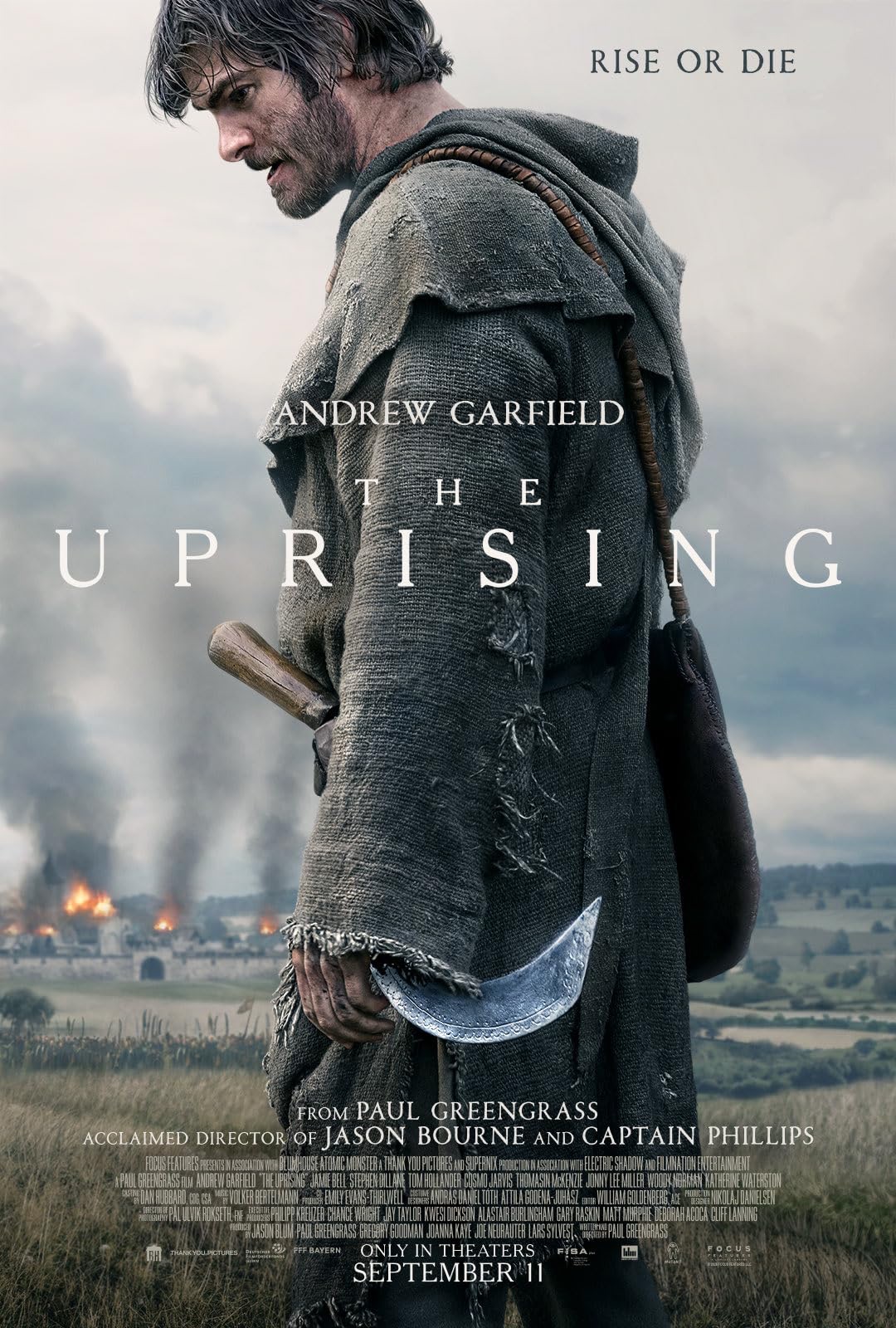


There is something poignantly fitting about The Uprising arriving at a time when many people’s faith in institutions feels fragile. Paul Greengrass has spent much of his career chronicling systems under strain, and here he turns to one of England’s earliest great popular rebellions with care, finding a story rooted in the distant past that still resonates with unsettling clarity today.

Set in 1381, in the aftermath of the Black Death, the film opens on a kingdom still reeling from immense loss. With half the population gone and England’s treasury under strain, the ruling council governing for the young Richard II faces a difficult choice. Rather than seek fairer ways to ease the kingdom’s burdens, it turns to those with the least power, placing yet more hardship on people already struggling to recover. Before long, the pressure becomes unbearable.

At the heart of it is Andrew Garfield’s unnamed Ploughman, a survivor bearing the unbearable loss of his wife and children to the plague. Garfield portrays him with quiet dignity and tenderness, grounding the entire film. His grief is never sentimentalized; it lives in every glance and gesture, making him a reluctant revolutionary rather than a conventional hero. He never sets out to change history. He is simply trying to endure, while history refuses to leave him alone.

The conflict begins with a tax dispute and soon turns violent when the Ploughman witnesses soldiers mistreating local girls. As he tries to protect them, he kills a soldier attempting to arrest him. Rebellion then spreads across England, drawing thousands together in anger and desperation, yet sustained by a fragile hope for change.

Greengrass and his co-writers weave fictional and historical figures through the narrative with largely effective results. The Ploughman offers audiences a welcoming entry point, while prominent historical figures bring the broader movement to life. Cosmo Jarvis gives a powerful, deeply human performance as rebel leader Wat Tyler, capturing both his courage as a warrior and his care as an organizer. Jamie Bell’s John Ball is driven by a moving sense of conviction, portraying the radical preacher as a man whose words resonate almost as strongly as the swords around him.

Their presence helps soften one of the film’s most noticeable shortcomings. Greengrass’s script understandably favors action over dialogue, so conversations can feel more functional than memorable, often serving to move audiences toward the next confrontation. The film also leaves little time to explore its supporting characters’ deeper motivations. Several intriguing figures arrive with the promise of fascinating stories, only to fade back into the crowd before those possibilities can fully unfold.

Fortunately, Greengrass remains one of cinema’s most effective directors of organized chaos. The Uprising is filled with scythes-and-pitchforks combat, street battles, riots, and desperate confrontations between ordinary people and those in power. The action carries a raw, tumultuous energy without romanticizing the suffering. Bodies are broken, hopes are crushed, and even victory comes at a painful cost, leaving its own wounds behind.

What gives the film depth beyond the familiar spectacle of medieval conflict is its compassion for the rebels’ plight and its recognition of the movement’s moral complexity. Their grievances are real: taxes have become unbearable, the government remains indifferent, and justice seems reserved for the wealthy. But when London falls into their hands, their justified anger gives way to violence. Beheadings reach beyond political targets, looting eclipses their cause, and the movement begins to turn against itself.

Greengrass resists easy answers. The ruling class is monstrous, yet the crowd is not inherently noble; both can be profoundly brutal. By refusing to reduce either side to a simple judgment, the story makes room for the human realities behind the conflict—and gains much of its power.

Woody Norman’s Richard II is especially compelling. Rather than depicting the young king as simply villainous, the film invites compassion for a frightened, psychologically fragile man, deeply manipulated by those around him. Haunted by nightmares of demonic mobs, Richard is caught between fear and the demands of authority. His eventual betrayal of the rebels is horrifying not because it is unexpected, but because it confirms the painful truth the movement had hoped against hope was untrue.

The film’s most heartbreaking stretch comes after Richard seems ready to grant reforms and clemency. The rebels allow themselves to hope they’ve achieved something historic. Their enemies smile, promises are made, and hands are shaken. But their hard-won hope is soon undone as the machinery of power returns to its familiar course. The betrayal feels both devastating and painfully inevitable.

Perhaps unsurprisingly for a Paul Greengrass film, *The Uprising* carries a strong present-day resonance. Its portrayal of a society struggling in the wake of a pandemic, alongside entrenched oligarchic power determined to protect itself at any cost, feels especially poignant. These parallels never overshadow the historical setting, but they remain quietly present throughout. The film recognizes how centuries pass, fashions change, and crowns give way to boardrooms, while ordinary people are still asked to make sacrifices—often with little regard for what they have already endured.

The much-discussed question of Robin Hood ultimately seems to rest more on publicity than on the film itself. Understandably, viewers might hope for a surprise appearance from England’s most famous outlaw, but those expectations may lead to disappointment. Greengrass’s comments about how outlaw legends grew in the wake of the revolt seem to have fueled speculation, yet the film offers little meaningful presence of Robin Hood. He is no more likely to appear in The Uprising than the Scarlet Pimpernel is to be found behind its battlements. The connection is felt more in the historical echoes than in the story itself.

Yet the film’s final moments touch on that mythology in a quietly moving way. When the surviving Ploughman takes up a green hood and leads archers living beyond the reach of royal authority, Greengrass gently evokes how acts of resistance can grow into legend. The ending may be a little heavy-handed, but it remains deeply effective, leaving audiences with the poignant image of resistance enduring long after military defeat.

Still, *The Uprising* succeeds because it recognizes a painful truth: revolutions often begin in desperation, descend into chaos, and are remembered through stories that leave out the people who suffered most. Greengrass portrays the revolt neither as a triumph nor a failure, but as a deep wound that never fully healed.

The result is a film steeped in mud, blood, broken promises, and hope worn thin—a story of the distant past that feels painfully familiar, and all the more heartbreaking for it.

B+. Peacock.


Leave a Reply