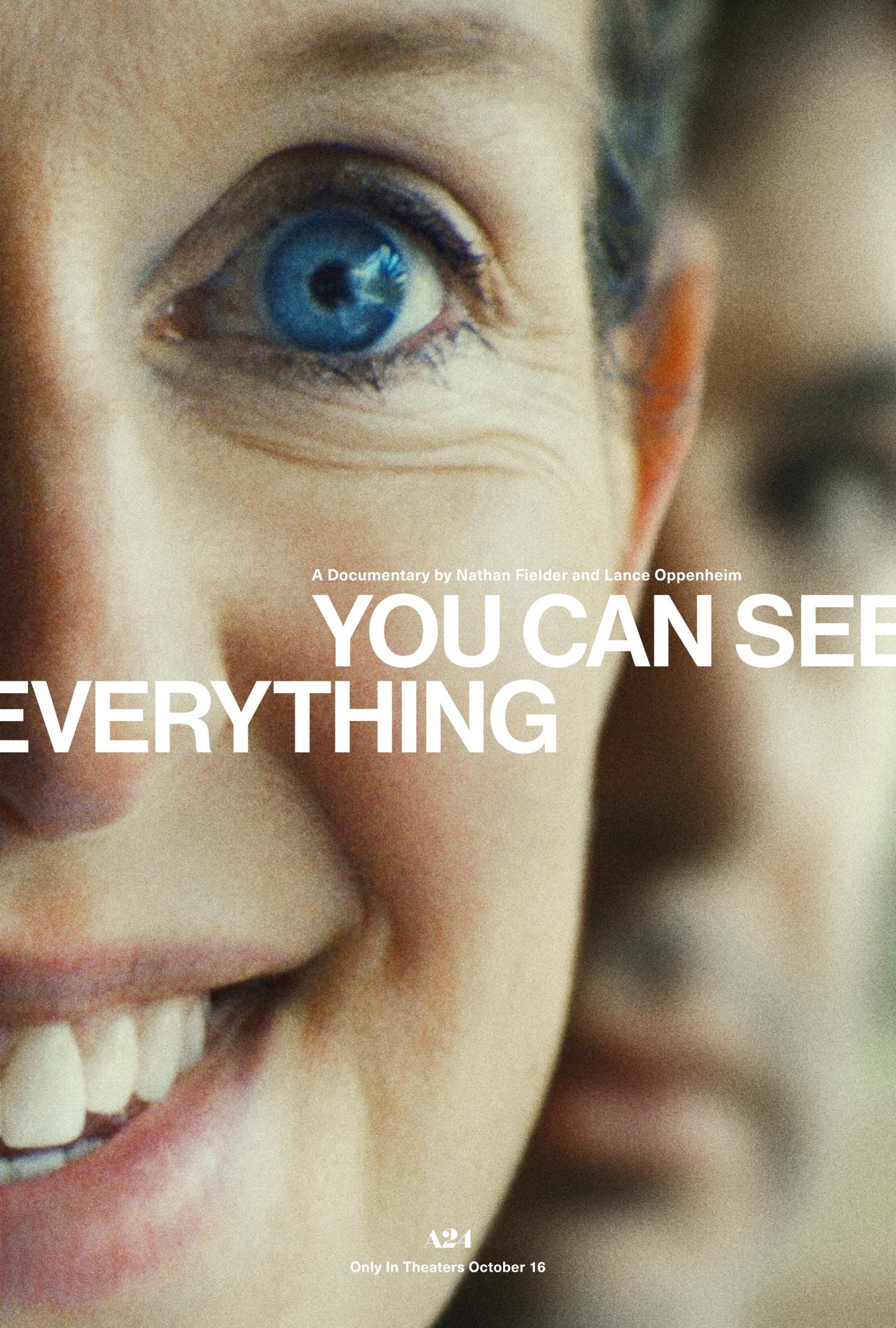


Nathan Fielder’s *You Can See Everything* first appears to be an access-driven documentary about about Elizabeth Holmes , but it soon becomes something far stranger, more suspenseful, and ultimately more unsettling. Working with Lance Oppenheim, Fielder transforms a familiar public scandal into a hall-of-mirrors investigation of performance, self-invention, and the fragile boundary between observation and participation. The result is one of the year’s most gripping nonfiction films—a thriller that draws its power not from revelations, but from uncertainty.

What makes the film so compelling is that it resists offering easy verdicts. Holmes enters the story with one of the most notorious reputations in modern American business, but Fielder is less interested in revisiting questions of guilt than in exploring how belief takes shape. Each conversation feels charged with hidden motivations, and every answer seems to open the door to another question. The tension comes from watching Fielder try to find his way through a situation where sincerity and strategy are difficult to separate.
The documentary’s greatest strength is the way it uses ambiguity to keep the story compelling. Fielder has spent much of his career exploring the difference between what people say and what they mean, and here that interest takes on its most ambitious form. Holmes becomes both the subject of the film and a co-author of her own image. The film keeps inviting us to consider whether her statements reflect genuine conviction, calculated manipulation, or a psychological state somewhere in between. Instead of resolving that mystery, the filmmakers make it the movie’s central driving force.
The structure unfolds like a gripping psychological thriller, with each new revelation reshaping how earlier scenes feel. Small moments take on an unsettling significance hours later, while conversations that once seemed awkward begin to carry strategic weight. The film keeps the audience on their toes, inviting us to continually reconsider who is directing the performance—and who is caught up in it.
A major reason the film works so well is its bold, and perhaps controversial, decision to make Billy Evans a central figure. While many documentaries might have stayed focused on Holmes, Fielder recognizes the value of a compelling counterforce. Evans first appears in a supporting role, then gradually becomes the film’s most unpredictable presence. His mystery adds an undercurrent of menace that gives the second half even more intensity. With each appearance, it becomes clearer that competing narratives are vying to shape Holmes’s public identity.
This thoughtful creative choice brings together two leading perspectives on the film. One sees Holmes as an elusive figure whose contradictions resist any definitive explanation. The other views the documentary as evidence of ongoing manipulation and image management. Fielder brings these perspectives together by presenting Evans as a possible villain without fully confirming that he is one. The film recognizes how much stories can draw us toward antagonists, while also inviting us to question that instinct. Evans becomes both a character and a narrative device, reflecting the audience’s desire to place responsibility on a single person.

That balancing act gives the documentary a fresh perspective beyond true-crime conventions. Each attempt to find certainty brings new questions. When Holmes appears vulnerable, it’s natural to remain skeptical. When Evans seems controlling, we may also wonder whether the film is shaping that impression. Even Fielder becomes part of the story. As his emotional investment grows, he shifts from observer to participant, adding another layer of complexity to the film’s search for truth.
Amanda Seyfried’s thoughtful participation in the reenactment sequences brings this theme into sharper focus. Her presence creates a compelling interplay between dramatization and reality. The film gently reveals how public narratives are constructed through artificial means. By revisiting Holmes with an actress already known for portraying her, the documentary invites viewers to consider representation itself.
Visually, the film builds suspense by inviting us to observe closely. Long lenses, lingering close-ups, and patient editing draw our attention to expressions, pauses, and moments when language seems to fall short. Fielder and Oppenheim show how uncertainty can become cinematic when we’re encouraged to search faces for clues. The documentary often seems less focused on revealing facts than on letting us watch people shape their own versions of themselves.

The ending may leave viewers hoping for a final answer feeling a little frustrated. But that’s exactly where its strength lies: it chooses not to provide one. Rather than solving the mystery of Elizabeth Holmes, You Can See Everything gently reminds us how difficult it is to truly understand anyone. The film suggests that truth, performance, self-deception, and manipulation aren’t separate categories, but interconnected forces that shape modern public life.
Few documentaries this year are as intellectually adventurous and captivating as this one. You Can See Everything playfully ties itself into knots, inviting viewers to enjoy the ride. It’s provocative, funny, unsettling, and surprisingly moving. Most of all, it leaves you with questions that keep multiplying long after the credits roll.
Grade: A.


Leave a Reply