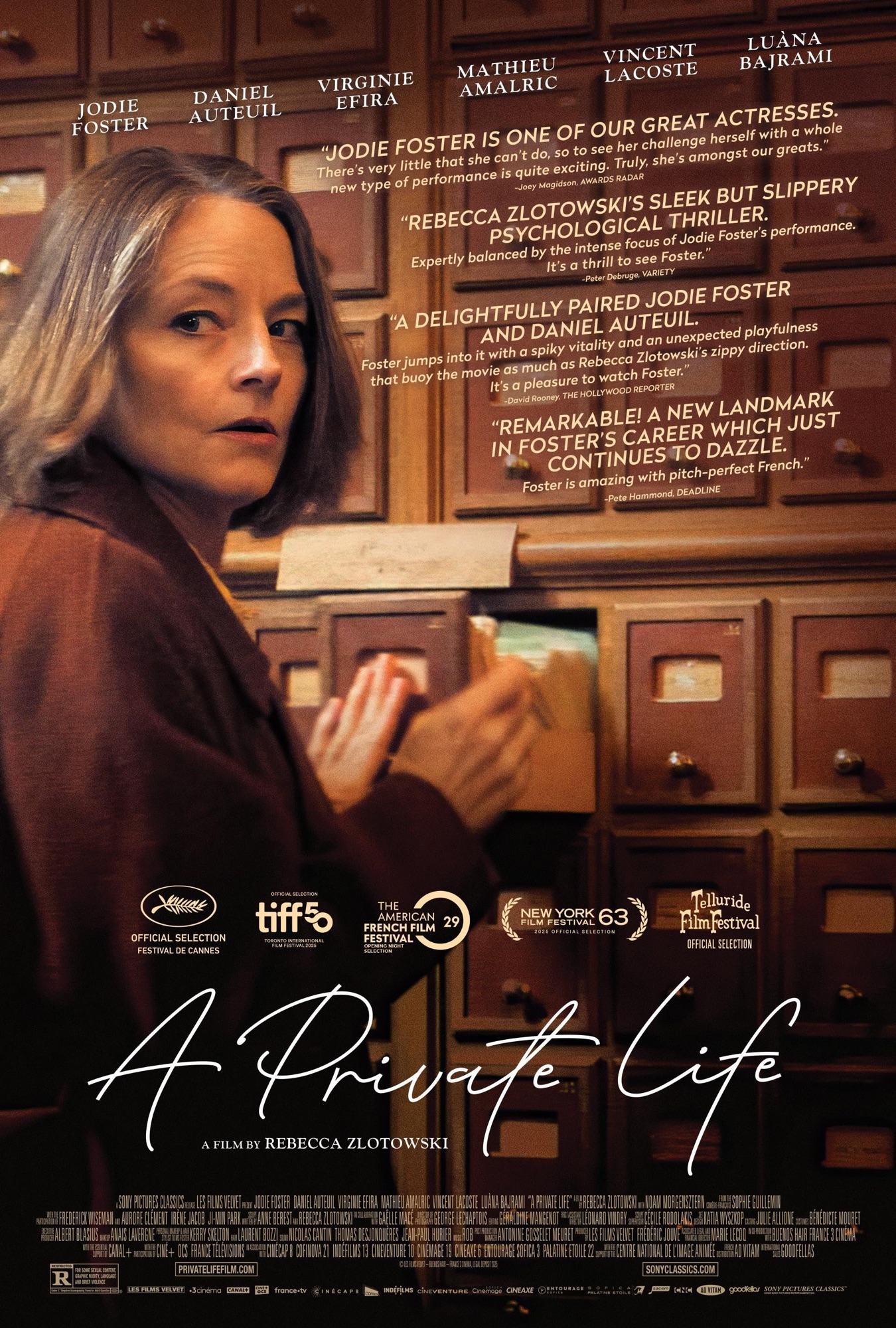


Watching Jodie Foster gently reveal the delicate layers of her character’s world in Rebecca Zlotowski’s A Private Life becomes a quiet, poignant experience, a subtle journey into the places people often conceal from themselves. The film moves with a gentle, measured pace, yet its emotional currents softly draw the viewer in, inviting empathy for Lilian Steiner’s vulnerable inner life beneath her polished exterior. What emerges is a work of psychological complexity and quiet beauty, a drama that speaks softly but profoundly, holding a tender grip on the audience.

Foster’s performance is the heartbeat of the film. She portrays Lilian with a guarded dignity that gradually begins to crack, revealing a woman who has spent years confounding her sense of stability with her composure. The film’s beauty lies in witnessing her gentle unraveling—not through melodrama, but through the slow loss of certainty. Her tears, her lingering doubts, her fading sense of reality—each one a quiet act of rebellion against the fortress she’s built around herself. The film’s sorrow deepens with this unraveling, born from the heartbreaking awareness that Lilian’s life has been carefully shaped to avoid feelings she now must face.

Zlotowski’s direction gently amplifies that sadness. She depicts Lilian’s world with such tenderness and careful detail that every upheaval feels profound. The gleaming surfaces, the orderly apartment, the professional rituals—these details are not mere decoration but reflections of a life diligently maintained to protect against chaos. When chaos inevitably enters through Paula’s death, it creates a rupture that leaves Lilian disoriented and vulnerable. The film’s mystery elements are less about solving a crime than about exploring the fragile fault lines of Lilian’s psyche, where grief and guilt have been quietly deepening, evoking empathy for her silent suffering.

The film’s Hitchcockian gestures—staircases, ocular distress, hypnotic visions—serve as emotional landmarks rather than mere stylistic homages. They vividly illustrate Lilian’s unraveling, transforming her inner turmoil into tangible spatial and sensory disturbances. Zlotowski employs these flourishes with restraint, allowing them to gently puncture the film’s calm without overwhelming it. The result is a psychological thriller that softly navigates the tension between unease and melancholy, inviting viewers into Lilian’s vulnerable experience.

Daniel Auteuil’s Gabriel serves as a gentle anchor amid Lilian’s spiraling turmoil. His tenderness softly stabilizes her sharp edges, and their renewed closeness brings a warm light to a film otherwise filled with emotional coldness. Their shared moments are tender and sincere, grounding the story in genuine human connection rather than mere plot twists. The most touching parts of the film emerge not from shocking revelations but from how these two characters gently navigate the fragile remnants of their shared past.

The mystery itself is quite complex, often stretching plausibility, yet Zlotowski gently embraces its improbability as part of the film’s unique charm. The narrative twists and turns, but the emotional core remains steady. Foster’s performance beautifully anchors each divergence in Lilian’s evolving sense of self. Her gradual loosening—of habits, defenses, and professional rigidity—becomes the true heart of the story. The detective work serves as a foundation for a deeper, more personal transformation.

Paula’s presence, fragile and spectral, softly weaves a haunting tenderness into the story. She is never simplified to a mere plot device; instead, she remains a poignant echo of the vulnerabilities Lilian struggles to confront. The film’s underlying sadness deepens with Paula’s absence, revealing how her death uncovers the delicate fragility of the structures Lilian relies upon. Zlotowski handles Paula with gentle tenderness, allowing her memory to nurture the film’s emotional depth even as the mystery gradually unfolds.

The hypnotic visions, surreal and unsettling, guide the film into a more emotionally daring realm. They softly blur the lines between memory, fantasy, and guilt, illustrating that Lilian’s investigation is as much an inward journey as an outward quest. While these sequences may seem intense, they ultimately deepen the film’s exploration of identity and inheritance. They gently uncover the buried histories that shape Lilian’s present, revealing the unspoken traumas underpinning her need for control.

By the film’s end, Lilian’s transformation feels genuinely earned. She gently sets aside the recording device that once served to mediate her patients’ voices, choosing instead to listen with her own heart, without the safety net of documentation. It is a small but meaningful gesture, signaling a deep and compassionate shift: a willingness to truly inhabit her own life, shedding the protective distance she once relied on. The film concludes not with triumph, but with a tender acceptance, a gentle acknowledgment that clarity often comes through rupture and struggle.

A Private Life is not without its imperfections. Its narrative jumps can sometimes seem indulged, and its tonal shifts may feel sudden. Yet, its emotional sensitivity, quiet bravery, and luminous leading performance create a work that is both compelling and gently haunting. It stays with you, not through shock, but through the gentle, steady build-up of feeling.

Letter Grade: B+. On Netflix.


Leave a Reply