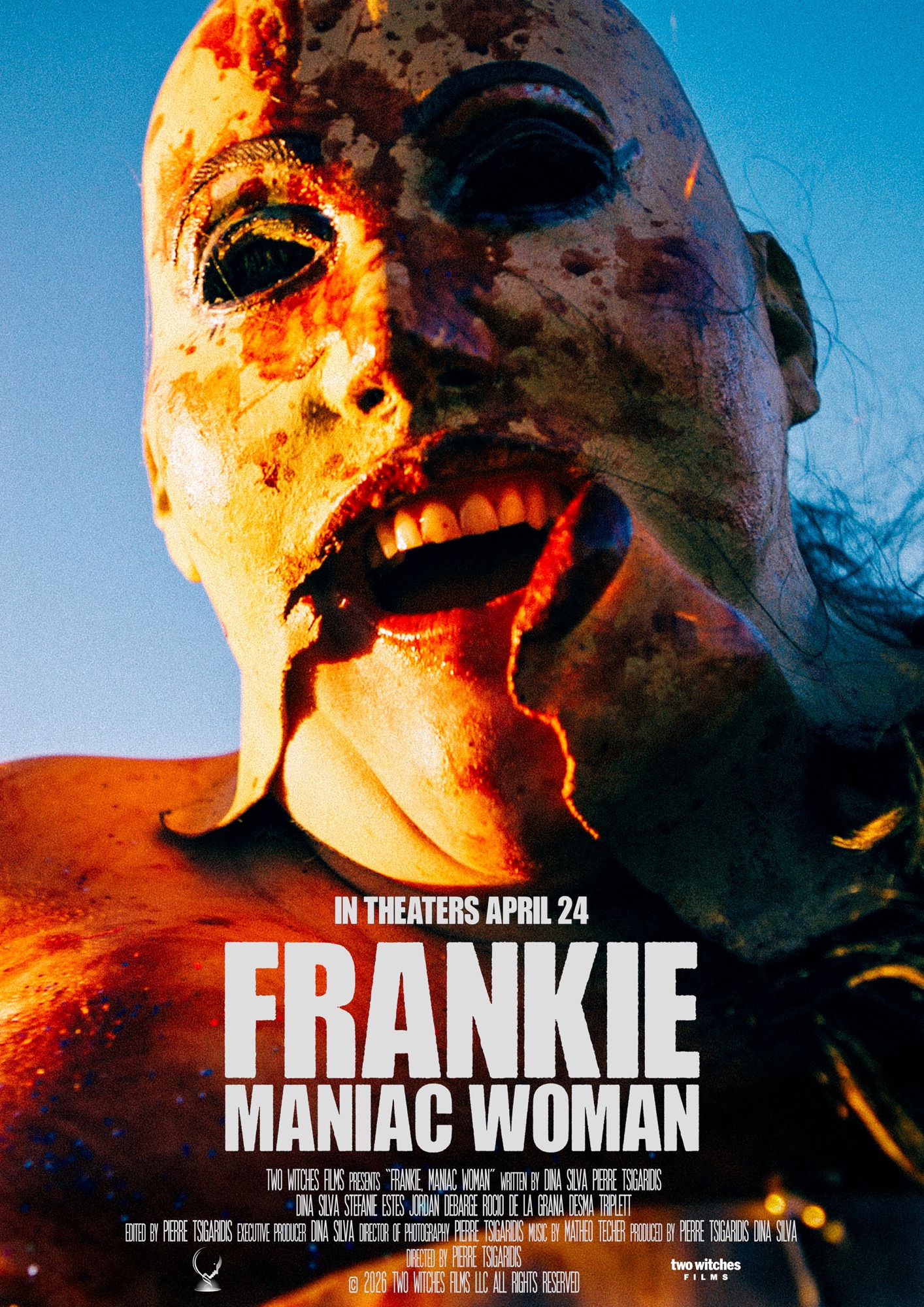


Frankie, Maniac Woman” opens with a charge that never settles, and Dina Silva carries that charge through every corner of Pierre Tsigaridis’ bruised, grime‑streaked world. The film pushes past its low‑budget slasher shell and turns its attention toward the machinery that shapes and distorts women in horror. Frankie’s unraveling becomes a confrontation with the forces that dismissed her pain long before the bloodshed began, and the film’s tension grows from that refusal to let her story be reduced to a trope.
Silva’s performance gives the film its deepest cut. Her Frankie Ramirez moves through the LA music scene with the weight of childhood trauma, internalized misogyny, and relentless body scrutiny pressing against her. Tsigaridis surrounds her with a cast that sharpens the film’s emotional stakes—Rocío de la Grana’s Lola, Jordan Kelly DeBarge’s Celeste, Stefanie Estes’ Claire, and Daniella Mendoza’s Mother each reveal another angle of the world that shaped Frankie’s breaking point. These characters aren’t presented for exposition; they become the pressure points that push the film’s critique into focus.
Tsigaridis leans into grime and claustrophobia, and those choices deepen the film’s argument. The camera lingers on rooms that feel scraped raw, on faces that refuse to soften, on moments where silence swells until it becomes its own threat. The violence arrives without polish, abrupt and mean, and that roughness underscores the film’s insistence that brutality is not spectacle but consequence. The aesthetic choices echo Frankie’s internal collapse, turning the film’s world into an extension of her unraveling.

The film’s ambition occasionally outruns its structure. Its shifts between revenge thriller, psychological spiral, and exploitation echo are bold but not always seamless. Yet the unevenness feels tied to the film’s larger purpose: to expose the instability of the “psycho woman” narrative and the eagerness with which society labels female rage as madness. The film keeps asking why no one around Frankie listens, and why the label of “maniac” is so readily applied to a woman who refuses to stay small.
By the end, the question isn’t whether Frankie is dangerous but who benefits from declaring her unhinged. “Frankie, Maniac Woman” is confrontational, messy, and alive with intention. It reaches for something sharper than its budget and lands enough blows to make its point felt. The result is a mixed‑to‑positive work of indie horror anchored by a performance that refuses to flatten itself into stereotype.
Letter Grade: B


Leave a Reply