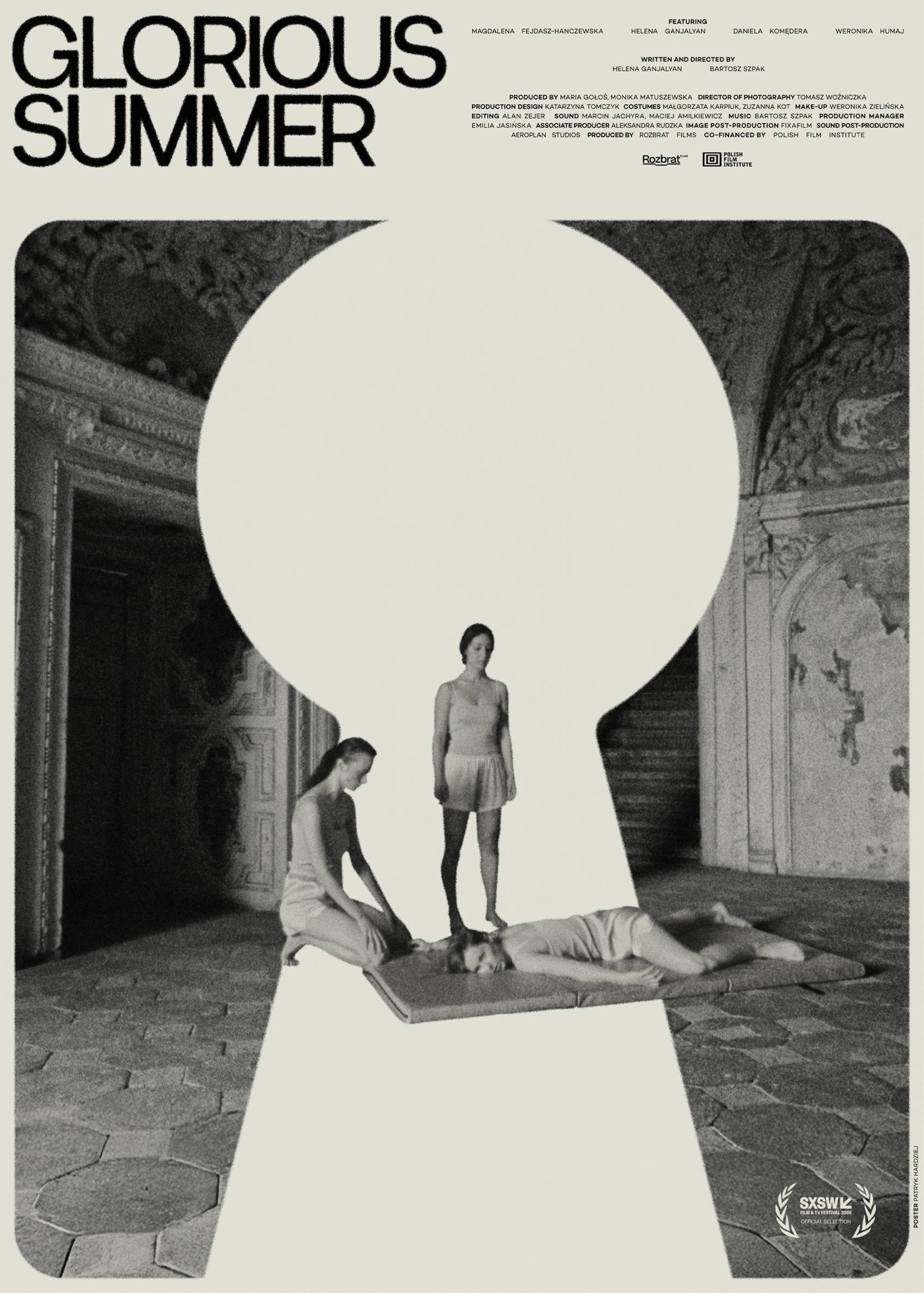


Glorious Summer opens in a Renaissance palace sealed from the world, and Magdalena Fejdasz becomes the pulse of that enclosure, her presence steady in a place where certainty dissolves. What Helena Ganjalyan and Bartosz Szpak build is an atmosphere of ritual and drift, and the review must begin there, because the film’s power comes from how its surfaces unsettle. The directors refuse to anchor the viewer in geography or history, and that refusal becomes a critique of systems that promise safety while eroding the imagination. Their restraint sharpens the film’s tension rather than softening it, and the result is a debut that feels both deliberate and raw.

The plot’s minimalism is not a weakness so much as a frame for the film’s deeper concerns. Three women—Fejdasz, Ganjalyan, and Daniela Komędera—live under the rule of a disembodied voice that provides food, instruction, and purpose. The palace glows, the days stretch, and the women move through routines that appear harmless until the edges fray. The film’s most striking achievement is how it turns comfort into a form of pressure. Tomasz Woźniczka’s cinematography keeps the estate luminous, yet the brightness carries a faint chill, a reminder that beauty can be engineered to distract from confinement. The film’s critique of curated realities emerges through these choices rather than through exposition.

Fejdasz gives the film its emotional center. Her resignation, her small hesitations, her quiet refusals—these gestures accumulate into a portrait of someone who has begun to sense the shape of the cage around her. Ganjalyan, playing the group’s de facto leader, pushes against the system with a sharper edge, and the contrast between the two performers becomes a study in how doubt forms. Komędera’s innocence, meanwhile, exposes the cost of surrendering one’s judgment to a benevolent-seeming authority. The film’s allegory deepens through these performances, each one revealing a different response to a world that claims to know what is best.

The annual ritual known as Glorious Summer becomes the film’s hinge. The women prepare for it without understanding its origins, and the directors wisely avoid explaining its purpose. The event becomes a test of perception rather than a narrative twist. Their participation—hesitant, dutiful, or eager—reveals the degree to which each woman has internalized the rules that govern them. When a fourth woman arrives, played by Weronika Human, the film briefly wavers, raising questions it cannot fully explore. Yet even this stumble reinforces the film’s argument: once a system’s logic begins to crack, the fractures multiply faster than they can be managed.

By the end, Glorious Summer has become a meditation on the seductions of structure and the difficulty of imagining alternatives. Alan Zejer’s editing keeps the film taut, Katarzyna Tomczyk’s production design turns the palace into a gilded enclosure, and Szpak’s score hums with a quiet dread that never overwhelms the film’s lyricism. This is a film—uneven in its final stretch, but rich in mood, intention, and craft. It lingers because it understands how easily comfort becomes control, and how awakening begins with the smallest shift in attention.

Letter Grade: B+.


Leave a Reply