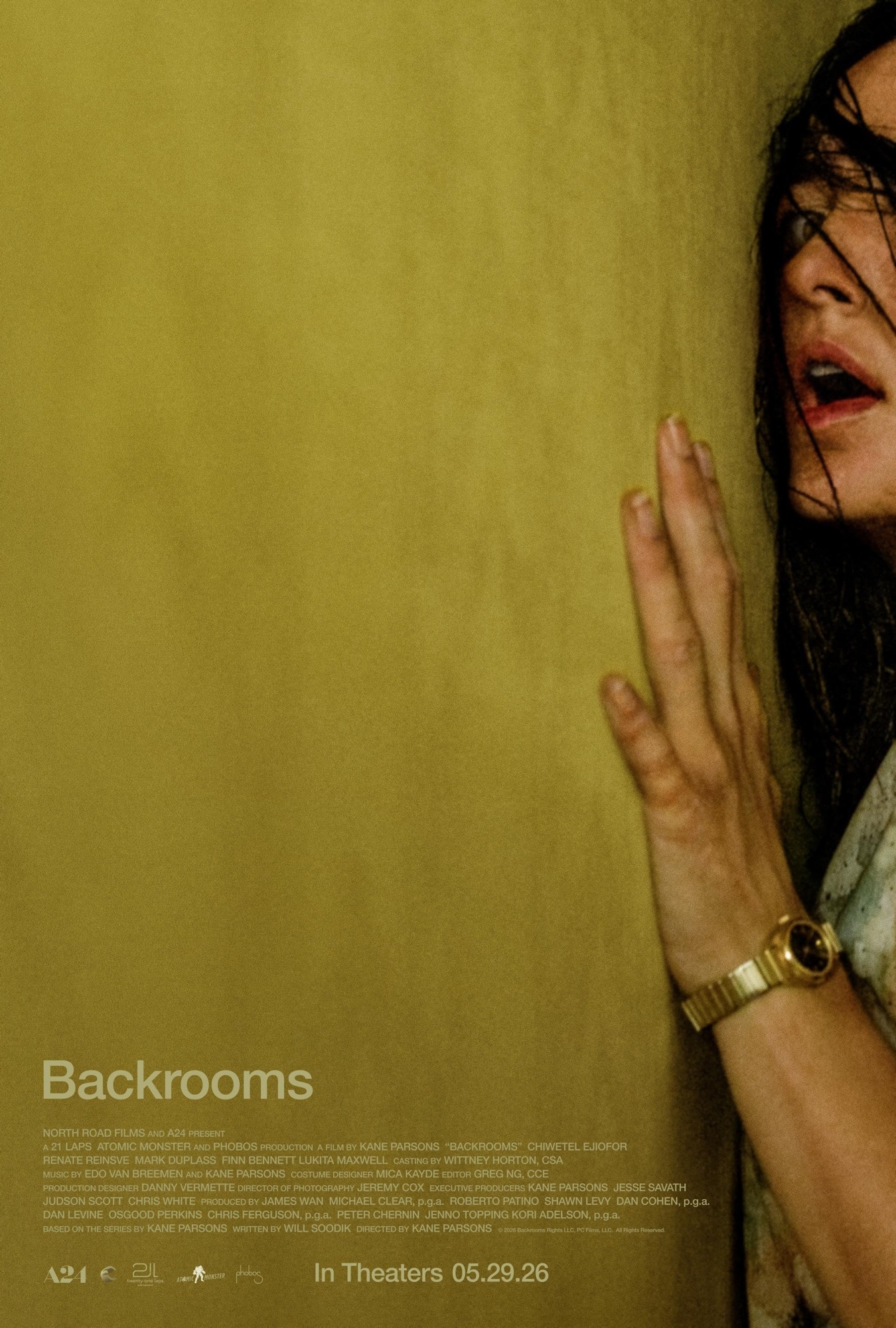


Kane Parsons’ Backrooms begins with a sound — fluorescent hum, steady and indifferent — and from that hum builds a world of memory and menace. The film’s opening sequence, a lone worker lost in yellow corridors, sets the tone: horror born from banality. Parsons, whose YouTube series first mapped this digital mythology, expands the concept into a feature that feels both ambitious and claustrophobic. The result is a film that understands dread as architecture, not event.

Chiwetel Ejiofor’s Clark enters this maze through the ordinary. His life, a furniture store and a therapist’s office, is already a series of rooms. Parsons uses these spaces to mirror the backrooms themselves — fluorescent, empty, humming with suppressed emotion. Ejiofor’s performance is taut, his anger and grief folded into silence. When he steps through the portal, the film shifts from realism to ritual. The transition is not spectacle but pressure, a slow collapse of boundaries.

Renate Reinsve’s Dr. Mary Kline follows him, her composure unraveling into obsession. Parsons frames her descent as both pursuit and confession. The therapy sessions echo through the maze, their dialogue returning in distorted fragments. The film’s editing turns repetition into rhythm, each cut a reminder that the mind’s corridors are endless. Reinsve’s performance carries the film’s emotional weight, her restraint giving way to panic without melodrama.

Parsons’ visual design remains the film’s most striking achievement. The yellow walls, the carpet stains, the hum — all rendered with precision. The camera lingers on corners and thresholds, turning emptiness into texture. The found-footage sequences, grainy and unstable, restore the original creepypasta’s intimacy. Yet the expansion to feature length exposes the concept’s fragility. The mystery stretches thin, and the film’s middle passages drift toward exposition.

Still, the film’s imperfections feel deliberate. Parsons seems aware that the backrooms cannot be fully explained without losing their power. The narrative’s strain becomes part of its tension — a commentary on the impossibility of translating internet myth into cinematic coherence. The corporate experiments and conspiracies flicker at the edges, never resolving. The film’s refusal to clarify becomes its own aesthetic stance.

Ejiofor’s Clark embodies that uncertainty. His masculinity, wounded and defensive, becomes the film’s emotional core. Parsons uses him not as hero but as vessel, a man whose rage fills the empty halls. The camera watches him dissolve into the architecture, his movements echoing through the fluorescent hum. The horror is not the monster but the persistence of space — the way it absorbs identity until only motion remains.

Reinsve’s Kline, in contrast, seeks meaning. Her descent into the backrooms is an act of empathy, not curiosity. Parsons turns her search into a meditation on therapy itself — the attempt to navigate another’s labyrinth. The film’s final act, fractured and dreamlike, finds her confronting the futility of understanding. The maze does not end; it only folds inward. The film’s rhythm slows, its light dims, and the hum deepens.

Parsons’ direction reveals both promise and limitation. His control of tone is remarkable, his sense of atmosphere exact. Yet the film’s ambition exceeds its structure. The mythology, once haunting in its simplicity, becomes burdened by explanation. Still, the film’s sincerity rescues it. Parsons believes in the horror of the ordinary, and that belief gives Backrooms its pulse.

Backrooms earns a B. It is uneven but absorbing, a film that turns internet myth into cinematic meditation. Ejiofor and Reinsve bring gravity to abstraction, and Parsons proves himself a filmmaker of texture and tension. The hum continues, the rooms remain, and the viewer leaves haunted by the persistence of space.


Leave a Reply