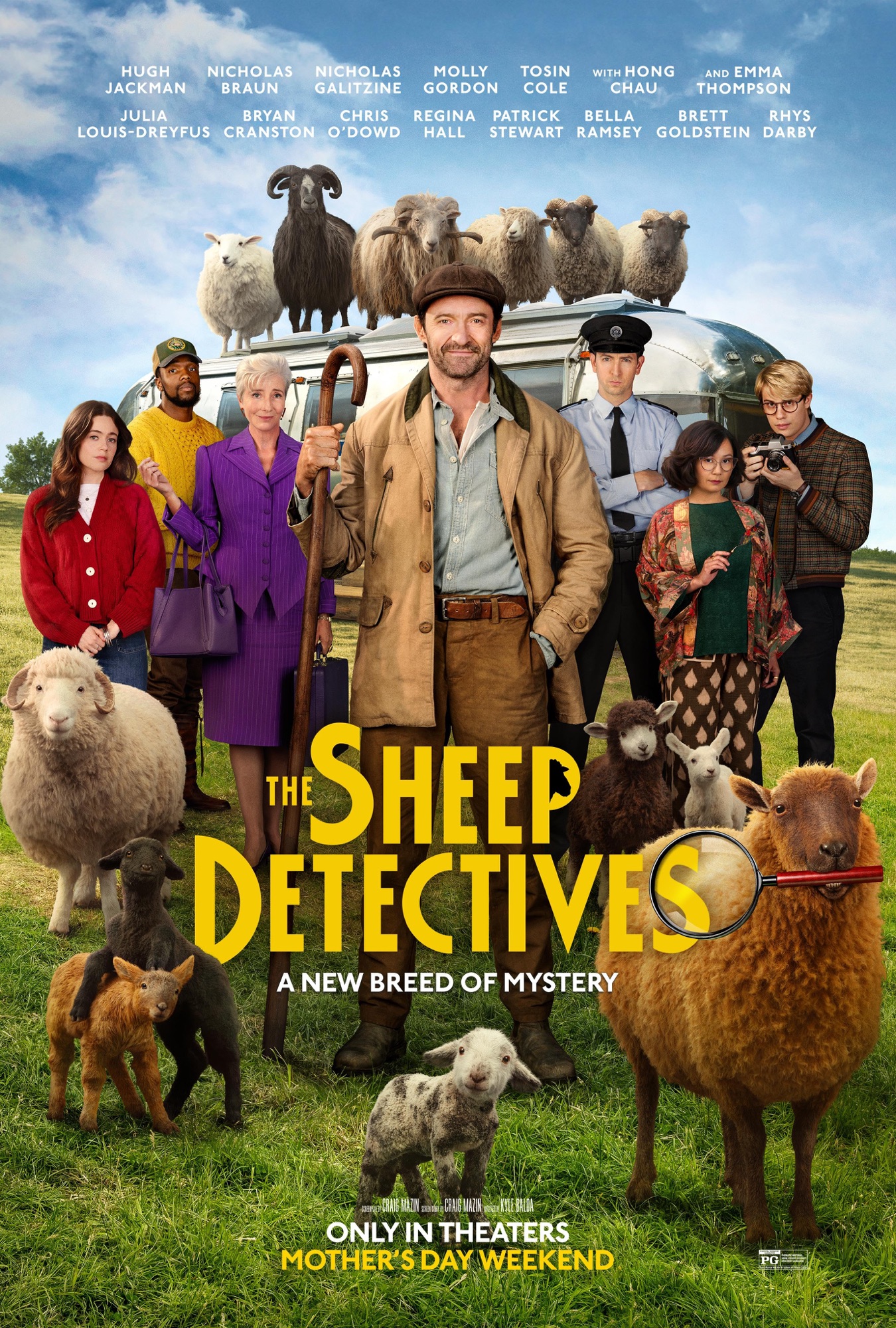


Kyle Balda’s The Sheep Detectives arrives with the air of a dare. Hugh Jackman tends a flock that listens to mystery novels, a flock that later decides to solve his murder, and the film never apologizes for its premise. That refusal becomes its strength. The story leans into its oddness until the oddness turns sturdy, a frame that can hold grief, inheritance, cruelty, and the stubborn tenderness that keeps a community from collapsing.

Balda shapes the film with a steady hand, letting the absurdity breathe without letting it drift. The early scenes with George Hardy and his sheep establish a rhythm of care that becomes the film’s emotional spine. Jackman plays George with a gentleness that never curdles, grounding the film each time it threatens to float away. His absence, once the sheep find him dead, creates a hollow that the film keeps returning to, a hollow that gives the mystery its weight.

The investigation that follows is both playful and pointed. Julia Louis-Dreyfus voices Lily with a sharpness that cuts through the woolly chaos, and the script uses her intelligence to interrogate the village’s assumptions. Nicholas Braun’s Tim Derry stumbles through the case with a clumsy charm that masks the film’s critique of institutional incompetence. His missteps are not just jokes; they expose how easily authority can be misled when it trusts its own certainty more than the evidence in front of it.

The will-reading sequence at the inn is where the film’s machinery clicks into place. Molly Gordon’s Rebecca enters the story with a mix of confusion and resolve, and the revelation of George’s hidden fortune reframes every relationship in the room. The film uses this moment to explore how money distorts grief, how inheritance can turn a death into a contest. Emma Thompson’s Lydia Harbottle sharpens each exchange with a lawyer’s precision, and the tension between the villagers becomes a second mystery running beneath the first.

Balda and screenwriter Craig Mazin refuse to let the sheep remain a gimmick. Mopple’s inability to forget becomes a quiet indictment of the flock’s collective amnesia, a habit that mirrors the village’s own desire to smooth over its darker histories. Bryan Cranston’s Sebastian deepens this thread, his sacrifice landing with a force that the film earns through restraint. The moment Lily confronts the truth about death marks a shift in tone that feels earned, a recognition that innocence is not the same as ignorance.

The film’s final act tightens the threads with surprising elegance. The reveal that Elliot Matthews is Peter Hampstead, George’s son, gives the story a human villain whose motives are rooted in resentment rather than melodrama. The detail of the mixed dyes on George’s hand is a clever touch, a physical clue that honors the genre’s traditions without feeling mechanical. When the twin rams Reggie and Ronnie bring Peter down, the moment carries both humor and justice, a release that satisfies without softening the film’s darker implications.

Rebecca’s decision to take ownership of the meadow restores the story’s balance. Her reading of George’s guide to the flock closes the film on a note of continuity rather than closure. Lily’s naming of the winter lamb as George extends that continuity into the future, a gesture that acknowledges loss without erasing it. The film earns its sentiment through the pressure it applies to every earlier scene.

What lingers after the credits is the film’s commitment to treating its audience with respect. Balda trusts viewers to hold humor and sorrow in the same breath. He trusts children to understand death without being shielded from it. He trusts adults to embrace wonder without embarrassment. The film’s lyricism grows from that trust, from its willingness to let the strange remain strange while still insisting on its emotional truth.

The Sheep Detectives is not flawless. Its pacing wobbles in the middle, and a few supporting characters fade before their arcs resolve. Yet the film’s ambition, its tonal balance, and its refusal to condescend make it a rare thing: a family mystery that honors both halves of that phrase. It stands in the tradition of PG films that once held entire households in their grip, and it suggests that such films still have a place.


Grade: B+


Leave a Reply