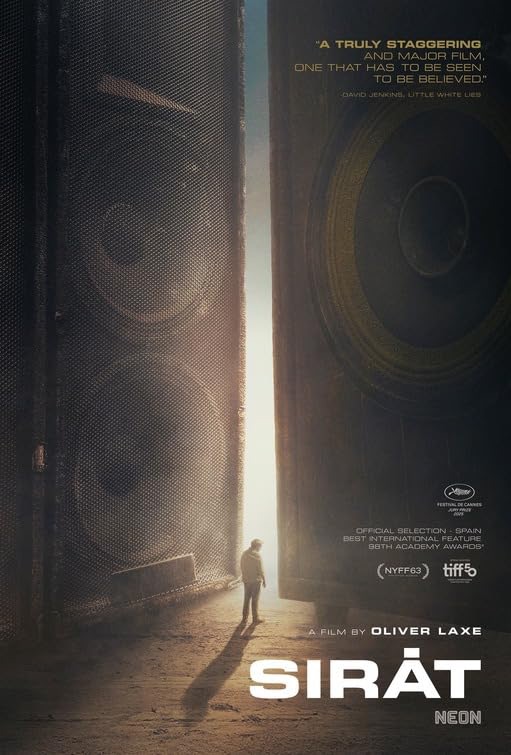


Life and death and everything in between — the laughter and the mourning — takes place in Oliver Laxe’s Sirat, a film that moves with a strange, unsettled pulse. Sergi López anchors it with a performance built on endurance and bewilderment, and the film around him keeps shifting its ground, refusing to settle into anything predictable. You’re never sure what will happen, which piques your interest, even when the uncertainty tightens your breath. Laxe shapes this drift into something sincere, mesmerizing, and admirably unorthodox, a work that invites your love and tests your patience in equal measure.

The premise is simple enough: a father and son searching for a missing daughter across the deserts of southern Morocco, pulled into the orbit of ravers whose hedonism masks deeper fractures. Yet Laxe refuses to let the plot sit still. Every narrative beat folds into a broader meditation on peril, devotion, and the strange communities forged under duress. The film’s power comes from how each event is held up to the light of its consequences, never allowed to exist as spectacle alone.

The path in Sirat narrows gradually, amid minor troubles, significant hardships and periodic shocks of beauty. The ravers motoring through the desert night, enveloped in inky black and swells of dust, become one of the film’s defining images, a vision of youth and abandon pressed against the vastness of a world collapsing at its edges. Laxe’s staging and shooting are polished without feeling ornamental, and the cinematography — shot on film — carries a grain that deepens the sense of fragility. The editing sharpens this effect, cutting with a rhythm that feels both intuitive and destabilizing.

As Luis, Esteban, and the ragtag group push deeper into the desert, the film’s tone grows more severe. Yet Laxe maintains a striking equanimity toward the characters, which can feel like a spiritual ethos. He doesn’t judge them, including politically, and he doesn’t ask you to do the same, even at their most reckless. Their choices unfold without moral punctuation, and the film trusts you to sit with the discomfort of their impulses and the tenderness of their attempts to care for one another.

The tragedies accumulate: Esteban’s death, Pipa’s death, the ravers’ mounting losses. Each moment is framed not as a narrative twist but as a rupture in the fabric of the journey. López carries these ruptures with a haunted stillness, and the ensemble around him — Stefania Gadda, Joshua Liam Henderson, Richard Bellamy, Tonin Janvier, Jade Oukid — gives the film its shifting emotional temperature. Their camaraderie, their exhaustion, their attempts at joy, all register with a raw immediacy.

These qualms fade when, at last, they cross into hell during a scene of such shocking violence that the pounding of your heart could drown out any electronic beat. It’s quick and unsparing. It’s near-unbearable, and as powerful as it is narratively useful. The minefield sequence becomes the film’s crucible, a place where grief, terror, and stubborn will converge. Laxe stages it with a severity that refuses catharsis, insisting instead on the weight of each step.

If Sirat were another kind of movie, its spasms of violence could seem like quasi-Brechtian provocations — a way to push and punish viewers, forcing them out of their ostensible complacency. Yet Laxe’s focus on existential dangers never feels like an intellectual assault or a nihilistic bleat. It reads instead as an assertion of life in its raw totality, a recognition that beauty and brutality often occupy the same breath. The film’s harshness becomes a form of honesty.

The final stretch — the survivors crossing the desert on the roof of a train — lands with a muted, aching grandeur. It’s not triumph, not defeat, but continuation. Laxe refuses to grant closure, and the refusal feels earned. The world of Sirat is too fractured for neat endings, too alive for despair. The film leaves you suspended between awe and sorrow, unsure where to place your emotional footing.

What lingers most is Laxe’s insistence on asking so much of you as a viewer, including your indulgence for other people’s frailties — for their humanity. He’s adept at seducing and charming you, but he’s even more adept at demanding your attention to the smallest tremors of behavior, the quietest shifts in allegiance, the most fragile attempts at connection. The film’s flaws — its indulgences, its narrative looseness — become part of its texture, part of its argument about the mess of being alive.

Sirat is beguiling, flawed, at times bonkers, and deeply moving. It’s a film that refuses to guide you gently, preferring instead to pull you into its dust, its danger, its strange pockets of grace. In the end, it earns its place among Laxe’s most ambitious works, a testament to his belief that cinema can still confront the world without flinching.

LETTER GRADE: A. On Hulu.


Leave a Reply