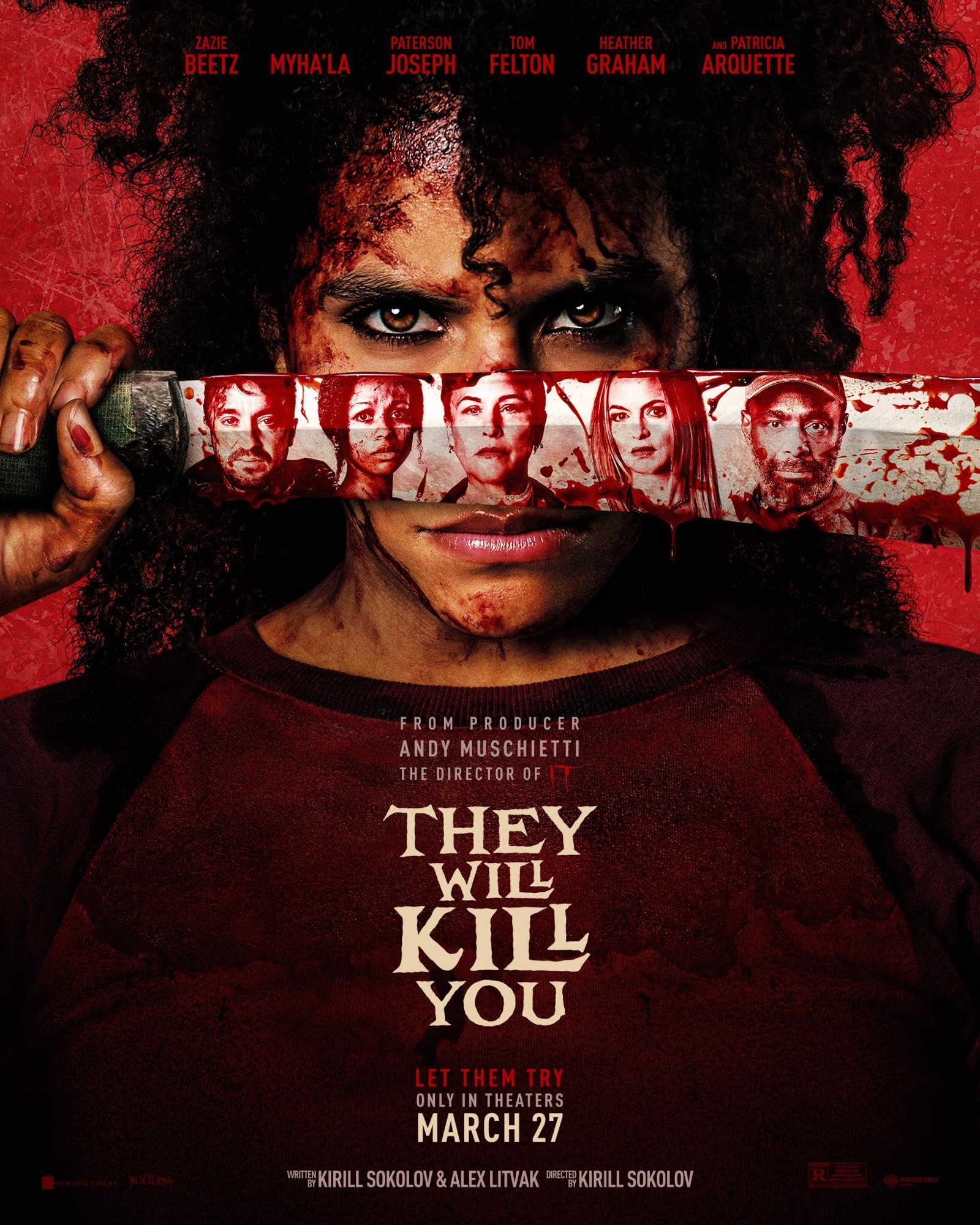


In They Will Kill You, The Virgil rises in the mind before the story does, its yellowed bedrooms and bruised hallway moldings forming a kind of architectural dare. Kirill Sokolov leans into that dare with a production design team that works at full voltage, building a boutique hotel that feels engineered for dread. The trouble is that the screenplay he co-wrote with Alex Litvak never meets that same level of invention, drifting toward the sense of a project shaped by fanboys tossing ideas into a communal pit. The film survives this imbalance through force of style and the sheer presence of Zazie Beetz, who turns Asia Reaves into a figure of relentless forward motion.

Asia’s arrival at the Virgil becomes the film’s first real jolt, not because of the plot mechanics—those are a spoiler minefield—but because Sokolov treats the building as a game map. Every corridor suggests a new rule. Every floor hints at a hidden boss. The masked intruders who descend on Asia in her sleep move with the logic of respawning enemies, and the film’s refusal to explain them early on gives the action a strange, ritualistic charge. The critic who reveals who “they” are or why they might kill “you” would be doing the audience a disservice; the film’s pleasures depend on the slow, unnerving discovery of the Virgil’s purpose.

Beetz anchors the chaos with a performance built on tension and refusal. Asia’s past—her father’s violence, her sister Maria’s disappearance, the decade of separation—presses into every decision she makes. The film never lets these details drift into melodrama. Instead, they sharpen the violence, turning each confrontation into a negotiation with memory. When Asia tears through the Virgil’s vents or stands her ground against resurrecting attackers, the action becomes a form of testimony.

The supporting cast deepens the film’s odd tonal blend. Patricia Arquette’s Lilith Woodhouse rules the Virgil with a brittle, ceremonial calm. Paterson Joseph gives Ray a wounded dignity that complicates the building’s hierarchy. Tom Felton and Heather Graham lean into the cultists’ theatrical menace, their performances echoing the “Ready or Not” comparisons that have followed the film since its earliest festival whispers. These characters never settle into realism, but the film doesn’t want realism. It wants a world where ritual and violence share the same breath.

The time-hopping structure pushes the film toward a fractured rhythm. Sokolov cuts between past and present with a confidence that occasionally slips into overstatement, yet the gambit pays off when the film reveals the full shape of Maria’s story. Myha’la plays her with a guarded stillness that becomes more unsettling as the truth of her allegiance emerges. The film’s emotional core rests in the sisters’ collision, and the screenplay finds its rare moments of clarity when it lets them speak plainly.

The violence carries a cartoonish exuberance that recalls Tarantino’s “Kill Bill,” especially in the arterial bursts and the choreography of Asia’s payback. Sokolov pushes the gore toward the edge of absurdity, then pulls it back with a detail that stings—a burned axe, a sentient eyeball, a pig’s head that speaks with the voice of James Remar. These flourishes give the film its pulse. They also expose the thinness of the writing, which often relies on shock when it could reach for something stranger or more precise.

Still, the film’s commitment to its own mythology keeps it from collapsing. The Virgil’s Satanic underpinnings, the immortality bargain, the ritual inscriptions on the pig’s skin—these elements form a cosmology that feels both ludicrous and oddly coherent. When Maria chooses her fate at the film’s climax, the gesture lands with unexpected weight. The film earns that moment through its willingness to push its world to the brink.

The final duel between Asia and Lilith becomes a study in endurance. The bleach, the fire, the collapsing hierarchy of the cult—each beat feels earned through the film’s accumulation of detail. When Asia escapes with Maria’s body, the story resolves not through triumph but through a grim acknowledgment of what survival costs. The explosion that follows is less a punctuation mark than a release of pressure.

“They Will Kill You” is a film built on contradictions: lavish production design paired with thin writing, committed performances set against a narrative that strains under its own mythology, moments of genuine emotional force surrounded by spectacle. Yet the contradictions never fully undo it. The film moves with a feverish confidence, trusting its imagery to carry what its script cannot. In the end, the Virgil stands as its own argument—a place where horror becomes architecture and survival becomes ritual.

Letter Grade: B.


Leave a Reply