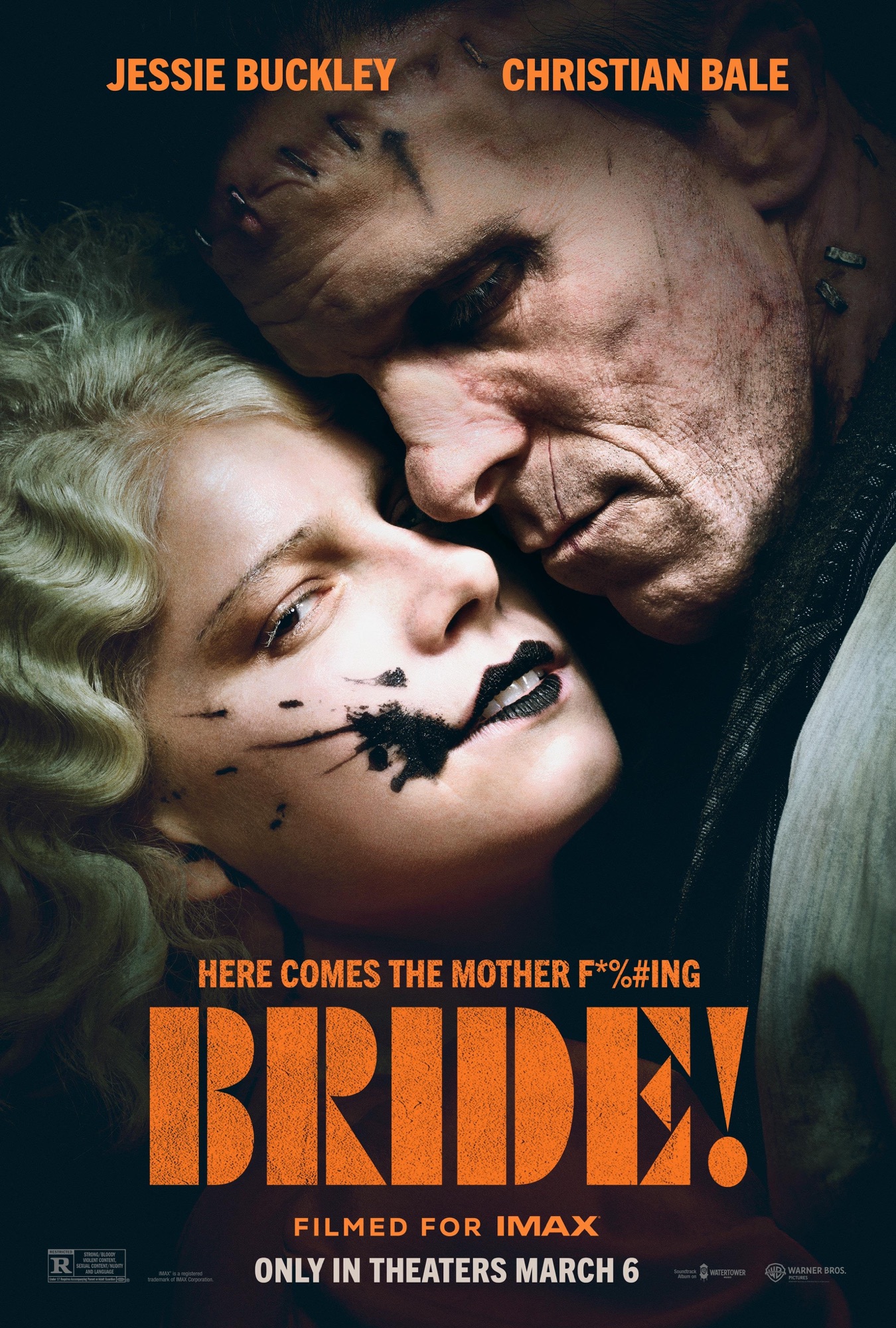


Maggie Gyllenhaal’s The Bride! arrives a stitched‑together fever dream—part resurrection ritual, part backstage musical, part feminist séance—and somehow, against all odds, it thrums with life. The film draws a bold if wobbly line from Mary Shelley’s age to our own, insisting that the monstrous woman remains a figure of power, danger, and necessary disruption. It’s a movie that yowls, growls, shrieks, and occasionally bursts into song, as if the exclamation point in its title were a command rather than punctuation.

Gyllenhaal writes and directs with ecstatic overabundance, throwing tones and genres like sparks from a live wire. The result doesn’t always cohere, but its energy is undeniable—handsome, unruly, and propelled by a cast that keeps the film’s wildest impulses tethered to something recognizably human. Even when the movie threatens to spill over, you feel the pulse beneath the chaos.

At the center of this unruly creation stands Jessie Buckley, playing both Mary Shelley and Ida, the murdered woman who becomes the Bride. As Mary, Buckley emerges in chiaroscuro, eyes lit like storm lamps, delivering her narration with the weary authority of someone who has lived too long and died too often. She’s immortal, she tells us, and also dead—a contradiction the film treats as a kind of thesis. Buckley’s Mary is a totem of female imagination, a witness to centuries of monstrousness, and a woman still sharpening her teeth.

Ida, by contrast, is all heat and impulse—a bottle‑blonde gangster’s moll in 1930s Chicago, smeared mascara, dangerous grin, a spark waiting for a fuse. Buckley plays her with a softness tempered by grit, a vulnerability that never collapses into fragility. Even before she dies, Ida feels like someone the world has already tried to bury. Her resurrection only makes that truth literal.

Enter Frank—Christian Bale’s unexpectedly tender, melancholy take on Frankenstein’s monster. Bale gives Frank a bruised charm, a hulking gentleness that makes his longing feel almost holy. When he asks Dr. Euphronius (a sharp, dry Annette Bening) to build him a companion, the request lands less as a demand and more as a plea from a creature who has tasted loneliness too deeply.

The film’s plot—Frank and Ida reborn, running through Chicago hand‑in‑hand, pursued by police, gangsters, and the weight of myth—plays like a cracked‑mirror version of Bonnie and Clyde. Gyllenhaal leans into the outlaw romance, letting the pair’s dead‑hand‑in‑dead‑hand flight become a kind of liberation fugue. They aren’t just escaping danger; they’re escaping the roles the world keeps trying to force them into.

Gyllenhaal overloads the film with references, ideas, and tonal swerves—sometimes to the point of exhaustion. Scenes linger past their peak, images repeat, metaphors collide. Yet even in its excess, the film feels alive, as if it’s trying to hold too many truths at once: the horror of being made, the thrill of remaking oneself, the ache of wanting a world that doesn’t yet exist.

What grounds the film, again and again, is Buckley. Her dual performance becomes the movie’s spine—Mary the creator, Ida the creation, both women furious at the ways their bodies and stories have been claimed by others. Buckley plays them with a shared resilience, a history of wounds carried like armor. She gives the film its emotional pressure, its sense of something ancient pushing through the cracks.

Despite the ooze and spew, The Bride! isn’t interested in terror. Gyllenhaal wants to entertain, to seduce, to make you laugh, then peel back the skin and show you the rawness underneath. She rallies for women to bite off tongues rather than swallow them. The film’s feminist howl is messy, sometimes incoherent, but always heartfelt—an unruly cri de coeur for anyone who has ever been told to stay small, stay pretty, stay dead.

By the end, The Bride! feels like a creature stitched from contradictions: exhausting yet exhilarating, indulgent yet sincere, chaotic yet strangely moving. It may lurch, but it lurches with purpose. Gyllenhaal has made a film that refuses to behave, refuses to apologize, refuses to die. In its wildness, it honors Mary Shelley’s legacy: a woman who birthed a monster to tell the truth about the world, and in doing so, became immortal.

Letter Grade: B+.


Leave a Reply