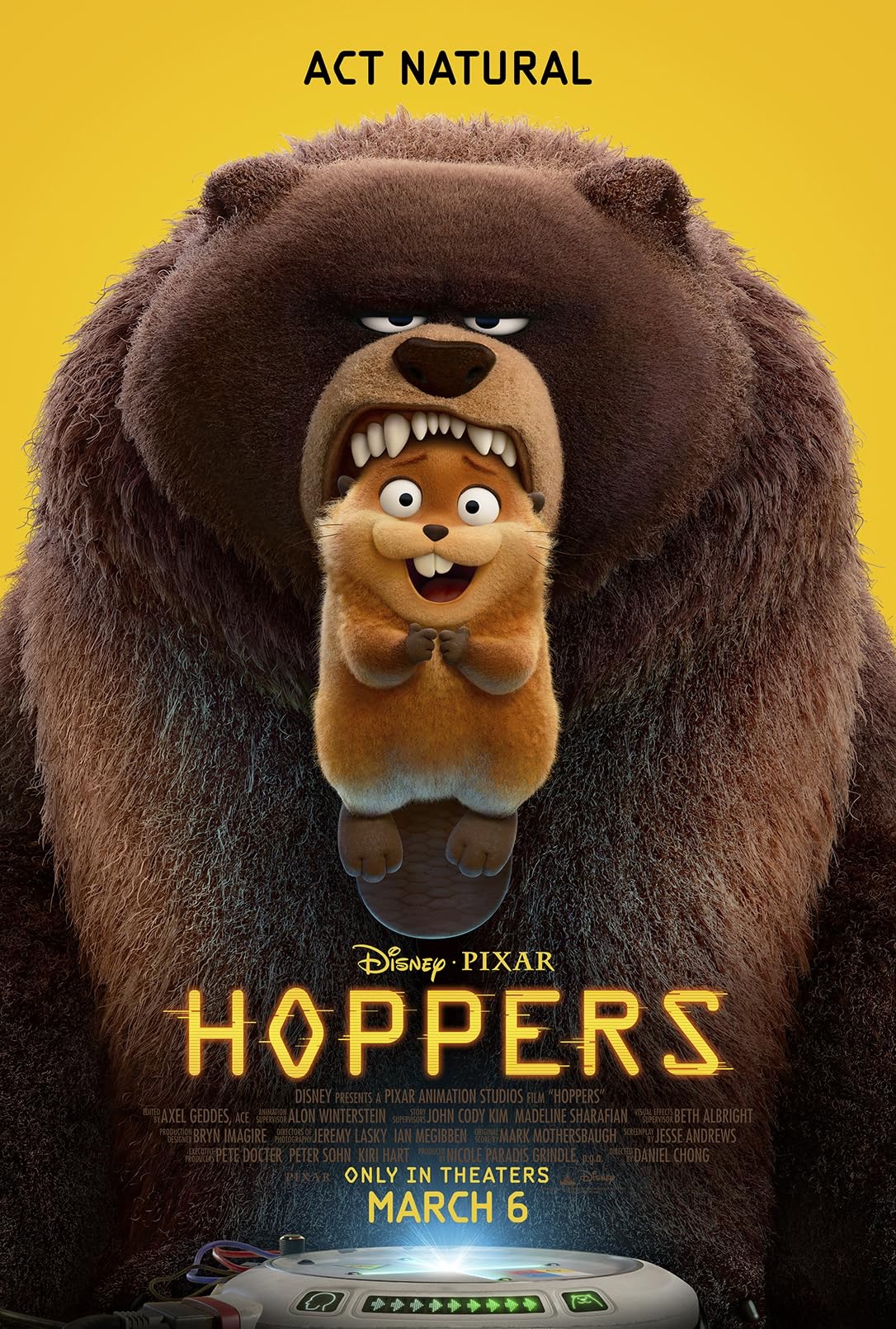


Hoppers opens with the soft thrum of a glade on the brink of erasure, and Daniel Chong treats that threatened patch of forest as both memory and battleground. The film moves with a lyric pulse—half ecological lament, half screwball adventure—and Jon Hamm’s Jerry Generazzo strides through it with the swagger of a man who’s never met a habitat he didn’t want to pave. The tone is the film’s first gift: playful, lightly absurd, and threaded with a melancholy that gives the story its gravity.

Pixar has always loved its taxonomies—its worlds where emotions have departments, monsters have unions, and toys have hierarchies. Hoppers joins that lineage with a science‑nerd grin, reveling in the categories, subcategories, and food‑chain politics of the animal kingdom. The world-building feels like a field guide come to life, full of the strange logic of ecosystems, and that delight becomes its own emotional engine.

The charm is immediate: pudgy beavers with bureaucratic tendencies, caterpillars with dynastic ambitions, a goose monarch who speaks as if he’s perpetually on the verge of declaring war. The absurdity is textured and specific. Even the jokes that miss feel rooted in the instincts and anxieties of actual creatures rather than human stand‑ins.

At the center is Mabel Tanaka, whose grief for her grandmother becomes the film’s quiet undertow. Her decision to “hop” into a robotic beaver—against the wishes of Dr. Sam Fairfax—sets off a chain of events that feels both madcap and mythic. What begins as an act of desperation becomes a revelation: the animal world is not simply cute or chaotic but structured, political, and full of its own heartbreaks. When Mabel discovers what Sam has been hiding, the film shifts into a deeper register, suggesting that scientific knowledge always carries a cost.

Jesse Andrews’s screenplay is clever, sometimes too clever, spinning plates of metaphor, ecological ethics, slapstick, and political satire. It’s no Toy Story, and it doesn’t need to be. The ambition occasionally outpaces the clarity, but the heart stays steady, and the humor sharpens the edges rather than smoothing them. A sly metaphor about artificial intelligence hums beneath the surface, but the film trusts the audience enough not to underline it.

Talking animals have become a tired trope in animation, but Hoppers dodges the trap by letting its creatures remain creatures. They don’t quip like sitcom characters; they behave with instincts, appetites, and territorial logic. This choice gives the film a refreshing realism, a sense that the animal kingdom is not merely a stage for human projection but a parallel society with its own rules.

The emotional core is the relationship between Mabel and King George, voiced with wounded nobility by Bobby Moynihan. Their bond is tender without tipping into sentimentality, funny without leaning on cuteness. When Mabel’s impassioned speech accidentally incites an assassination plot, the film reveals its sharpest insight: coexistence is messy, and good intentions can be dangerous.

The movie’s action crescendos into a sequence that is both hilarious and genuinely tense—a shark dropped onto a car, a butterfly monarch with delusions of grandeur, a wildfire threatening to swallow the glade. Through it all, Chong maintains emotional clarity: this is a story about responsibility, about the cost of living alongside other species, and about the courage required to inconvenience yourself for the sake of the world.

The final act, in which George sacrifices the dam to save Beaverton, lands with unexpected force. It’s a gesture of ecological reciprocity, a reminder that survival is collective rather than competitive. The closing moments—Mabel and George communicating through text‑to‑speech and emojis—carry a strange, quiet ache, a testament to friendships that outlast bodies, technologies, and even language.

Hoppers may not reach the mythic heights of Pixar’s most iconic films, but it earns its place among the studio’s most thoughtful. It’s a fable with teeth, a comedy with a conscience, and a story that understands coexistence as a practice rather than a slogan. In a world engineered for convenience, Hoppers argues—with humor, warmth, and conviction—that the better path is the one that leaves room for others.

LETTER GRADE: B+.


Leave a Reply