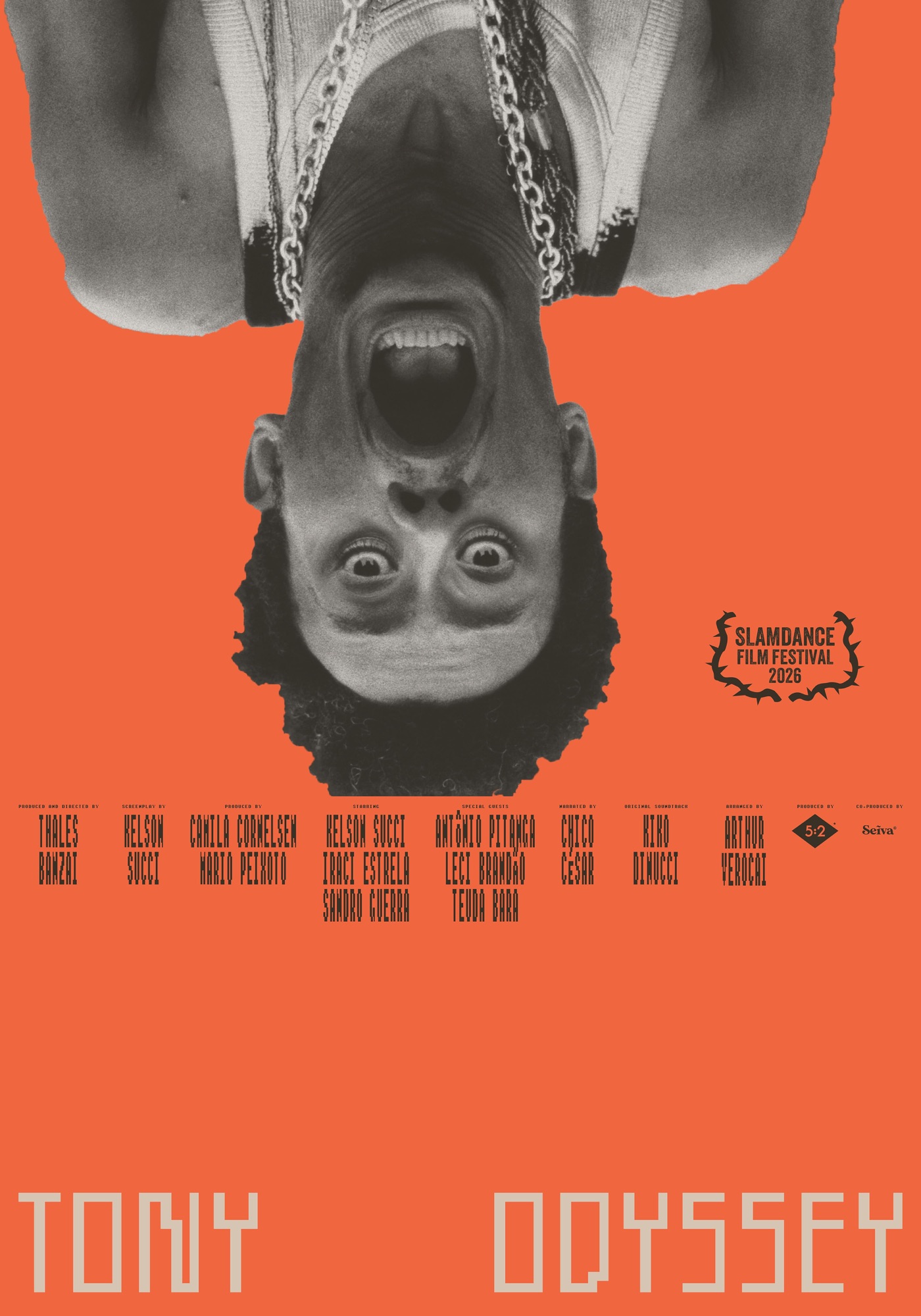


Tony Odyssey opens with a pulse already fraying at the edges, a portrait of a man whose days have been sanded down to a single exhausted gesture. Kelson Succi plays Tony with a worn‑in gravity, a young man trapped in a roadside bar that feels less like a workplace and more like a sentence. Thales Banzai leans into this oppressive routine until it becomes a kind of drone, a hum that fills the frame with a pressure that begs for rupture.
That rupture arrives through Ivy, played with sharp, restless energy by Iraci Estrela. Her arrival cracks the shell Tony has been living inside, pushing him toward a heist that is less about money and more about possibility. The film’s early stretch thrives on this tension: the sense that Tony has been waiting for someone to remind him he is still capable of wanting something beyond survival.
Once the drug enters their bloodstream, the film shifts into a new register, one where every image feels pulled from the corners of Tony’s mind. Banzai indulges in surreal detours—absurd, jagged, and strangely tender—each one revealing the parts of Tony that have rusted from disuse. These passages give the film its pulse, its willingness to wander through memory, fear, and longing without apology.
The journey toward God becomes a pilgrimage through purgatory, a space where Tony confronts the debris of his life. Banzai avoids grand political gestures, choosing instead to focus on the internal conflict that blooms when a man finally questions the shape of his existence. The film’s spiritual ambition rests in this interiority, in the way Tony’s search for answers becomes a search for permission to change.

The camerawork is the film’s most potent instrument. Extreme‑wide shots stretch the world until it feels mythic, revealing characters caught between instinct and reflection. These images build a surrealist reality that mirrors Tony’s fractured consciousness, a world where the mundane and the cosmic sit side by side without friction.
Banzai’s narration oscillates between intensity and banality, echoing the rhythm of Tony’s former life. The monotony he once accepted becomes a subject of inquiry, a pattern he finally sees for what it is: a cage disguised as routine. The film’s quieter moments carry a strange electricity, as if Tony is learning to name the forces that shaped him.
The odyssey expands into philosophical territory—art, identity, the erosion of essence under public scrutiny. These tangents fold into the film’s central idea: that enlightenment requires a refusal to bow to convention. Tony’s rebellion is small in scale but enormous in spirit, a push against the narrowness he inherited.

Yet the film’s ambition sometimes loops back on itself. Its roundabout path toward a simple truth exposes it to the same critiques aimed at Everything Everywhere All at Once: a sprawling imagination delivering a conclusion that feels familiar. The experience is vivid, inventive, and emotionally charged, but the revelation at its core remains one we have heard before.
Even so, Banzai’s command of image and sound elevates the material. His compositions shimmer with intention, even when the script circles ideas without deepening them. The film’s 90 minutes stretch and contract with a hypnotic rhythm, offering a well‑meaning meditation on existence, faith, and the desire to break free from the machinery of oppression.
In the end, Tony Odyssey stands as a chaotic, heartfelt, and visually striking work—one that urges the working class to seize their agency, even if its philosophical reach exceeds its grasp. Succi anchors the film with a performance full of ache and defiance, giving the odyssey its emotional spine. It is a familiar story told with enough fervor to feel renewed.
LETTER GRADE: B-.


Leave a Reply