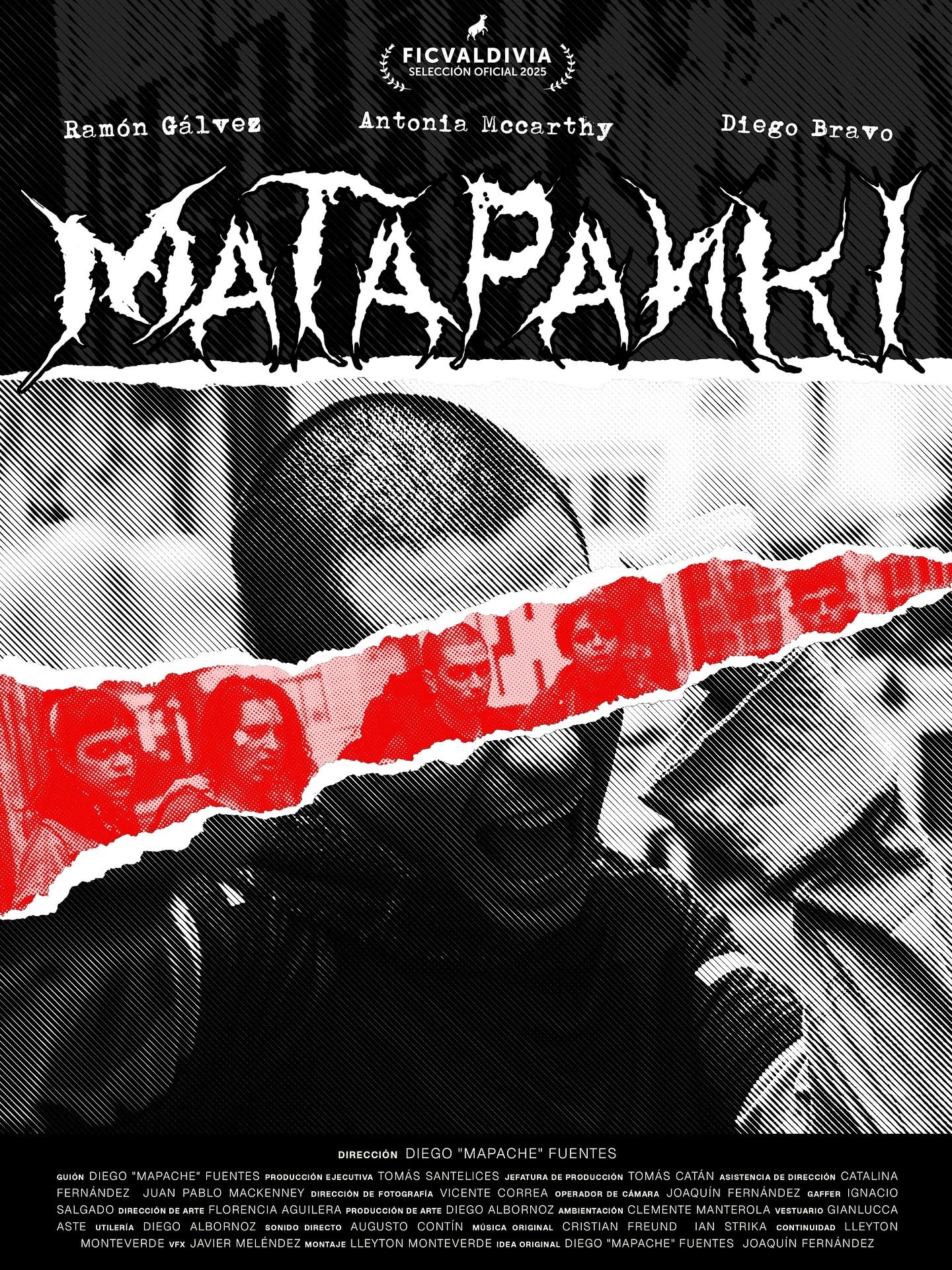


Matapanki opens with the thrum of Santiago’s punk nights, a city vibrating with noise, friendship, and the slow churn of political fatigue. Diego Fuentes builds the film as a living mural—thick lines, bold colors, and the restless energy of a graphic novel trying to leap off the page. At its center stands Ricardo, played with raw, stumbling conviction by Ramón Gálvez, a young man who drinks, moshes, cares for his grandmother, and carries the weight of a country’s contradictions in his shoulders. The movie’s lyric pulse comes from watching him try to turn that weight into action.
The strange alcoholic brew—Matapanki—arrives as both catalyst and curse. One sip, and Ricardo’s body becomes a conduit for something volatile, a force that amplifies his anger, his hope, his confusion. Fuentes uses these sequences to explore Chilean politics without sermonizing: the power surges, the frame tightens, colors flare, and the film suggests that political awakening often feels less like clarity and more like combustion. The superpower is a metaphor for the dream of change, but it is also a trap.

Diego Bravo’s Mella becomes the film’s emotional ballast. He is the friend who sees the danger in Ricardo’s new mission, the one who understands that political awareness grows unevenly, through mistakes, through late-night arguments, through the slow realization that the world rarely bends the way you want it to. Their friendship is the movie’s most grounded thread, a reminder that revolutions begin in small rooms, in shared cigarettes, in the quiet dread of watching someone you love run toward a fire.
Fuentes threads U.S. influence through the narrative with a steady, unblinking gaze. Rodrigo Lisboa’s U.S. President appears first as a distant figure, then as a looming force whose decisions ripple across continents. When Ricardo’s alcohol‑fueled crusade spirals into an international incident, the film widens its frame, showing how global politics can turn a single mistake into a geopolitical storm. The commentary is sharp but never didactic; it simply shows how power moves, and who gets crushed beneath it.
The film’s middle stretch leans heavily into its graphic‑novel aesthetic. Action scenes unfold in bursts of stylized violence, panels seem to flicker at the edges, and the comedy lands in uneven waves—hit and miss, but always earnest. Fuentes embraces the messiness of genre, letting superhero culture collide with political satire, letting punk chaos bleed into melodrama. The result is a film that feels alive even when it stumbles.

Ricardo’s brutal mistake becomes the hinge on which the story turns. The lost year(s) of a generation echo through the fallout: those who survived did so without direction, drifting between idle days and life‑altering moments, buffing the smudges from crystal balls while history gurgled under their feet. The film captures that sense of drifting urgency, the way young people try to predict a future that refuses to settle.
As the international conflict escalates, the movie shifts into a meditation on responsibility. Ricardo’s powers, once a symbol of possibility, become a burden he can no longer carry. Mella and Claudia watch him unravel, each trying to pull him back from the edge. The tension between personal loyalty and political consequence becomes the film’s sharpest question.
The final moments return to Ricardo’s grandmother, to the small domestic space where he once felt safe. The superhero myth dissolves, leaving a young man who wanted to help and instead became a symbol. Matapanki is messy, ambitious, and alive. It reaches for something larger than itself and sometimes catches it, offering a portrait of a country, a generation, and a boy who drank too deeply from the dream of change.
Letter Grade: B


Leave a Reply