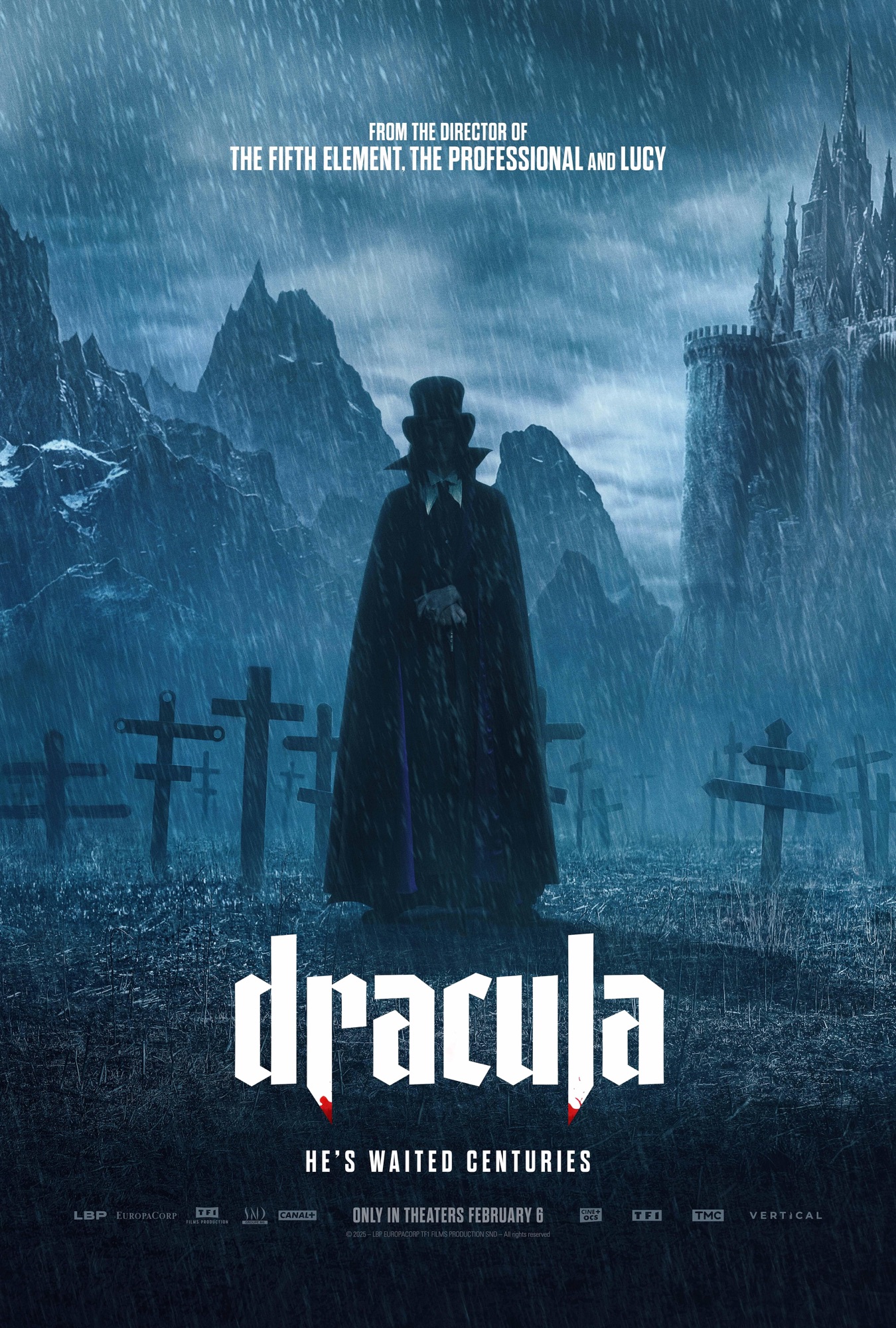


Luc Besson’s Dracula arrives as a sweeping, romantic resurrection of the world’s most enduring gothic myth, carried by Caleb Landry Jones with a performance that glows with sorrow, devotion, and yearning. This is a film that treats the Count as a pilgrim of the heart, a prince who carries centuries of longing through shadowed corridors and moonlit battlements, seeking the one soul who can restore his own. Every frame feels carved from a single desire: the return of Elisabeta, the beloved whose loss reshaped his eternity.

Besson opens with the fall of Prince Vladimir of Wallachia, a warrior who renounces heaven after Elisabeta’s death and steps into the mantle of Dracula. Jones gives this transformation a trembling grace, turning the birth of the vampire into a tragic vow rather than a descent. His Dracula carries the weight of centuries with a regal stillness, his every gesture a prayer for reunion. The film’s early passages establish him as a romantic hero whose devotion never fades, even as the world shifts around him.

Across four hundred years, Dracula’s search becomes a sacred pilgrimage. His vampiric agents, including Maria—played with fierce tenderness by Matilda De Angelis—serve as witnesses to his unwavering faith in love’s return. The perfume he creates to draw Elisabeta’s reincarnation toward him becomes a symbol of hope rather than manipulation, a fragrant beacon for a soul he believes still walks the earth. Besson frames this pursuit as a spiritual quest, a yearning for restoration rather than conquest.

When Dracula meets Jonathan Harker, played with earnest precision by Ewens Abid, the story turns toward Paris, where Mina Murray—Zoë Bleu in a luminous dual performance—awakens echoes of Elisabeta. Mina’s presence stirs a storm within Dracula, a collision of memory and revelation. Jones and Bleu share a chemistry that pulses with recognition, as though their souls converse beneath the surface of every scene. Mina’s gradual awakening becomes the film’s emotional spine, a journey toward remembrance that feels both tender and inevitable.

The Paris sequences shimmer with gothic romance. Dracula moves through the city with renewed vitality, sustained by the blood of nuns yet guided by a desire for grace rather than domination. Maria’s loyalty deepens the film’s spiritual texture, her devotion to Dracula rooted in gratitude for the life he granted her. She becomes a guardian of his hope, a witness to the love that fuels his centuries of wandering. Through her, the film reveals the Count’s capacity for mercy and connection.

When Dracula brings Mina to Wallachia, the story reaches its most intimate register. Mina’s plea to join him in eternity becomes a moment of pure surrender, a declaration that love transcends mortality. Their bond radiates with sacred intensity, a union that feels destined across lifetimes. Besson treats their connection as a form of grace, a bridge between the earthly and the eternal. Mina’s desire for transformation becomes an act of devotion, a step toward a shared salvation.

Jonathan Harker’s escape and his alliance with the priest Abraham Van Helsing—played with solemn authority by Christoph Waltz—introduce the film’s spiritual reckoning. Waltz embodies a priest who seeks redemption for all souls, even those who dwell in shadow. His pursuit of Dracula carries a sense of duty rather than vengeance, a mission to guide a fallen prince toward repentance. The siege on the castle becomes a confrontation between faiths: one forged in centuries of longing, the other rooted in divine mercy.

The final encounter between Dracula and Van Helsing stands as the film’s most powerful moment. Van Helsing urges Dracula to reclaim his place within the light, to free Mina from the eternal hunger that would follow her transformation. Dracula’s surrender becomes an act of profound love, a sacrifice that restores his soul and grants Mina a future unbound by darkness. His final declaration of love, spoken as he dissolves in Mina’s arms, becomes a prayer answered through surrender.

Zoë Bleu’s Mina carries the film’s closing movement with grace. Her grief becomes a testament to the depth of their bond, a love that transcends centuries and reshapes destiny. The final image of a white car approaching, paired with the echo of a familiar step, leaves the story suspended between hope and mystery. It suggests that love continues to move through the world, seeking reunion across time.

Luc Besson’s Dracula stands as a Christian romance wrapped in gothic splendor, a tale where salvation blooms through sacrifice and devotion. Caleb Landry Jones delivers a performance of rare emotional clarity, turning the Count into a figure of tragic holiness. This is a film that sings of eternal love, of the soul’s hunger for reunion, and of the grace that arrives when a heart chooses surrender. It is a triumph of passion, faith, and cinematic beauty.

Letter Grade: A


Leave a Reply