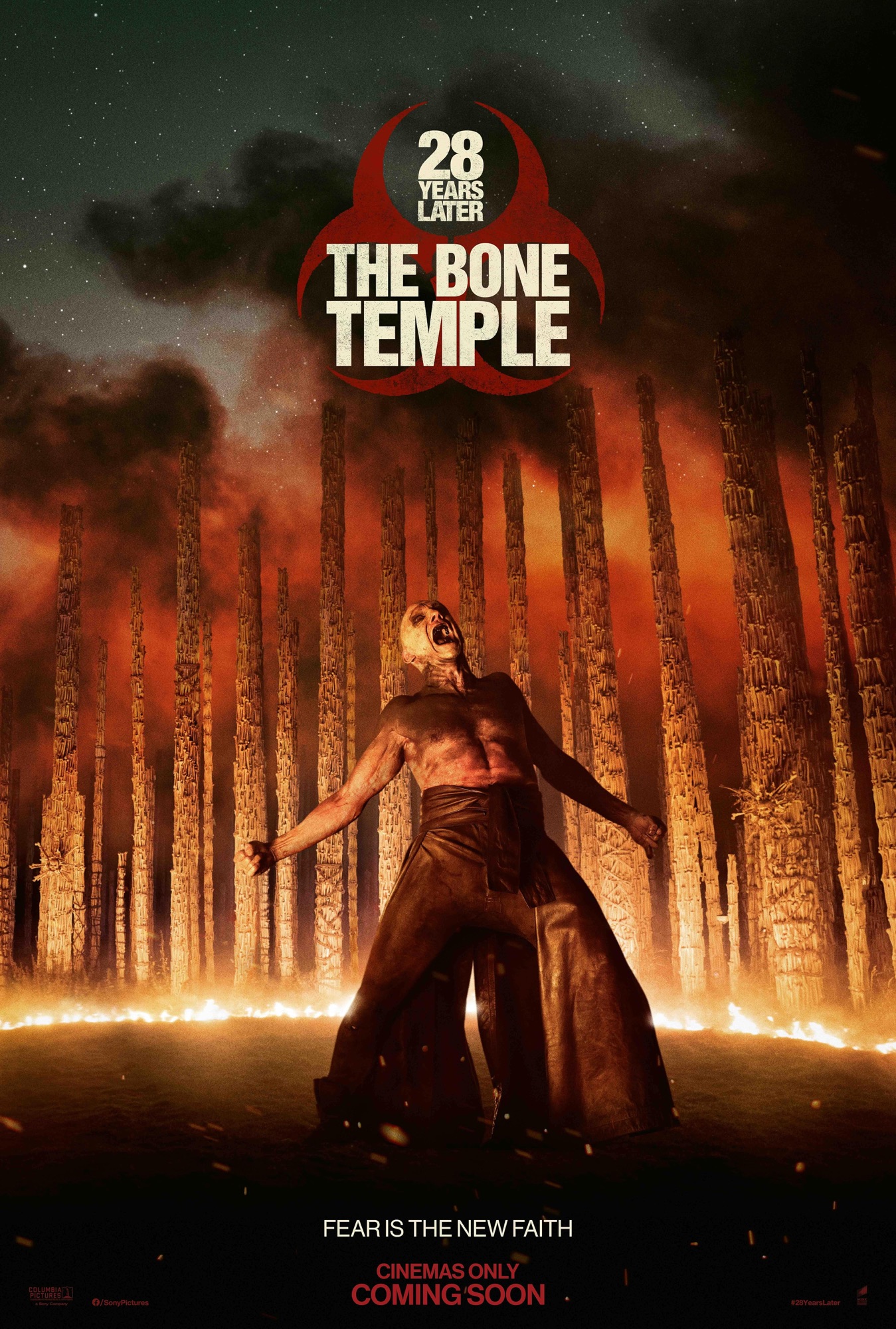


Nia DaCosta guides 28 Years Later: The Bone Temple toward a stranger, more searching register than its predecessors, shaping a film that treats apocalypse as a stage for spiritual inquiry. Ralph Fiennes, as Dr. Ian Kelson, becomes the film’s anchor—an aging caretaker tending a memorial built from bone, memory, and devotion. His work inside the Bone Temple gives the film its pulse: a meditation on what remains sacred when the world has burned through every certainty.

The film’s most striking gesture is its willingness to explore good and evil through religious and philosophical frames without offering a single doctrine as the final word. Atheism, Satanism, and Christianity move through the story like competing liturgies, each shaping the characters’ choices. Jack O’Connell’s Sir Lord Jimmy Crystal embodies a theatrical, ecstatic form of Satanism, a worldview built on spectacle and domination. His gang, the Fingers, treat violence as ceremony. Yet DaCosta frames their belief system as a distorted mirror of Christian ritual—an inversion that still affirms the power of faith, even when misdirected.

Kelson’s bond with Samson, the Alpha infected played with immense physical presence by Chi Lewis-Parry, becomes the film’s most surprising theological thread. Samson’s lucidity under sedation, his memories of childhood, and his eventual gratitude toward Kelson suggest a world where redemption can bloom in the unlikeliest soil. Their scenes together echo the earlier films’ fascination with the infected as more than monsters. Here, the series’ long-standing interest in empathy reaches a new height, offering a vision of healing that feels both fragile and luminous.

Spike’s journey, portrayed with raw openness by Alfie Williams, brings the film back to the human scale. His time among the Fingers, his uneasy friendship with Erin Kellyman’s Ink—later revealed as Kelly—and his longing for escape give the film its emotional throughline. DaCosta treats Spike as a pilgrim wandering through competing belief systems, searching for a way to live without surrendering his sense of self. His final emergence alongside Kelly into the wilderness feels like a small resurrection.

The film’s climax inside the Bone Temple is its boldest sequence. Kelson’s hallucinogenic performance of “The Number of the Beast,” the attempted crucifixion, and the final confrontation between Kelson, Jimmy, and the Fingers unfold like a fevered mass. Yet beneath the spectacle lies a sincere inquiry: what does it mean to embody evil, and what does it mean to resist it? Jimmy’s final moments—crying out for voices that once guided him—offer a portrait of spiritual collapse, while Kelson’s “Memento mori” affirms the film’s belief in mortality as a sacred truth rather than a curse.

The closing return of Cillian Murphy’s Jim, homeschooling his daughter Sam before witnessing Spike and Kelly fleeing toward him, ties the film back to its origins. It affirms the series’ enduring themes: survival as a communal act, hope as a fragile but persistent force, and the idea that even in a world shaped by rage, compassion can still carve out a path forward.

DaCosta’s entry expands the mythology with ambition and tenderness. It honors the earlier films’ intensity while offering a richer spiritual palette, inviting viewers to consider how belief shapes both ruin and renewal. The result is a film that feels both fierce and contemplative, a story where faith—twisted, reclaimed, or reborn—remains the last fire burning.

Letter Grade: A-.


Leave a Reply