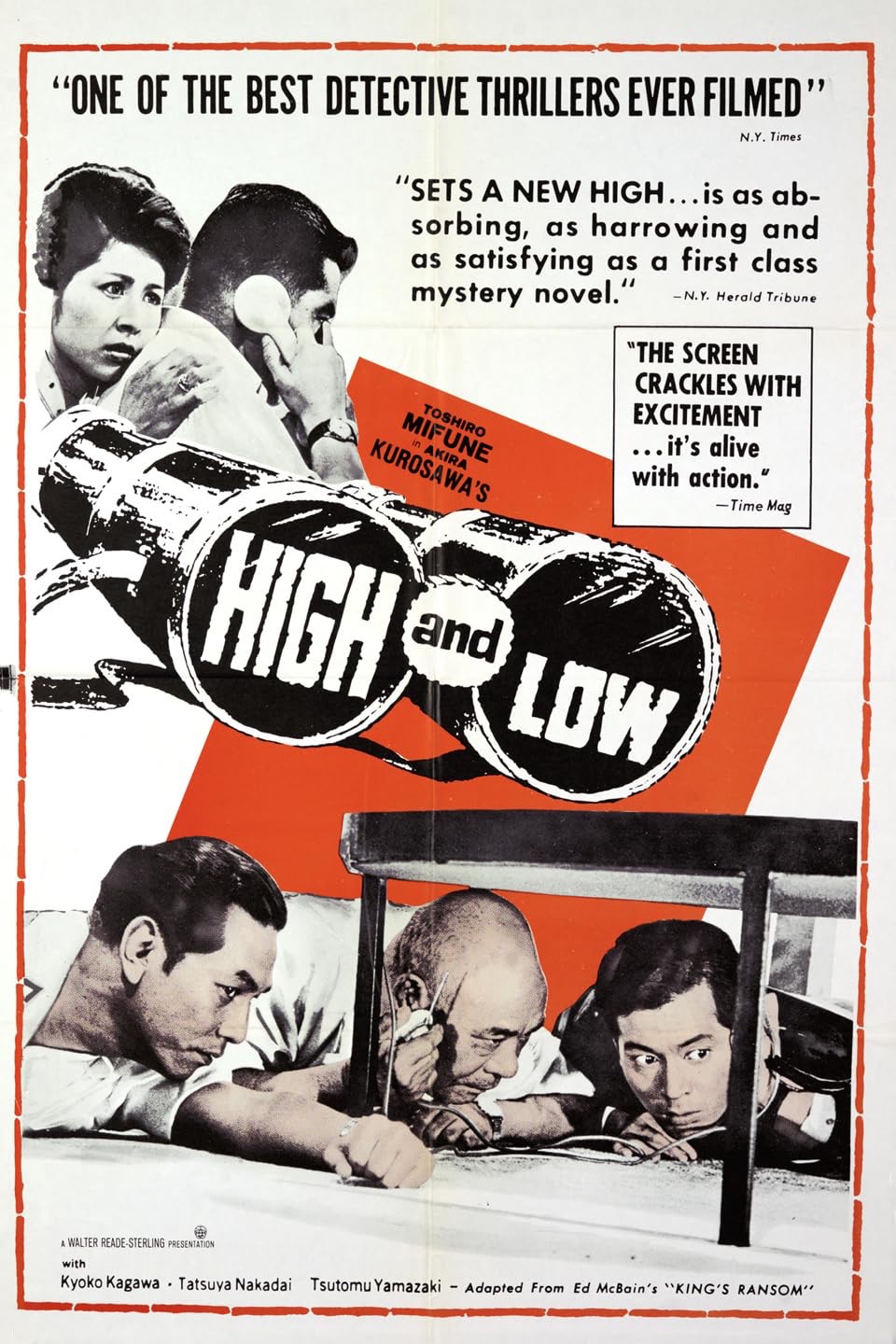


Akira Kurosawa’s 1963 masterpiece High and Low (Tengoku to Jigoku) is often described as a crime thriller, but its influence reaches far beyond genre. It is a film that redefined cinematic ethics, spatial storytelling, and the psychological architecture of class. Adapted loosely from Ed McBain’s American detective novel King’s Ransom, Kurosawa transformed a pulp premise into a profound meditation on moral responsibility, postwar industrialization, and the invisible scaffolding of social inequality. Its legacy reverberates through the works of directors like Martin Scorsese, Bong Joon-ho, and David Fincher—not just in style, but in the ethical dilemmas their characters inhabit.

One of the most striking innovations of High and Low is its use of verticality to symbolize class division. The film opens in the hilltop home of Kingo Gondo (played by Toshiro Mifune), a wealthy executive whose panoramic view of the city below becomes a visual metaphor for power and detachment. When a child is kidnapped—not Gondo’s own son, but his chauffeur’s—the camera begins to descend. The narrative shifts from the rarefied air of corporate strategy to the humid alleys and cramped tenements of Yokohama. Kurosawa’s use of architecture is not just aesthetic—it’s moral. The higher you live, the more removed you are from consequence. The lower you go, the more you see.

This spatial metaphor has echoed through cinema for decades. Bong Joon-ho’s Parasite (2019) uses staircases and basements to dramatize class tension. Fincher’s Zodiac (2007) borrows Kurosawa’s procedural pacing and moral ambiguity. Even Scorsese’s Taxi Driver (1976) owes something to High and Low’s descent into urban despair, where the city itself becomes a character, indifferent and sprawling.

At the heart of High and Low is whether Gondo should sacrifice his fortune to save someone else’s child. The film doesn’t offer easy answers. Gondo’s dilemma is both personal and systemic—his decision will affect his family, his career, and his sense of self. Kurosawa’s genius lies in how he dramatizes this tension without sentimentality. The camera lingers on Gondo’s sweat, his silence, and the ticking of the clock. The moral weight is palpable.

This kind of ethical realism influenced a generation of filmmakers who sought to portray characters not as heroes or villains, but as flawed individuals navigating impossible choices. Paul Schrader’s First Reformed (2017) and Asghar Farhadi’s A Separation (2011) carry this torch—films where morality is not preached but wrestled with.

The second half of High and Low shifts into a police procedural, meticulously tracking the investigation. Kurosawa’s attention to detail—maps, phone traces, stakeouts—is not just technical; it’s human. The detectives are not faceless enforcers but empathetic observers. They walk the streets, listen to witnesses, and slowly piece together a portrait of the kidnapper, who turns out to be a medical student consumed by resentment and poverty.

This dual narrative—of the wealthy man’s moral reckoning and the poor man’s descent into crime—creates a mirror. Kurosawa doesn’t excuse the kidnapper, but he contextualizes him. The film’s final scene, a prison visit between Gondo and the condemned man, is a masterclass in ambiguity. There is no catharsis, only confrontation.

Kurosawa’s influence is often traced through his samurai epics—Seven Samurai, Yojimbo, Rashomon—but High and Low may be his most quietly radical film. It showed that genre could carry philosophical weight, that thrillers could meditate on justice, and that the city could be both setting and symbol.

Its legacy lives on in films that blur the line between crime and conscience. In Spike Lee’s Inside Man (2006), the bank heist becomes a critique of corporate greed. In Denis Villeneuve’s Prisoners (2013), the search for a missing child becomes a descent into moral compromise. And in Hirokazu Kore-eda’s Shoplifters (2018), the question of who deserves care and protection echoes Gondo’s dilemma.

“High and Low” is not just a film—it’s a lens. It teaches us to look at the city not as a backdrop, but as a moral terrain. It asks us to consider who lives above and below and what it costs to cross that divide. In a world still grappling with inequality, surveillance, and the ethics of care, Kurosawa’s vision remains urgent. His camera may have stopped rolling in 1998, but the questions he posed in 1963 are still flickering in the hallway.

Grade A+. Streaming on The Criterion Channel.


Leave a Reply