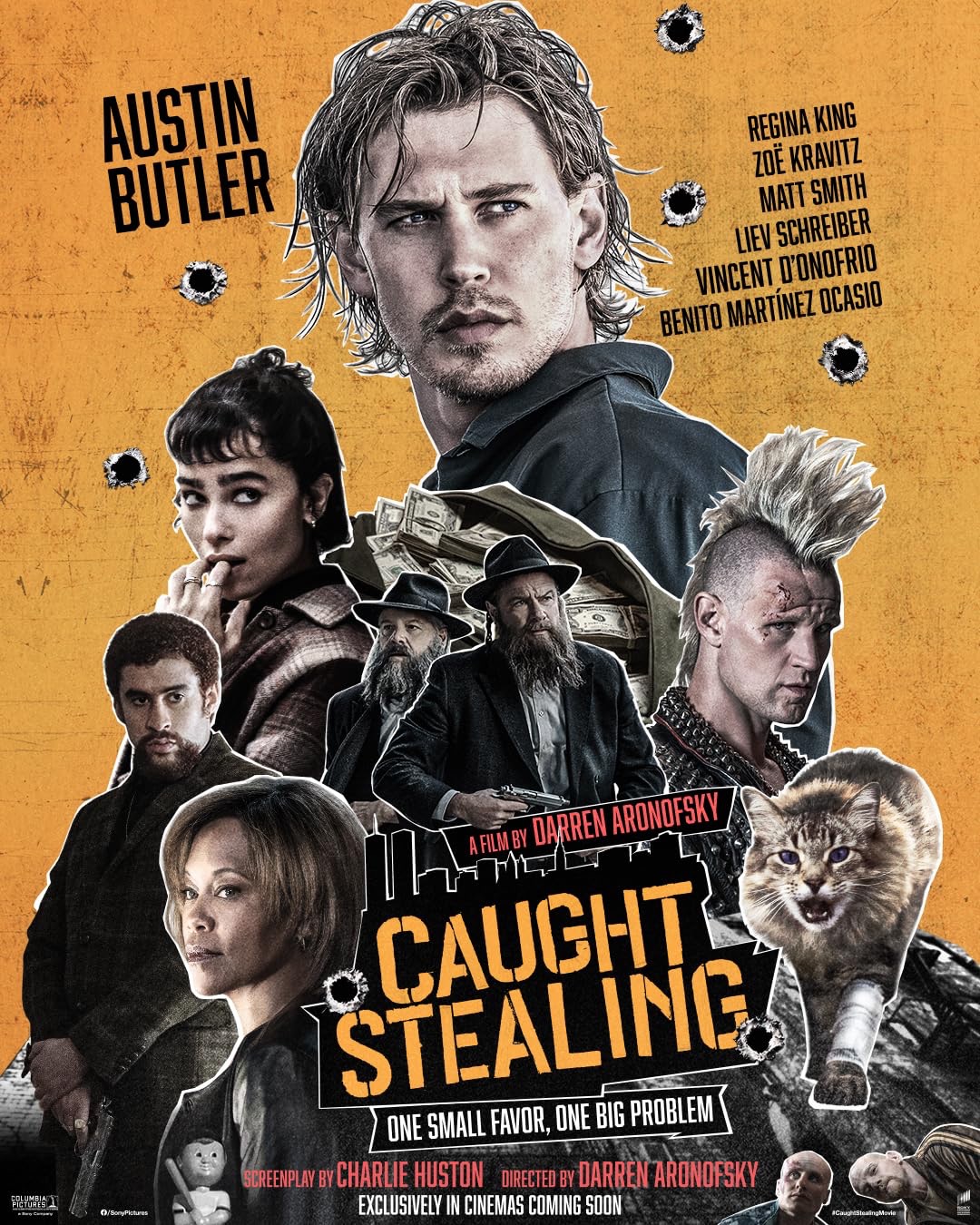


Darren Aronofsky’s Caught Stealing is a bruised valentine to New York’s underbelly, a film that stumbles, bleeds, and occasionally dances through its own wreckage. It’s a comedy of errors, so lacerating it leaves claw marks, a noir so drenched in absurdity it forgets to be cool. Austin Butler’s Hank Thompson is a man who can’t stop losing—his kidney, his girlfriend, his dignity, his grip on reality—but somehow gains our sympathy with every misstep. The film doesn’t ask us to admire him. It dares us to endure him.

Set in 1998’s Lower East Side, the movie maps private grief onto public chaos with a cartographer’s eye for alleyways, dive bars, and subway tunnels. Hank’s trauma—his friend Dale’s death, his busted knee, his failed baseball dreams—echoes through every cracked sidewalk and flickering neon sign. Aronofsky turns the city into a haunted maze, where every corner hides a new betrayal or a half-dead cat. The geography of pain is precise, and the absurdity is relentless.

The title Caught Stealing plays out— a curse. Hank is caught stealing time, second chances, and identities, stealing back a life that never quite belonged to him. The metaphor stretches across the film’s jagged architecture: every character is trying to steal something—money, power, escape, even love. But the thefts are constantly botched, always bloody, always too late. The film’s moral compass spins wildly, pointing toward survival rather than redemption.

Austin Butler gives a twitchy and tender performance, a man unraveling in slow motion while trying to duct-tape his soul back together. His Hank is a fuck-up of the highest order, but Butler never lets him become a caricature. There’s a quiet dignity in his desperation, a tragic rhythm to his stumbles. Zoë Kravitz’s Yvonne, though underused, brings warmth and gravity, while Regina King’s Roman is a masterclass in menace—her smile is a threat, her silence a verdict.

The plot is a carnival of chaos, and not all the rides are worth the ticket. There are moments when the film loses its footing, especially in the third act’s rush of double-crosses and shootouts. The Flushing Meadows showdown feels overstuffed, and the Shabbos dinner detour strains credibility. But even when the narrative falters, Aronofsky’s direction remains hypnotic. He paints in high-relief artifice—blood that gleams like lacquer, shadows that swallow whole scenes, comedy that bites like broken glass.

The film’s greatest strength is its refusal to tidy up. It doesn’t offer rational solutions to irrational realities. Instead, it leans into the mess, the noise, the grief. Hank’s journey is less a redemption arc than a slow-motion collapse that somehow ends in flight. The final scenes in Tulum, with Hank posing as Russ and Bud limping beside him, are both ludicrous and oddly moving. The absurdity becomes its own kind of grace.

Caught Stealing is hit and miss, but the hits bruise beautifully. The misses—some pacing issues, a few underwritten characters—don’t sink the ship so much as add to its listing charm. Aronofsky’s vision is clear even when the plot isn’t. He’s less interested in coherence than emotional truth, and the film delivers that in spades.

The supporting cast is a rogues’ gallery of delight. Matt Smith’s Russ is a jittery delight, Liev Schreiber and Vincent D’Onofrio as the Drucker brothers are terrifying and hilarious, and Action Bronson’s Amtrak is a one-scene wonder. Even Bud the cat earns his place in the pantheon of cinematic survivors. Carol Kane’s Bubbe nearly steals the film with a single line about brisket and betrayal.

As a film, Caught Stealing works more often than it doesn’t. As a thematic exploration of chaos, identity, and the art of losing badly, it’s a minor triumph. Aronofsky directs with feverish precision, Butler anchors the madness with bruised humanity, and the city becomes a living archive of grief and absurdity. It’s not perfect, but it’s unforgettable.

Grade: B+


Leave a Reply