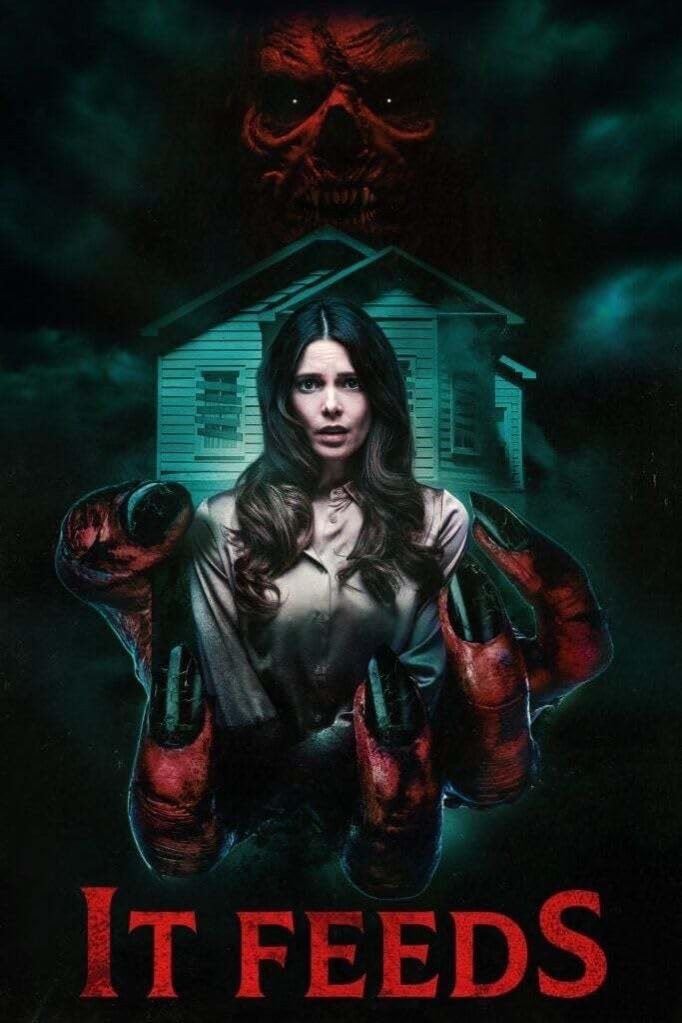


There is a quiet dread in Chad Archibald’s It Feeds, a film that moves not with thunder but with the slow, deliberate pulse of something ancient and buried. It is not a scream at night but a whisper in the walls. Ashley Greene’s Cynthia is the anchor of this haunted vessel, a clairvoyant therapist who walks the corridors of other people’s minds, searching for rot. Her gift is not salvation—it is exposure. And what she finds, again and again, is that pain has teeth.

The film’s psychological horror is built on dual scaffolding: psychiatry and clairvoyance. Cynthia’s sessions with Larry, a man unraveling from within, are not just therapeutic—they are ritualistic. She enters his mind like a priestess, confronting the beast that feeds on his memories. The monster is not a creature of flesh but of thought, a metaphor for trauma that devours from the inside. Archibald’s vision is clear: the horror is not what lurks in the shadows, but what festers in the psyche.

Jordan, Cynthia’s daughter, is the film’s trembling heart. Her awakening powers mirror her mother’s, but they are raw, untamed. When Riley arrives, scarred and hunted, Jordan’s curiosity becomes a descent. Her disappearance is not just a plot device—it is a rupture. The bond between mother and daughter, already strained by grief and inheritance, is torn open. Cynthia’s search is not just for Jordan—it is for the part of herself she buried when her husband died.

The entity that stalks them is a dark echo of Insidious, a blackened figure that moves between realms. Archibald borrows the aesthetic of that franchise—the creeping dread, the layered realities—but he adds a mournful texture. The demon is not just a threat; it is a symptom. It feeds, yes, but only because something more profound is starving. The title plays out in every scene: the hunger for connection, healing, and truth. The monster is merely the mouth.

Ashley Greene’s performance is a revelation. She does not play Cynthia as a hero but as a woman unraveling gracefully. Her stillness is charged, her grief palpable. Ellie O’Brien’s Jordan is equally compelling; her fear is never overwrought, and her bravery is never forced. Shawn Ashmore’s Randall is a cipher, a man who may be protector or predator, and his ambiguity adds tension. Juno Rinaldi’s Agatha brings levity, but even she is touched by the film’s sorrow.

The plot is uneven. There are moments when the pacing falters, when the procedural elements drag. The scenes of household exploration, while atmospheric, sometimes feel indulgent. But when the film dives into the “inside,” it finds its rhythm. The final act, though occasionally silly, is visually arresting. Cynthia’s confrontation with the entity is not a battle but a reckoning. The fantasy imagery is bold, if not always coherent, but it serves the emotional arc.

The theme of inheritance—gifts passed down, wounds shared—is well presented. The film does not preach; it mourns. The idea that clairvoyance is both a blessing and a curse is explored with nuance. The therapy sessions are not just exposition—they are excavations. Archibald understands that horror is most effective when personal, and he crafts scenes that bleed with intimacy.

Direction-wise, Archibald is confident. He knows how to build tension, how to linger on a face, how to let silence speak. His use of lighting and sound is effective, though not groundbreaking. The film’s tone is consistent, its mood oppressive. There are missteps—some dialogue feels forced, some scares predictable—but the overall vision is intact.

It Feeds is not a masterpiece, but it is a work of care. It understands the horror of memory, the terror of inheritance. It is a film that gnaws, that whispers, that waits. It succeeds more often than it fails, and when it does fail, it does so with ambition. The cast is in tune with its themes, the direction mostly assured, and the story—though familiar—finds new shadows to explore.

Grade: B+. Streaming on Hulu.


Leave a Reply